

Balancing reach, engagement, and privacy is one of the most underrated challenges in content creation today. Most creators focus on what performs best without stopping to ask what that performance costs in terms of personal data exposure, platform risk, or long-term content security. The format you choose matters more than most people realize. A live stream and a static photo post carry very different privacy implications, even if both go viral. This guide breaks down four core visual content types, gives you a clear framework for choosing between them, and shows you how to build a strategy that earns results without sacrificing your digital safety.
Table of Contents
- How to choose the right content type for privacy and engagement
- Side-by-side: Which content type fits your privacy strategy?
- Our take: Why smart privacy isn't a blocker for your best content
- Take privacy to the next level with one2many.pics
- Frequently asked questions
Key Takeaways
| Point | Details |
|---|---|
| Balance content and privacy | Choosing the right content type means optimizing both engagement and privacy for your audience. |
| Audit your uploads | Regularly review and manage your content footprint to prevent accidental data exposure. |
| Leverage platform controls | Use privacy settings and features like hiding stories or disabling downloads to protect your content. |
| Visuals require extra care | Remove metadata and avoid location tags in images and videos to maintain privacy security. |
How to choose the right content type for privacy and engagement
Not every content format fits every creator's risk tolerance or audience. Before you default to whatever's trending, it's worth evaluating each option against a few practical criteria.
The key selection factors you should weigh include:
- Audience preferences: What does your specific audience actually engage with? Younger audiences lean into short video and stories, while professional audiences often respond better to carousels and infographics.
- Platform compatibility: Not every format performs equally on every platform. Instagram favors reels and carousels, LinkedIn rewards document posts, and TikTok is built for short video.
- Privacy settings available: Some formats give you granular control over who sees your content. Others are inherently more public.
- Data footprint: Every upload carries embedded data. Images contain EXIF metadata. Videos can include GPS coordinates. The format you choose affects how much you expose.
- Content hygiene: Regularly auditing what you've posted, who can see it, and what data it carries is a discipline, not a one-time task.
Some content types expose far more personal information than others. A photo taken on your phone and uploaded without stripping its metadata can reveal your device model, the exact location where it was shot, and the timestamp. Privacy enhancement can be achieved by using private accounts, hiding stories from specific users, disabling downloads, adding alt text without personal data, and avoiding location tags. These aren't optional extras for privacy-conscious creators. They're baseline practices.
When it comes to protecting shared images, the most effective approach combines platform-level settings with pre-upload processing. Review app permissions regularly, revoke access from third-party tools you no longer use, and never assume a platform strips your metadata automatically.
Pro Tip: Use a VPN when uploading content from public networks, and keep a running log of which accounts have access to your content management tools. Selective sharing isn't paranoia. It's professional hygiene.
1. Photo posts: Still visuals with privacy-smart tactics
Photo posts remain the backbone of most social feeds. They're versatile, easy to produce at scale, and perform consistently across platforms. But they also carry the highest risk of passive data exposure if you're not careful.
Every image captured on a smartphone or camera embeds EXIF data by default. This includes GPS coordinates, device model, software version, and the exact date and time the photo was taken. Most platforms strip some of this on upload, but not all of it, and not always reliably.
Here are the essential privacy moves for photo posts:
- Strip EXIF and location data before uploading using a dedicated metadata removal tool.
- Use private folders or drafts to review images before they go live.
- Limit download options on platforms that allow it, such as Instagram's download disable feature.
- Avoid tagging your physical location unless it's strategically necessary.
- Review your photo archive every quarter and delete anything that no longer serves a purpose.
"Add alt text without personal data and avoid location tags to protect privacy in visual content."
Alt text is often overlooked as a privacy consideration. It's primarily an accessibility feature, and it should stay that way. Describe what's in the image clearly and simply, without embedding personal identifiers, location names, or other traceable details.
For creators managing multiple accounts or posting across platforms, the risk compounds quickly. The same image posted to five platforms without metadata removal creates five separate data points that can be cross-referenced. Using untraceable social media images as part of your workflow removes that risk entirely before content ever reaches a platform.
Pro Tip: Schedule a bulk image audit every three months. Pull your last 90 days of posts, check which ones still carry metadata, and run them through a stripping tool before any future reposts.
2. Video content: Stories, live streams, and reels
Video is the highest-engagement format available to creators right now. Videos generate up to twice the engagement of images on major platforms, which makes them hard to ignore. But that same visibility comes with amplified exposure risk.
Live streams are the most vulnerable format. You're broadcasting in real time, which means location cues, background details, and audio can all leak information you didn't intend to share. Even a window view or a store sign in the background can identify your location to a determined viewer.
Privacy controls to use with video content:
- Control your audience: Set live streams and video posts to specific audience segments rather than public by default.
- Mute location services: Turn off location tagging in your camera and social apps before recording.
- Enable story archiving carefully: Archived stories remain accessible longer than you might expect. Audit your archive regularly.
- Disable downloads: On platforms that allow it, prevent viewers from saving your video content locally.
For event coverage, the risk is even higher. If you're live streaming from a brand event or a client location, hide stories from specific users and disable downloads to limit who can capture and redistribute your content. Pre-record and edit where possible. Edited video gives you control that live content simply doesn't.
Reels and short-form videos offer a middle ground. They're pre-recorded, which means you can review them before posting. Strip any embedded location data from the video file, keep backgrounds neutral when privacy matters, and use platform scheduling tools to post at optimal times without being physically present online.

3. Stories and ephemeral content
Ephemeral content, meaning content designed to disappear after a set time, offers a genuinely different privacy profile from permanent posts. Stories on Instagram, Facebook, and Snapchat vanish after 24 hours by default, which limits long-term data exposure and reduces the risk of old content being surfaced out of context.
Setting up story privacy filters properly takes just a few steps:
- Go to your platform's privacy settings and locate the story visibility options.
- Create a custom audience list that excludes people you don't want viewing sensitive content.
- Enable screenshot or screen recording alerts where the platform supports it.
- Set replies to "people you follow" or "close friends" only.
- Review your close friends or custom list every month to keep it current.
Hide stories from specific users to retain control when sharing visual content that's meant for a limited audience. This is especially useful for creators who manage both personal and professional content under the same account.
The 24-hour window also makes stories ideal for time-sensitive promotions. You can share a limited offer, a behind-the-scenes moment, or a location-specific update without that content living permanently on your profile.
Pro Tip: Use ephemeral content for any promotion or announcement that you'd rather not have indexed or reshared long-term. It keeps your content footprint lean and gives you natural control over your content lifecycle.
4. Infographics and carousel posts
Carousels and infographics are the workhorses of educational content on social media. They drive higher swipe rates, longer view times, and stronger save metrics than single static images. For creators who want to deliver real value to their audience, these formats are hard to beat.
From a privacy standpoint, they're also among the safer options, provided you follow a few key rules.
- Focus on educational or data-driven visuals rather than personal stories or identifiable information.
- Never include screenshots that contain usernames, email addresses, or account IDs.
- Avoid embedding personal data into infographic designs, even accidentally through chart labels or source attributions.
- Avoid personal data in carousel posts or infographics to minimize your data footprint.
Here's a quick comparison of interaction rates and average privacy risk across common visual formats:
| Format | Avg. interaction rate | Privacy risk level | Metadata risk |
|---|---|---|---|
| Static photo | Medium | High (without stripping) | High |
| Carousel post | High | Low to medium | Low |
| Infographic | High | Low | Low |
| Short video/reel | Very high | Medium | Medium |
Carousels also give you a natural way to repurpose content without reposting identical images. Each slide can be a variation, which reduces duplicate detection risk across platforms while keeping your core message intact.
Side-by-side: Which content type fits your privacy strategy?
With each format covered, here's a direct comparison to help you match content types to your specific goals and risk tolerance.
| Content type | Reach potential | Engagement level | Privacy risk | Best use case |
|---|---|---|---|---|
| Photo post | High | Medium | High (unstripped) | Brand visuals, product shots |
| Video/reel | Very high | Very high | Medium to high | Tutorials, promotions |
| Story/ephemeral | Medium | High | Low | Time-sensitive updates |
| Carousel/infographic | High | High | Low | Education, data storytelling |
When to use each format:
- Photo posts: Use when you have strong visual assets and have already stripped metadata. Best for evergreen brand content.
- Video and reels: Use for maximum reach and engagement, but apply all privacy controls before publishing.
- Stories: Use for real-time updates, limited-audience content, and anything you want to expire naturally.
- Carousels and infographics: Use when you want to educate, explain, or compare without exposing personal data.
For your periodic privacy audit, check permissions, delete old content, and evaluate your overall content footprint at least once per quarter. Treat it like a content health check, not a crisis response.
Our take: Why smart privacy isn't a blocker for your best content
There's a persistent myth in creator circles that privacy-focused strategies limit your reach or make your content feel less authentic. We've seen the opposite play out consistently. Creators who build protection-first content creation habits into their workflow don't produce less interesting content. They produce more intentional content.
When you strip metadata, limit who sees what, and think carefully about what each post reveals, you're not holding back. You're making deliberate choices. That discipline tends to sharpen your creative instincts because you stop posting reflexively and start posting strategically.
There's also a trust dimension that most creators underestimate. Audiences are increasingly aware of data practices. A creator who handles their own privacy carefully signals that they'll handle their audience's data carefully too. That builds the kind of community loyalty that algorithms can't manufacture.
Privacy-respecting creators aren't playing defense. They're building something more durable.
Take privacy to the next level with one2many.pics
The strategies in this article give you a strong foundation, but executing them consistently at scale requires the right tools. Manual metadata removal and image variation take time, and that time adds up fast when you're managing multiple accounts or posting across several platforms daily.
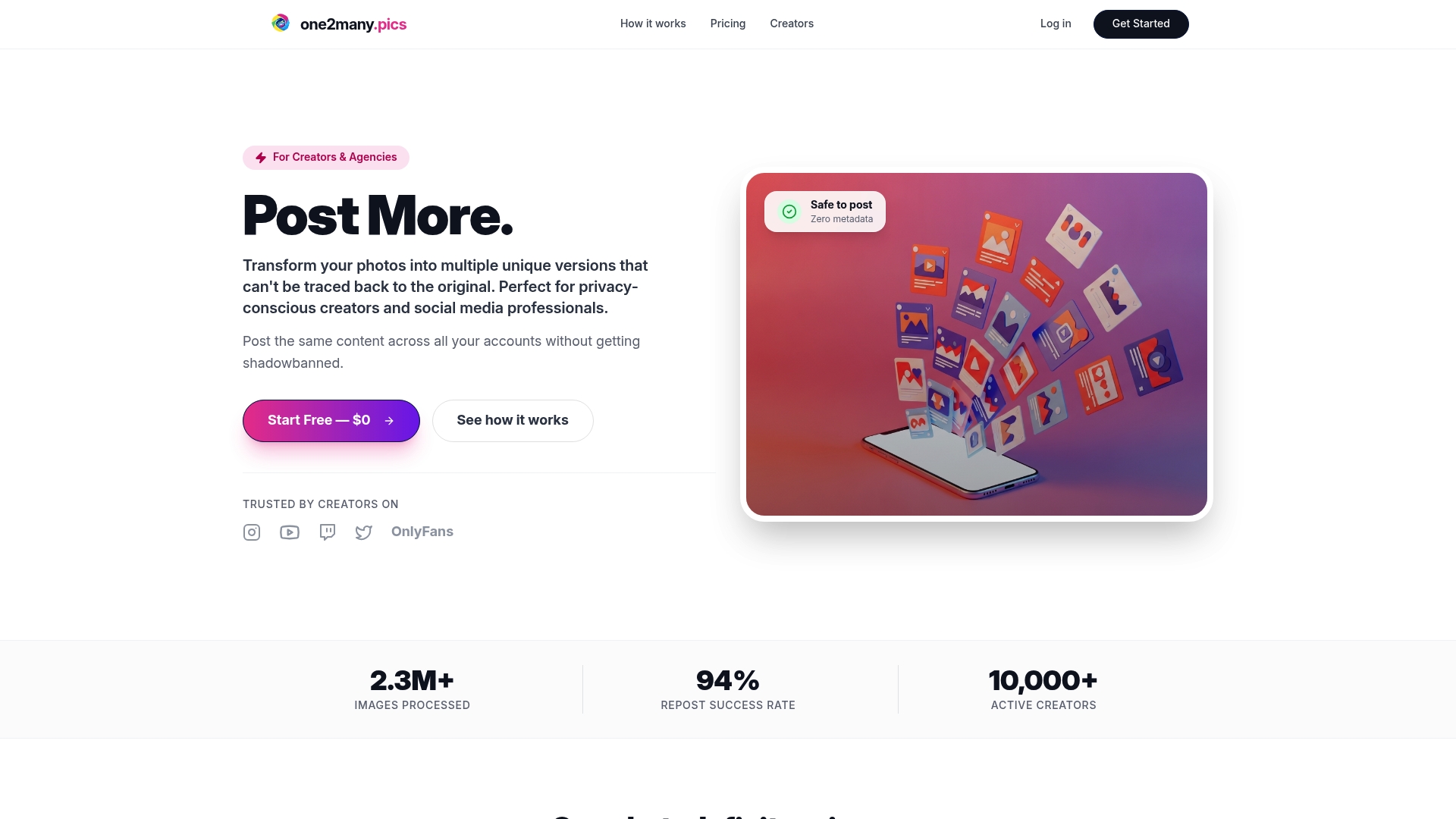
Untraceable images on social media are exactly what One2Many.pics is built to deliver. The platform lets you upload your original images, strip all identifying metadata automatically, and generate unique visual variations so the same core asset can be posted across accounts without triggering duplicate detection. It's the practical layer that turns privacy strategy into a repeatable, scalable workflow. If you're serious about protecting your digital footprint while keeping your content output high, it's worth exploring what the platform offers.
Frequently asked questions
Which social media content types are the safest for privacy?
Ephemeral content and private photo posts limit data exposure, making stories and metadata-stripped photo posts the safest options for most creators.
How can I hide my social media stories from specific users?
Most platforms offer a "hide story" or "custom audience" feature within privacy settings, letting you hide stories from selected users without restricting your full account.
What is the best way to remove location data from images?
Strip EXIF metadata before uploading using a dedicated tool, or rely on platforms that remove location tags by default, though manual removal is more reliable.
Can infographics or carousel posts compromise my privacy?
They can if you include traceable or personal data, so always avoid personal data in carousel or infographic posts and review every visual before publishing.