

Every day, roughly 3 billion images get shared across social media, and 85% of them are stolen, exposing creators to copyright takedowns, account bans, and suppressed reach. If you're a content creator or agency managing multiple accounts, the images you post are either working for you or quietly working against you. This guide breaks down exactly why unique images drive stronger engagement, how platform algorithms detect and penalize duplicates, and what you can do right now to protect your content and scale originality without burning hours on manual editing.
Table of Contents
- Why image uniqueness is becoming critical
- The engagement advantage: How unique images outperform duplicates
- Copyright risks and privacy: How image variations protect you
- How to create and manage unique image variations efficiently
- The overlooked value: Why originality now trumps trends
- Level up your social media content with unique image tools
- Frequently asked questions
Key Takeaways
| Point | Details |
|---|---|
| Unique images drive engagement | Original visuals can double or triple your social media engagement rates. |
| Copyright risks are real | Duplicate or stolen images often result in takedowns and suppressed reach. |
| Privacy requires true originality | Only genuinely unique variations keep you safe from reverse image search tracking or bans. |
| Efficient tools matter | Batch automation and AI-driven tools make image originality scalable for agencies. |
Why image uniqueness is becoming critical
The sheer volume of content being shared daily means platforms are under enormous pressure to police duplicate and stolen media. Instagram, Facebook, TikTok, and YouTube all use automated systems to scan uploads and compare them against known image databases. The result? Even creators who aren't intentionally stealing content can find themselves flagged simply for reposting something that's been circulating widely.
The scale of this problem is staggering. 85% of daily shared images are stolen or unauthorized reposts, which has forced platforms to invest heavily in Rights Manager and Content ID style tools. These systems don't care whether you meant to violate a copyright. They flag, suppress, or remove content automatically.
Here's what's at stake when you rely on duplicate or widely circulated images:
- Content takedowns that damage your posting consistency
- Account strikes that can escalate to permanent bans
- Algorithmic suppression that quietly cuts your reach without warning
- Lost brand credibility when audiences see the same visuals across multiple accounts
Beyond the legal and algorithmic risks, there's a creative argument too. Audiences on every major platform are increasingly visual and increasingly selective. A post that looks exactly like what someone saw three accounts ago doesn't stop the scroll. Unique images do. Learning unique photography techniques gives you a real edge, not just legally, but creatively.
"Originality is no longer a nice-to-have for creators. It's a survival requirement in an algorithm-driven content economy."
Platforms are also getting smarter. Perceptual hashing (a method where an image is converted into a unique numeric fingerprint) allows platforms to detect even slightly edited versions of the same image. Cropping, resizing, or changing brightness is no longer enough to slip past detection. You need genuine visual variation, and you need it at scale. That's where purpose-built unique image creation tools come in, giving creators and agencies a reliable way to produce truly distinct assets from a single source image.
The bottom line: duplicate images aren't just risky, they're increasingly ineffective. Platforms reward novelty, and so do audiences.
The engagement advantage: How unique images outperform duplicates
Let's talk numbers. Engagement metrics across major platforms reveal a clear pattern: original, visually distinct content consistently outperforms recycled or stock imagery. The difference isn't marginal.
Photo posts generate 35% more engagement than text-only posts on Facebook. Instagram carousels featuring unique images see 114% more engagement than single static images. TikTok creators posting original visual content average a 4.25% engagement rate, which is significantly higher than most other content formats.
| Content type | Avg. engagement boost | Platform |
|---|---|---|
| Original photos vs. stock | Up to 40% higher | |
| Carousel with unique images | 114% more than single posts | |
| Original video thumbnails | 30% higher CTR | YouTube |
| Unique image posts | 35% more than text posts | |
| Original TikTok content | 4.25% avg. engagement rate | TikTok |
Why does this happen? Platform algorithms are designed to surface content that keeps users on the app longer. When an image is visually fresh and hasn't been seen before, it generates curiosity and interaction. When it's a recycled stock photo that users have scrolled past on a dozen other accounts, it blends into the background.
There's also a trust dimension. Creators who invest in protecting privacy with unique images tend to build more loyal audiences because their content feels intentional and personal. Followers can tell when someone is putting in genuine creative effort versus mass-scheduling generic visuals.
Practical engagement benefits of unique imagery include:
- Higher save rates, because original content feels worth revisiting
- More shares and reposts, because unique visuals stand out in feeds
- Better comment quality, because distinct images prompt real reactions
- Stronger profile identity, making your account recognizable across platforms
For a deeper look at how visuals for social media affect overall strategy, the connection between creative originality and audience retention is well-documented. Agencies managing multiple client accounts can multiply these gains significantly when they apply unique image practices at scale.
Copyright risks and privacy: How image variations protect you
Reverse image search technology has improved dramatically. Tools like Google Lens, TinEye, and platform-native systems can now match images with surprising precision, even when they've been lightly filtered or resized. For creators managing multiple accounts or repurposing content across platforms, this creates real exposure.

Unique variations reduce traceability through reverse image search and copyright monitoring systems, making your content harder to flag and your accounts safer. This matters whether you're repurposing your own content or using licensed material across campaigns.
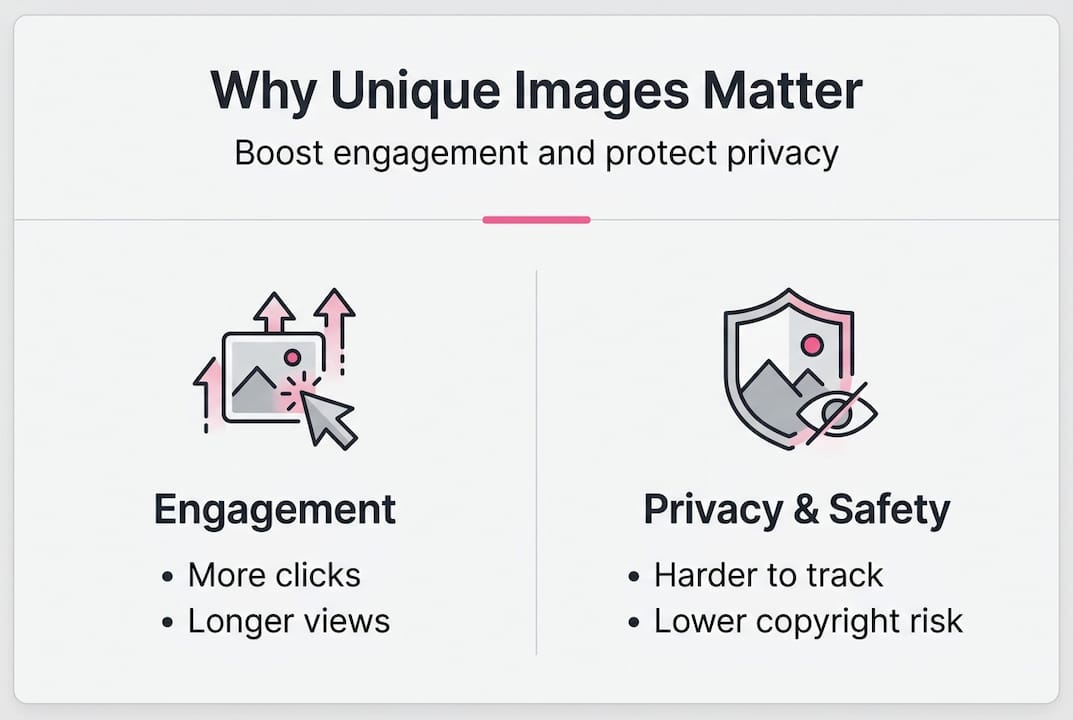
Here's how copyright and privacy risks break down across common creator behaviors:
| Action | Risk level | Primary threat |
|---|---|---|
| Reposting identical images | Very high | Copyright flags, account strikes |
| Light edits (crop, filter) | High | Perceptual hash detection |
| Batch-generated variations | Low | Minimal detection risk |
| Fully original images | Very low | Negligible |
The risks aren't just about third-party copyright. When you post images with embedded metadata (location data, device fingerprints, timestamps), you're also exposing your workflow to competitors and, in some cases, to platforms that use that data to link accounts. Stripping metadata is a key step that many creators skip entirely.
Pro Tip: Before scheduling any batch of posts, run your images through a metadata removal process. Even if the visuals are unique, metadata can still connect accounts and reveal your digital footprint to platforms that flag coordinated behavior.
For agencies, the stakes are even higher. Managing content for multiple clients means one mistake can affect several accounts at once. Using tools to minimize reverse image risks at the workflow level rather than handling it post-production protects your clients and your reputation.
Batch variation also protects against something less obvious: content exhaustion. When you vary your image assets systematically, you extend the life of a single shoot or creative session across dozens of posts, all while keeping each piece distinct.
How to create and manage unique image variations efficiently
Creating unique images at scale sounds time-consuming. With the right workflow, it's not. Here's a practical framework that creators and agencies use to produce original image variations without starting from scratch every time.
- Start with a strong source image. Invest time in your base photo or graphic. The better the source, the more variation options you have downstream.
- Use seed-based generation tools. Seed values in AI image tools let you reproduce consistent visual styles while generating distinct outputs. This is critical for brand consistency across variations.
- Apply img2img workflows. Image-to-image (img2img) tools take an existing image and generate new versions that share compositional elements but differ visually. This is ideal for batch content across multiple accounts.
- Strip metadata at the export stage. Build metadata removal into your export step, not as an afterthought. Location, device info, and timestamps should be cleared before any image leaves your production environment.
- Organize by variation set. Name files with a consistent system (campaign name, variation number, platform) so you can track what's been posted where and avoid accidental duplication.
- Schedule privacy checks before publishing. Don't skip the final review. A quick check for metadata and visual similarity before scheduling protects you from preventable takedowns.
Agencies benefit from batch variation tools like img2img and seed-based engines because they dramatically reduce the manual labor involved in scaling original content. What used to take a full day of editing can now be handled in an automated pipeline.
Pro Tip: Use a dedicated folder structure for each client with subfolders for source images, generated variations, and published assets. This makes audits fast and prevents costly mix-ups across campaigns.
For creators looking to build a recognizable visual brand across platforms, solid photo branding tips make the difference between a scattered presence and a cohesive one. Pairing brand consistency with image variation is the professional standard. Explore image batch generation tips to see how automation can fit into your current workflow.
The overlooked value: Why originality now trumps trends
Here's a perspective most strategy guides skip: following visual trends isn't just creatively limiting, it's a liability. When everyone on your niche feeds posts similar content because they're chasing the same trending aesthetic, platforms start treating those visuals as near-duplicates. Your reach drops. Your posts blend together. And if any of those trend images carry underlying copyright claims, you're caught up in someone else's legal mess.
Originality compounds. A creator who consistently posts unique, branded visuals builds a visual fingerprint that audiences recognize and algorithms reward over time. Trends give you a temporary spike. Originality gives you a growing asset.
We've seen agencies burn significant budgets on trend-chasing campaigns only to have content suppressed because the visuals were too similar to flagged material from other accounts. The safer play, and the smarter one, is building an original content strategy that uses variation tools to scale uniqueness rather than replicate trends. It's more work upfront, but it's the only approach that holds up as platform enforcement gets tighter.
Level up your social media content with unique image tools
Every strategy in this guide points to the same need: a reliable, scalable way to produce truly unique image variations without draining your team's time. That's exactly what the one2many.pics platform is built for.
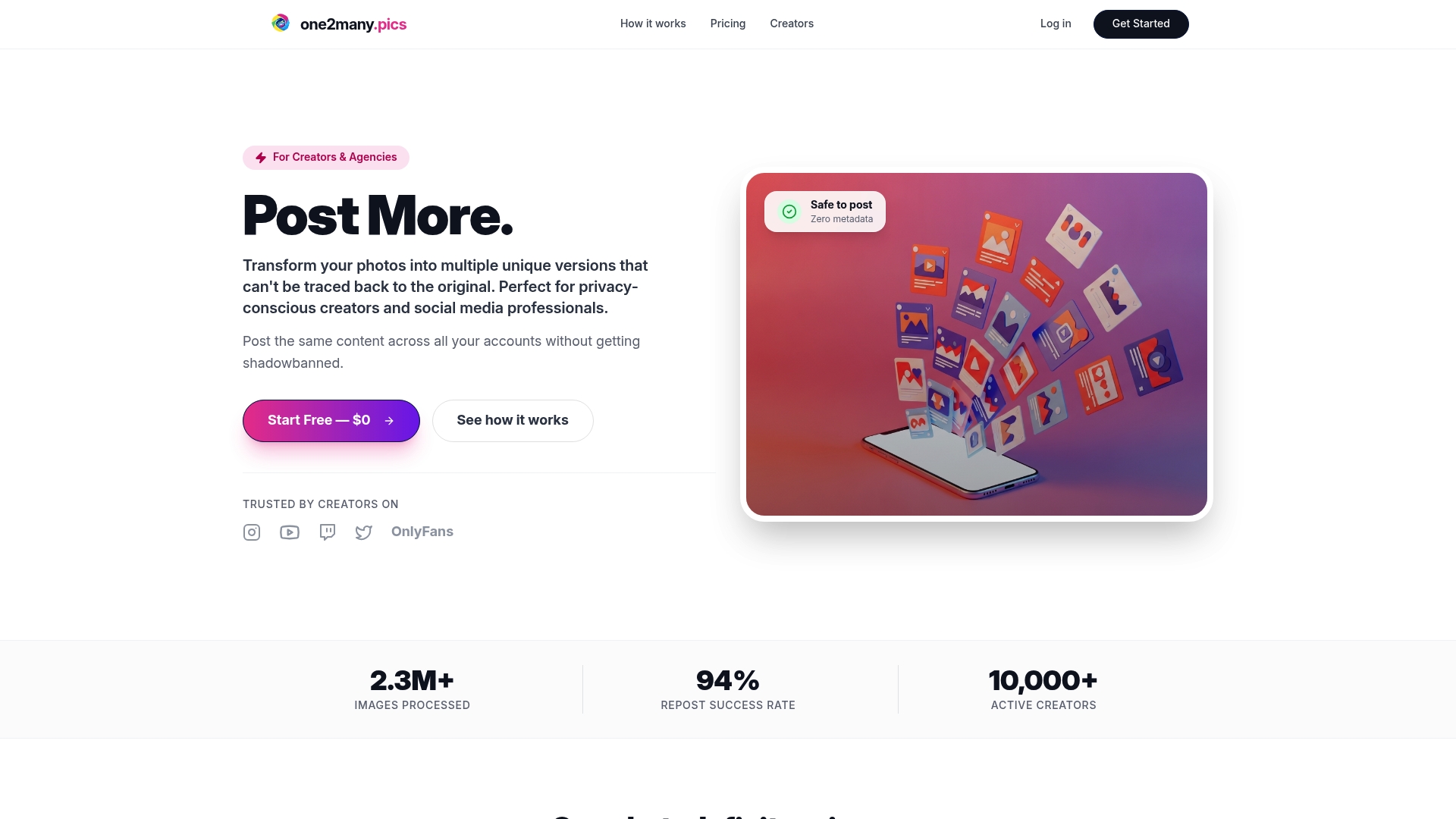
One2Many.pics lets creators and agencies upload source images and generate multiple unique visual variations instantly, with metadata stripped and privacy protected by default. Whether you're managing one account or fifty, the platform handles batch processing, customizable variation settings, and secure downloads in a single workflow. If you're serious about protecting your content and growing your engagement without risking platform penalties, this is where your process should start.
Frequently asked questions
How do unique images help avoid copyright takedowns?
Unique images are harder for copyright bots and reverse image search tools to detect, making them significantly less likely to trigger automatic content removal or account strikes.
Do unique images really boost social media engagement?
Yes. Posts with unique images earn measurably more interaction, with Instagram carousels seeing 114% more engagement than single static images across comparable accounts.
What tools can I use to create unique image variations at scale?
Batch variation tools like img2img engines, AI image platforms, and seed-based generators allow agencies and creators to produce dozens of distinct images from a single source efficiently.
What's the risk of using popular or stock images?
Widely circulated or stock images risk takedowns and reduced reach because duplicate detection algorithms on major platforms are designed to identify and suppress content that's been seen before.