

Visual content is the engine of social media growth, but picking the wrong format can tank your reach, expose your data, or get your account flagged before you ever find your audience. Most creators focus on aesthetics alone, missing the bigger picture: the format you choose determines not just how many people engage, but how safely and sustainably you can scale your content strategy. This article walks you through the criteria, the formats, the comparisons, and the practical decisions that help you post smarter across every platform.
Table of Contents
- What makes visual content engaging on social media?
- Popular types of visual content for engagement
- Comparing visual formats: Engagement and privacy matrix
- Situational strategies: Choosing the right visual content
- What most creators miss about visual content choices
- Enhance your engagement with privacy-first tools
- Frequently asked questions
Key Takeaways
| Point | Details |
|---|---|
| Interactivity unlocks conversions | Formats like polls and quizzes routinely yield double the engagement of static visuals. |
| Privacy is key | Anonymizing content before sharing protects both creator and audience trust. |
| Platform-adapted visuals win | Choosing content types that match the platform's tools enhances reach and impact. |
| Use mixed formats | Combining static, video, and interactive visuals offers layered engagement opportunities. |
| Experiment consistently | Always test new visual content strategies to stay ahead of algorithm and audience shifts. |
What makes visual content engaging on social media?
Great visual content does three things well: it grabs attention fast, invites some kind of response, and fits the platform where it lives. But there is a fourth factor most creators ignore entirely, and that is privacy. The type of visual you share can expose metadata, reveal your location, or leave a digital fingerprint that gets you shadowbanned (meaning your content is hidden from search and feeds without any notification).
When selecting a visual format, weigh these core factors:
- Relevance: Does this format match what your audience expects on this platform?
- Interaction potential: Can viewers respond, vote, swipe, or share?
- Platform fit: Is the format natively supported, or will it look awkward?
- Privacy impact: Does the visual contain metadata or identifying information?
- Production cost: Can you realistically create this format at scale?
Platform choice changes everything. A vertical short-form video that crushes it on TikTok may barely register on LinkedIn. A polished infographic that earns thousands of saves on Pinterest might feel completely out of place on Snapchat. Understanding top social media video formats helps you match content type to platform expectations before you invest time producing anything.
Data supports prioritizing interactive formats especially. Interactive content like quizzes and polls generates 2x the conversions of passive visual content, making participation a measurable advantage over simple views. That is not a marginal difference. That is doubling your results from the same posting schedule.

Checking your social media security tips before publishing any visual is equally important. Most creators skip this step entirely, assuming privacy is only relevant for text or personal accounts.
Pro Tip: Add a poll or quiz sticker to your next Story post and track your reply rate versus a standard image post over two weeks. The difference in participation will likely push interactive formats to the top of your rotation permanently.
Now that we have outlined the criteria, let us explore specific visual formats that drive engagement.
Popular types of visual content for engagement
Every format has a job to do. Here is how the main visual content types stack up for engagement, privacy, and platform performance:
-
Static images: Fast to produce and highly shareable, images are the baseline of social content. The privacy risk is real though. EXIF data (embedded metadata that records your camera model, GPS coordinates, and timestamp) travels with the image file unless you strip it. Anonymizing images for privacy before posting protects your location data and device identity from anyone who downloads your content.
-
Short-form videos: Reels, TikToks, and YouTube Shorts deliver some of the highest organic reach available right now. The algorithm rewards watch time and replays, so hooks matter within the first two seconds. Audio metadata and location tags can expose personal information if you are not careful about export settings.
-
Carousels: These multi-image posts are built for storytelling and education. Each swipe is a micro-interaction that keeps people on your post longer, which signals value to the algorithm. Carousels consistently earn more saves and shares than single images on Instagram.
-
Stories: Ephemeral by design (disappearing after 24 hours), Stories create urgency and intimacy. They also support interactive stickers like polls, questions, and quizzes, which is where interactive content proves its 2x conversion advantage most clearly.
-
Infographics: Data-rich visuals that simplify complex ideas perform exceptionally well for education-focused brands. They earn backlinks, get saved, and spread across platforms. The production time is higher, but the shareability makes them a long-term asset.
-
Memes: Low production cost, high viral potential. The catch is cultural timing. A meme that lands perfectly one week feels stale the next, and a misjudged reference can backfire publicly. Use memes strategically within content mixes, not as your primary format.
-
Interactive formats: Polls, quizzes, and interactive videos are the highest-converting visual type available. Story-driven engagement strategies work especially well when paired with interactive prompts that feel personal rather than promotional.
For video-specific content, creative TikTok visuals offer a detailed breakdown of ideas that consistently outperform standard footage. Understanding what works on each platform prevents wasted effort and keeps your content calendar focused. Creating untraceable media ensures that no matter which format you use, your digital footprint stays clean across multiple accounts.
Pro Tip: Tailor your format to the intent of the platform. TikTok rewards entertainment, LinkedIn rewards insight, Instagram rewards aesthetics. Matching format to intent lifts engagement without requiring more content volume.
Comparing visual formats: Engagement and privacy matrix
Let us look at these formats side by side. This table gives you a quick reference for engagement potential, privacy risk, and the platforms where each format performs best.
| Format | Engagement potential | Privacy risk | Best platforms |
|---|---|---|---|
| Static image | Medium | High (EXIF data) | Instagram, Pinterest, Twitter/X |
| Short-form video | Very high | Medium (location tags) | TikTok, Reels, YouTube Shorts |
| Carousel | High | Medium | Instagram, LinkedIn |
| Stories | High | Low (ephemeral) | Instagram, Facebook, Snapchat |
| Infographic | Medium-high | Low | Pinterest, LinkedIn, Twitter/X |
| Meme | High (viral spikes) | Low | Twitter/X, Instagram, Reddit |
| Interactive (polls/quizzes) | Very high | Low | Instagram, Facebook, TikTok |
The data from this comparison points to a consistent pattern. Formats that invite participation outperform passive formats across nearly every metric. Video quality also plays a major role in performance, since blurry or poorly formatted videos get penalized by platform algorithms regardless of how good the content is.
"Participation soars with interactive visuals on Stories, delivering double the conversions compared to standard image posts."
That quote reflects what the data on interactive formats consistently shows: interaction is not a nice addition to your strategy. It is the strategy. When you give people something to respond to, they respond. And that response signals to the platform that your content is worth showing to more people.
Privacy risk also scales differently than most creators expect. Static images carry the highest inherent risk because metadata travels with the file. Stories carry the lowest because they disappear and are less likely to be downloaded and analyzed. When you understand privacy in media sharing from a technical level, you start making format choices for reasons beyond aesthetics alone.
After seeing these head-to-head comparisons, let us discuss scenario-based recommendations.
Situational strategies: Choosing the right visual content
Knowing which format performs best in theory is useful. Knowing which format to use for your specific campaign goal is what actually moves results. Here is how to match format to objective:
For brand awareness: Lead with short-form video and memes. Both formats optimize for reach over depth, spreading your name and visual identity to new audiences quickly. Do not worry about converting these viewers immediately. Focus on memorability.
For lead generation: Carousels and infographics work well here because they deliver enough value to earn an email signup or a profile follow. Pair these with a clear call to action in the caption that tells people exactly what to do next.
For conversions: Interactive formats win. A poll that asks "Which product do you want to see next?" or a quiz that helps someone find the right option for their situation creates a psychological investment that static content never can. Interactive quizzes and polls double conversion rates compared to passive content, which makes them the obvious choice when you need results rather than reach.
For sensitive campaigns: Choose formats with lower privacy risk and strip metadata from all assets before posting. Stories are naturally safer due to their ephemeral nature, but static images used in any campaign should go through metadata removal before upload.
Here is a practical checklist to run through before finalizing your visual content choice for any campaign:
- Define the primary goal: awareness, engagement, leads, or sales?
- Identify the target platform and its native formats.
- Assess your audience's content preference based on past performance data.
- Evaluate your production capacity and budget for the format.
- Check privacy requirements: does any visual contain location, device, or personal data?
- Strip metadata from all static images and apply visual variations for multi-account posting.
- Decide whether to include interactive elements and how to measure their impact.
Understanding video format options helps you stay current with what each platform supports technically, since format specs change and outdated specs can hurt your reach even when your content is strong.
Review your account security setup alongside your content plan. Privacy and performance are not separate concerns. They are the same concern viewed from two angles.
Pro Tip: Run layered campaigns that use multiple formats at once. Use a short-form video for reach, a carousel for depth, and a Story poll for conversion. Each format does a different job, and together they cover the full journey from discovery to action.
Taking this practical advice further, here is our team perspective on the overlooked best practices.
What most creators miss about visual content choices
Here is the uncomfortable truth that most marketing guides skip: following trends is not a strategy. It is a reaction. When you chase the latest format because everyone else is using it, you are already behind the curve, competing in a saturated space with content that looks identical to everything around it.
The creators who consistently outperform their peers share one habit: they experiment with formats before the algorithm rewards them widely. They tested Reels when organic reach was at its peak. They built carousels on LinkedIn before everyone else discovered that saves drove reach. They used interactive Stories features when most brands were still posting static graphics.
But here is the part that almost never gets discussed: privacy is a performance variable, not just a legal concern. When your images carry metadata that links them back to a single device or location, platforms can detect patterns across accounts. This is one of the mechanisms behind shadowbanning and duplicate content detection. Strip that data, vary your visual fingerprint, and your content moves through the algorithm more freely.
Using anonymizing strategies is not paranoia. It is the same discipline that separates professional content operations from amateur ones. A marketing agency managing ten client accounts cannot afford to have all those accounts linked by shared metadata. Neither can a creator managing multiple brand identities.
The other thing creators miss is that interactivity is not just about conversion metrics. When someone responds to your poll or answers your quiz, they form a micro-relationship with your content. That relationship increases the chance they will come back, share, and buy. The best engagement is earned through trust and creative risk, not through perfect production values or posting at the "optimal time." Real engagement comes from giving people something worth engaging with.
Review and anonymize all your visuals before sharing. Not just the sensitive ones. All of them. Build it into your workflow and the benefits compound over time.
Enhance your engagement with privacy-first tools
You now have the framework for choosing visual content types that drive real engagement across any platform. But strategy only goes as far as your tools allow.
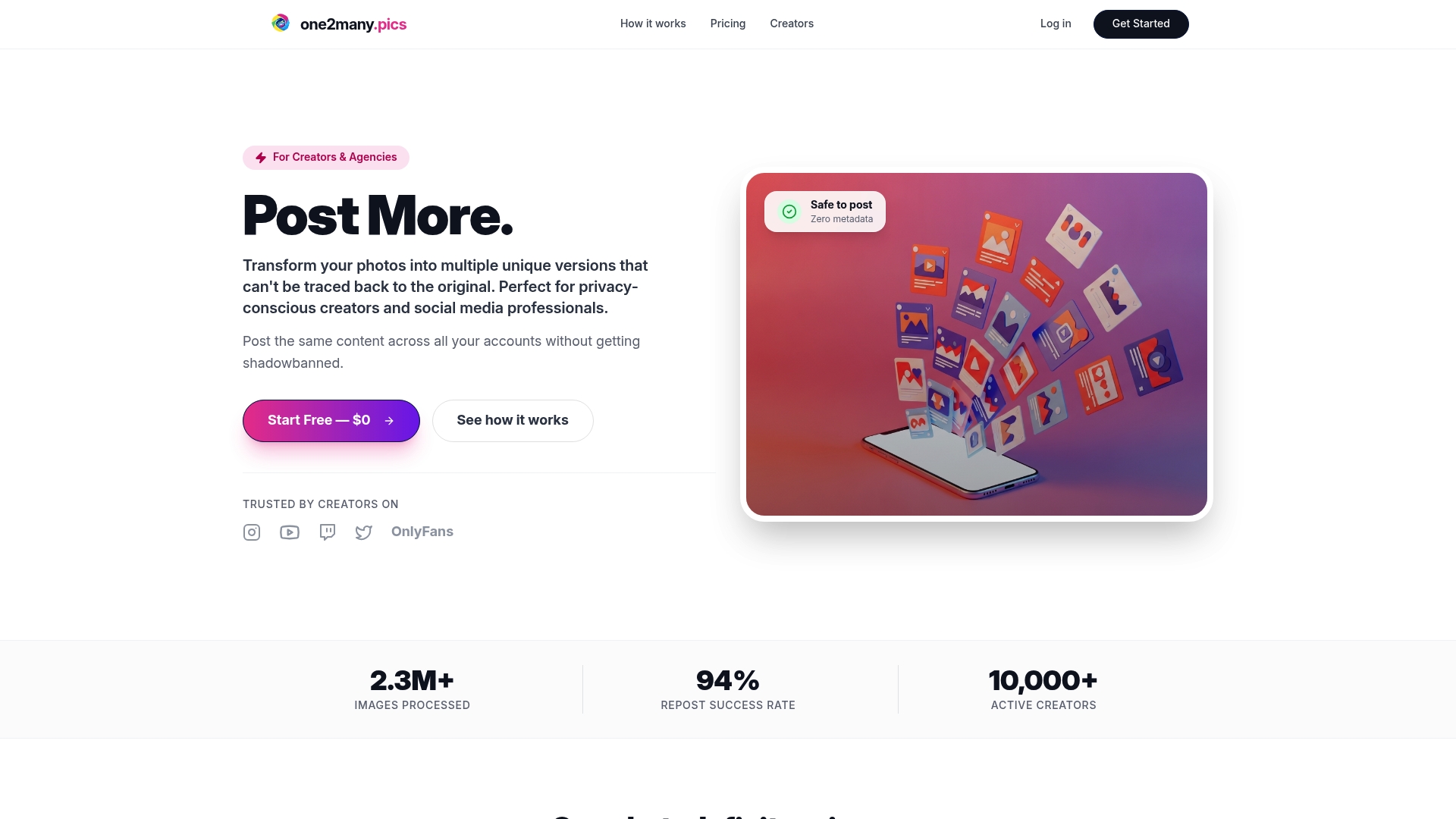
One2Many.pics gives you the practical capability to back up that strategy. You can create untraceable images that are free from metadata and visually unique across every account you manage, eliminating the risk of shadowbanning or duplicate content detection. Whether you are managing a single brand or scaling content across dozens of accounts, the platform transforms your original images into multiple distinct versions without sacrificing quality. If you work with other creators or manage client campaigns, the affiliate program lets you share that advantage and earn while you grow. Privacy-first content creation is the edge that separates sustainable growth from constant platform penalties.
Frequently asked questions
What visual content type drives the most engagement?
Interactive visuals like quizzes and polls have been shown to double conversions compared to static images, making them the highest-performing format for measurable results.
How can I protect my privacy when sharing visual content?
Use anonymizing tools to strip metadata and ensure visuals contain no identifiable information before posting. Anonymizing your images removes location, device, and timestamp data that could expose your digital footprint.
Which platforms support interactive visual formats?
Most major platforms including Instagram, Facebook, TikTok, and Snapchat support interactive formats such as polls and quizzes, particularly through their Stories features.
Do video quality and format affect engagement rates?
Yes, high-quality optimized videos consistently outperform low-resolution or incorrectly formatted content because platform algorithms favor watchability and technical compliance.