

Platforms are watching every upload with a level of precision most creators never expect. Meta's SSCD achieves 90% precision in identifying copied images, meaning even subtly altered reposts can trigger suppression. For social media creators and marketers, this is not a distant technical concern. It directly affects reach, revenue, and audience growth. Understanding how duplicate detection works, what consequences follow, and how to build an originality and privacy strategy is now essential knowledge for anyone serious about scaling content in 2026.
Table of Contents
- How algorithms identify duplicate content
- What happens when duplicates are detected
- How creators can avoid algorithmic suppression
- Balancing originality and privacy in 2026
- The uncomfortable truth most creators miss about duplicate detection
- Protect your content and privacy with one2many.pics
- Frequently asked questions
Key Takeaways
| Point | Details |
|---|---|
| Algorithms are highly precise | Social platforms use advanced similarity measures and fingerprints to spot duplicates, even with minor changes. |
| Duplicates cost visibility | Flagged content is often suppressed or demoted, cutting reach and revenue for creators. |
| Semantic changes beat edits | Originality requires meaningful changes—semantic transformation and commentary work better than superficial edits. |
| Privacy matters more than ever | Creators must anonymize and protect images to avoid identity and copyright risks in 2026. |
| Tools help bridge the gap | Platforms and apps like one2many.pics support creators in staying original and secure. |
How algorithms identify duplicate content
Platforms do not rely on simple pixel matching. That approach would be too easy to fool. Instead, they use a layered combination of techniques designed to catch duplicates even after significant visual changes.
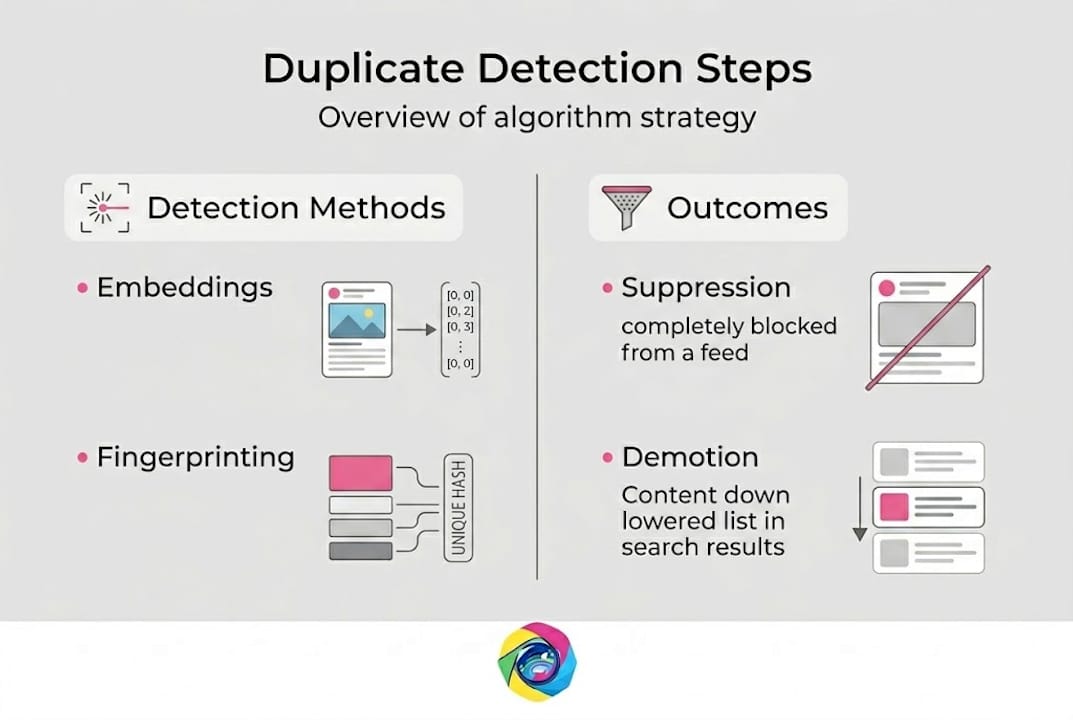
Image fingerprinting and embeddings are the core tools for photo and graphic content. Platforms convert images into mathematical representations called embeddings. These are compact numerical summaries of an image's visual meaning, not its exact pixels. Meta's SSCD uses 512-dimensional embeddings paired with cosine similarity scoring to compare any uploaded image against a reference database with 90% precision. Cosine similarity measures the angle between two embedding vectors. The closer to 1.0, the more similar the content. Meta flags matches above a 0.75 cosine similarity threshold, which means a cropped, color-shifted, or slightly blurred version of an original image can still be caught.
For video and audio, platforms use a different but equally rigorous approach. YouTube Content ID generates unique fingerprints from reference files submitted by rights holders, then automatically scans every new upload for acoustic and visual matches. This happens in seconds and covers even short clips embedded in longer videos.
Here is a quick breakdown of what each major technique targets:
- Image embeddings: Detect visually similar photos even with color, crop, or filter changes
- Audio fingerprinting: Match identical or near-identical soundtracks across files
- Video fingerprinting: Scan frame sequences for visual and motion pattern matches
- Metadata analysis: Flag repeated upload patterns, device signatures, or timing
Duplicate detection is not just about catching pirates. It actively shapes which content gets promoted and which gets buried.
| Platform | Primary method | Outcome on match |
|---|---|---|
| Meta (Facebook/Instagram) | SSCD embeddings + cosine similarity | Demotion, suppression |
| YouTube | Content ID audio/video fingerprinting | Block or monetization redirect |
| TikTok | Audio + visual hash matching | Reduced distribution |
For creators managing multiple accounts or posting across platforms, understanding this social media security guide can make a real difference in how content performs.
What happens when duplicates are detected
Once a platform flags your content as a duplicate, the response is fast and largely automated. You rarely get a warning. The consequences range from mild to severe depending on the platform and how many times you have triggered the system.
Here is the typical sequence of events:
- Algorithmic demotion: Your post is shown to fewer people immediately after upload
- Reduced distribution: The algorithm stops recommending your content to new audiences
- Monetization loss: Ads are removed or revenue is redirected to the original rights holder
- Content blocking: The post is made invisible or removed entirely
- Account flags: Repeated offenses can trigger broader restrictions on your account
Facebook actively suppresses unoriginal content, prioritizing posts from creators who add genuine value. This is not limited to stolen content. It also affects legitimate creators who repost their own content across accounts without enough variation. YouTube's Content ID system can automatically block a video in certain countries or route all ad revenue to the original file owner.
| Consequence | Facebook/Instagram | YouTube |
|---|---|---|
| Demotion | Yes | Partial |
| Monetization impact | Indirect | Direct revenue redirect |
| Content block | In severe cases | Yes, by country or globally |
| Account risk | Repeated flags | Strike system |
Platform algorithms increasingly treat originality as a ranking signal, not just a copyright concern.
Empirical tests by marketers have shown that even reposts with added text overlays, slight crops, or minor color adjustments still trigger suppression on Facebook and Instagram. The systems are calibrated to look past surface changes.

Pro Tip: If you are managing multiple accounts or posting similar images across platforms, safeguard your accounts by making semantic changes to every piece of content, not just cosmetic ones. Minor pixel tweaks rarely fool modern detection systems.
How creators can avoid algorithmic suppression
Knowing how detection works gives you a real advantage. The goal is not to trick the algorithm but to create content that genuinely registers as original. There are clear, practical ways to do this.
Semantic transformation is the most effective strategy. This means changing the actual meaning or context of an image, not just its appearance. A different angle, a new subject placement, or a completely reframed narrative around the same visual idea reads as new content to detection systems. Platforms reward posts that add something fresh to the conversation.
Adding original commentary works on a similar principle. A caption that provides your unique analysis, a text overlay that reframes the image's message, or a voiceover that adds context all shift the content from pure repost territory into something the algorithm can treat as original contribution. Semantic transformation and commentary are the strategies recommended for creators who want to stay visible without starting from scratch every time.
Here are the most effective tactics for avoiding suppression:
- Reframe the narrative: Change the context, caption, and purpose of every post
- Use original overlays: Add graphics, text, or design elements unique to each version
- Vary your format: Turn a photo into a carousel, a video, or a story with different crops
- Anonymize your images: Strip metadata and adjust visual signatures before uploading
- Schedule posts with gaps: Rapid identical posting triggers pattern detection
Privacy is also part of the equation. Images carry metadata including location data, device identifiers, and timestamps. Platforms and third parties can use this information to link accounts or track posting behavior. Learning how to anonymize images for privacy protects your digital footprint alongside your content strategy.
Pro Tip: Do not rely on lazy reposts even if you add a new filter. The algorithm is looking at the structural meaning of the image, not just the surface. Invest in tools that create genuinely distinct visual versions of your content.
Balancing originality and privacy in 2026
In 2026, the pressure to be both original and private has never been higher. Algorithms are smarter, detection systems are more precise, and the consequences of getting flagged are more immediate. But there is a real tension for creators: being highly original often means showing more of yourself, your location, your device, and your workflow. That exposure creates its own risks.
Meta's SSCD demonstrates how precisely platforms can now match content across millions of uploads. As these systems improve, creators who rely on subtle variations alone will find diminishing returns. The standard for what counts as original is rising every year.
At the same time, privacy risks are compounding. Every image you upload carries embedded data that can reveal where you shot it, what device you used, and when. If you manage multiple accounts or create content for different brands, this metadata trail can link accounts that should be separate, triggering platform penalties or exposing client relationships.
Here is a practical checklist for creators who want to stay ahead in 2026:
- Strip all metadata from images before uploading to any platform
- Create genuinely distinct visual versions for each account or posting context
- Add original commentary or design elements that shift the semantic meaning
- Use privacy tools that generate unique image signatures without compromising quality
- Audit your posting patterns regularly to avoid triggering frequency or similarity flags
- Treat safe social media sharing as a standard part of your content workflow
Originality and privacy are not competing priorities. They reinforce each other. A content strategy built on genuinely unique posts, combined with strong metadata hygiene, gives you the best protection against both suppression and unwanted exposure.
The uncomfortable truth most creators miss about duplicate detection
Most creators assume duplicate detection is about catching plagiarists. It is not. These systems are built to optimize platform quality and engagement, which means they affect everyone who reposts, recycles, or scales content across accounts, regardless of intent.
The real mistake is thinking that technical workarounds are enough. Changing pixels, adding a filter, or cropping an image before reposting is not a strategy. It is a delay tactic at best. The platforms building these tools are investing heavily in semantic understanding, which means they are getting better at reading what an image means, not just what it looks like.
What actually works is building a content practice that treats originality as a default, not a workaround. That means combining strong creative thinking with technical privacy habits. Anonymization is not optional anymore. It is part of professional content management. Creators who understand both sides of this, the creative and the technical, are the ones who sustain reach over time. Our security perspective has always been that protection and performance go hand in hand. The creators who treat privacy as an afterthought are the ones most at risk when the next algorithm update rolls out.
Protect your content and privacy with one2many.pics
If this article made one thing clear, it is that originality and privacy are now technical requirements, not just creative ideals. One2Many.pics was built for exactly this challenge.

With One2Many.pics, you can create untraceable images by removing all embedded metadata, including location, device info, and timestamps, and generating visually distinct versions of any original photo. This means you can scale your content across accounts and platforms without leaving a digital trail or triggering duplicate detection. For creators ready to stop guessing and start protecting, the anonymize images guide is the perfect place to start building a smarter, safer posting workflow.
Frequently asked questions
How do social media algorithms detect near-duplicate images?
Platforms convert images into mathematical embeddings and compare them using cosine similarity scoring. Meta's SSCD achieves 90% precision for copy detection, catching altered copies that look different on the surface but share the same underlying visual structure.
What happens if I post duplicate content on Facebook or YouTube?
Your content can be suppressed, demoted, or blocked within minutes of upload. Facebook demotes unoriginal reposts automatically, while YouTube Content ID can redirect all monetization to the original rights holder or block your video in specific regions.
Are minor edits enough to bypass duplicate detection algorithms?
In most cases, no. Modern systems analyze semantic meaning, not just pixel data. Semantic transformation and commentary are far more effective than cosmetic edits like cropping or color adjustments.
How can I keep my content original and protect my privacy?
Combine semantic changes with technical privacy practices. Anonymizing images removes identifying metadata, while adding original commentary and creative overlays ensures your posts register as genuinely new content to platform algorithms.