

A secure content posting workflow is a structured process that combines automated safety checks, platform-specific scheduling, and human approval steps to publish content safely and consistently across multiple channels. Without this structure, creators and marketers face two compounding risks: privacy exposure from leaked metadata or credentials, and content suppression triggered by platform algorithms detecting inorganic or duplicate activity. The solution is not more caution. It is a better system. This guide covers the tools, governance layers, and step-by-step process you need to build one that scales.
What does a secure content posting workflow actually require?
A secure content posting workflow depends on three interlocking components: automated governance, official API access, and human approval gates. Each layer handles a different failure mode. Governance filters unsafe content before it reaches a platform. API access keeps your posting behavior within platform rules. Human approval confirms that what gets published is what you intended.
Official API usage combined with staggered post timing prevents automated systems from flagging accounts for spam or inorganic activity. That means your scheduling tool should never fire posts in rapid bursts across accounts. Platforms like LinkedIn, Instagram, and Mastodon each expose scheduling APIs precisely so developers can post at controlled intervals without triggering rate limits.
Role-based access control sits at the foundation of any serious setup. Tools like "forge-social` and CLI pipelines with cryptographic approval enforce strict permission boundaries between who can draft content, who can approve it, and which system can actually publish it. OAuth tokens encrypted with AES-256-GCM and keyed by user-controlled secrets are the current standard for storing platform credentials securely. This treats your social tokens with the same rigor as financial data.

Pro Tip: Never store OAuth tokens in plain text environment variables shared across a team. Use a secrets manager like HashiCorp Vault or AWS Secrets Manager, and rotate tokens on a fixed schedule.
| Tool or Method | Primary Function | Security Feature |
|---|---|---|
forge-social | Social post scheduling via Forge CMS | AES-256-GCM token encryption |
| Ed25519 signing | Cryptographic content approval | Blocks altered content from publishing |
| Platform scheduling APIs | Native post scheduling | Rate-limit compliance, spam prevention |
| Role-based access control | Permission management | Separates drafting, approval, and publishing |
| CLI approval pipelines | Human-in-the-loop review | Cryptographic sign-off before execution |
How do automated governance layers prevent privacy breaches and content suppression?
A content firewall placed upstream of your publishing pipeline is the single most effective defense against accidental data exposure. The firewall runs four checks before any content reaches a platform, and each check targets a specific failure mode that manual review routinely misses.
The four governance layers work as follows:
-
Source classification. Every piece of content gets labeled before it moves through the pipeline. Labels include public, private, sensitive, and credentials. Anything tagged sensitive or credentials is blocked from publication automatically, regardless of what the draft says.
-
Public/private boundary checks. The system scans outgoing content for patterns that match private data: API keys, internal URLs, personal identifiers, and location strings embedded in image metadata. This check catches the mistakes that happen when a creator copies from an internal doc into a post draft.
-
Evidence verification. Any post making a factual claim, citing a statistic, or referencing an external source must include a verifiable URL or log entry. This prevents the publication of unverified claims that could damage credibility or trigger platform moderation.
-
Novelty detection. Automated workflows must include novelty checks to prevent repetitive or near-duplicate posts that trigger suppression algorithms. The system compares each new post against a hash of recent content and blocks anything that falls below a defined uniqueness threshold.
"A refusal layer is not a bottleneck. It is the mechanism that lets you post at scale without losing account standing or leaking data you never meant to share."
Pro Tip: Build your novelty detection around semantic similarity, not just exact-match hashing. Two posts with different wording but identical meaning will still trigger duplicate detection on most major platforms.
What is the step-by-step process for building a secure posting workflow?
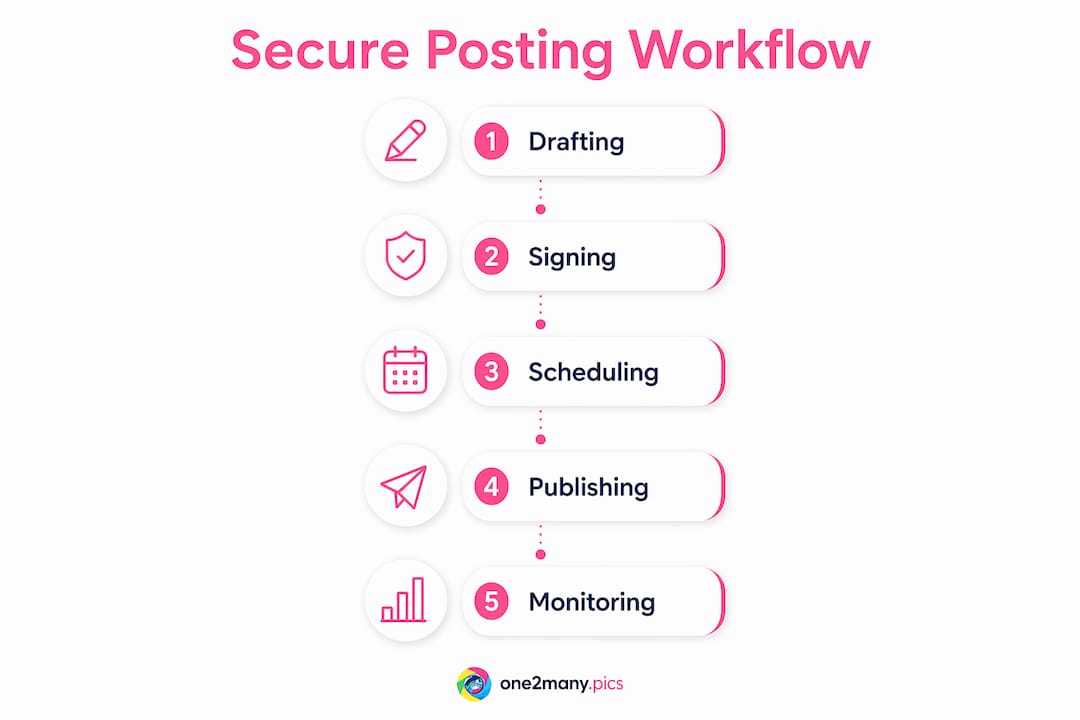
Building a secure content posting workflow from scratch follows a clear sequence. Each stage hands off to the next only after a defined condition is met, which is what separates a real workflow from a checklist.
-
Draft content. Use AI assistance or team collaboration tools to produce the initial draft. Keep AI in a drafting-only role. Separating AI drafting from human approval reduces risk and preserves content integrity at the source.
-
Run governance checks. Pass the draft through your content firewall. All four layers, source classification, boundary checks, evidence verification, and novelty detection, must return a pass before the draft advances.
-
Human review and feedback. A designated reviewer reads the approved draft, makes edits, and either approves or returns it. This step is non-negotiable. No automated system replaces the judgment call a human makes about tone, accuracy, and brand alignment.
-
Cryptographic signing. Once approved, the content is signed using an Ed25519 key pair. Cryptographic approval signatures ensure that only verified content reaches the publishing stage. If the content is altered after signing, the signature fails and the post is blocked.
-
Schedule and publish. Submit the signed content to the platform's scheduling API. Use staggered timing across accounts and platforms. Never publish the same asset simultaneously to multiple accounts.
-
Monitor and retry. Log every publish attempt. On failure, the system should wait a defined interval and retry with exponential backoff. After three failures, escalate to a human reviewer rather than retrying indefinitely.
Common mistakes at this stage include skipping the signing step for "low-risk" posts, sharing scheduling credentials across platforms, and using third-party automation tools that bypass official APIs. Each of these shortcuts creates the exact exposure the workflow is designed to prevent.
| Stage | Key Action | Security Check |
|---|---|---|
| Drafting | AI or team creates content | AI access limited to drafting only |
| Governance | Firewall runs four-layer check | All layers must pass |
| Human review | Reviewer approves or returns | No bypass allowed |
| Signing | Ed25519 signature applied | Signature verified before publish |
| Scheduling | API submission with stagger | Rate limits respected |
| Monitoring | Logs capture every attempt | Failures escalate after three retries |
How does token isolation reduce risk across multiple platforms?
Per-platform process isolation limits the risk that a compromised credential on one platform can contaminate access to others. Running separate execution contexts for each platform means that if your Instagram token is exposed, your LinkedIn and Mastodon tokens remain unaffected. This is the blast radius principle applied to content security management.
The practical implementation looks like this:
- Each platform gets its own isolated process or container with no shared memory or file access.
- OAuth tokens are stored encrypted, per-platform, in a secrets manager. Encrypted token storage with strict per-platform access limits is the current standard for reducing compromise scope.
- AI agents that assist with drafting or scheduling never have direct access to tokens. Authentication is handled by a separate service that the AI calls through a narrow, permission-scoped interface.
- Shared token pools are explicitly prohibited. A single pool means a single point of failure across every platform you manage.
"The question is not whether a token will be compromised. It is how much damage that compromise can do. Isolation is the answer."
This architecture also applies to image metadata. When you post visual content across multiple accounts, removing embedded metadata such as location, device identifiers, and timestamps before publishing prevents platforms from linking accounts through shared digital fingerprints. One2many handles this at the asset level, stripping metadata and generating unique visual variants so each post appears original to platform detection systems.
What best practices ensure scalability and compliance in secure workflows?
Scalability in content security management requires treating content as a managed asset with a defined lifecycle. Defining the content lifecycle from creation to secure deletion reduces legacy content risks and keeps you compliant as platform rules evolve.
The practices that hold up at scale are:
- Audit trails for every action. Log who drafted, who approved, who signed, and when each post was published. Audit logs are your defense when a platform flags an account or a compliance review asks for evidence.
- Scheduled credential rotation. Rotate OAuth tokens and API keys on a fixed calendar, not just after an incident. This limits the window of exposure for any credential that may have been silently compromised.
- Content lifecycle policies. Define how long published content stays live, when drafts are deleted, and how archived posts are stored. Treat old content as a liability if it contains outdated claims or sensitive references.
- Failure monitoring with automated retries. Use platform APIs to detect failed posts and trigger retries with backoff logic. Manual monitoring at scale is unreliable and creates gaps in your audit record.
Pro Tip: Connect your posting automation tools to a centralized logging service like Datadog or Loggly. A single dashboard showing publish success rates, failure codes, and retry counts across all platforms makes compliance reporting straightforward.
Security by design actually accelerates content velocity by reducing the manual cleanup and recovery time that follows security incidents. Teams that build governance in from the start spend less time responding to suppressed accounts or leaked credentials and more time producing content.
Key takeaways
A secure content posting workflow requires four governance layers, per-platform token isolation, and cryptographic human approval to prevent suppression, privacy exposure, and credential compromise at scale.
| Point | Details |
|---|---|
| Four governance layers | Source classification, boundary checks, evidence verification, and novelty detection must all pass before publishing. |
| Token isolation per platform | Store OAuth tokens encrypted and separately per platform to limit the damage from any single compromise. |
| Cryptographic approval | Sign approved content with Ed25519 key pairs so altered drafts are automatically blocked before publishing. |
| Official API scheduling | Use platform-native scheduling APIs with staggered timing to avoid spam flags and content suppression. |
| Content lifecycle management | Define creation-to-deletion policies and maintain audit logs to stay compliant as volume and platform rules grow. |
What I've learned building secure posting workflows at scale
The first time we ran a multi-platform posting pipeline without proper token isolation, a single misconfigured credential exposed scheduling access across three accounts simultaneously. Nothing was published that shouldn't have been, but the near-miss made the architecture change obvious. Isolation is not a feature you add later. It is the foundation.
What surprised me most was how much faster the workflow became after we added the governance layers. The instinct is to assume that more checks mean more friction. The reality is that automated checks run in milliseconds and catch the errors that used to require a human to find after the fact. The secure content sharing process we settled on now handles hundreds of posts per week with fewer manual interventions than our original manual review process required.
The human approval step is the one I would never remove, even under pressure to automate everything. An AI can draft well and a firewall can filter reliably, but the judgment call about whether a post is right for this moment, this audience, and this platform still belongs to a person. The cryptographic signing step makes that approval meaningful. It is not a rubber stamp. It is a verifiable commitment.
The lesson on metadata was harder to learn. We assumed that removing EXIF data from images was enough. It was not. Platform duplicate detection operates on visual fingerprints, not just metadata. Generating unique visual variants for each account, which is what One2many does at the asset level, closed the gap that metadata stripping alone left open.
— one2many.pics
How One2many supports your secure posting workflow

One2many is built for creators and agencies who need to post across multiple accounts without leaving a traceable digital footprint or triggering platform suppression. The platform removes image metadata including location, device identifiers, and timestamps, and generates unique visual variants so each post appears original to platform detection systems. For teams managing bulk content, One2many's workflow integrations connect directly to your existing publishing pipeline, handling asset-level security so your governance layers can focus on content and credentials. Whether you manage five accounts or five hundred, One2many gives you the privacy controls and scalability that manual processes cannot. Explore the platform and see how it fits your workflow.
FAQ
What is a secure content posting workflow?
A secure content posting workflow is a structured publishing process that combines automated governance checks, human approval gates, and platform-specific scheduling to prevent privacy exposure and content suppression. It treats every post as a managed asset with defined security requirements before it reaches any platform.
How do I prevent content suppression across multiple platforms?
Using official platform APIs with staggered post timing prevents spam detection systems from flagging your accounts. Novelty detection within your workflow also blocks near-duplicate posts that trigger suppression algorithms.
Why should OAuth tokens be encrypted per platform?
Per-platform token encryption using AES-256-GCM limits the blast radius of any server compromise. If one platform's token is exposed, isolated storage prevents attackers from accessing credentials for your other accounts.
What does cryptographic signing do in a content workflow?
Cryptographic signing with Ed25519 key pairs creates a verifiable record that a specific human approved a specific piece of content. If the content is altered after signing, the signature fails and the post is automatically blocked before it reaches the platform.
How does image metadata affect content security?
Image metadata including GPS coordinates, device model, and timestamps can link multiple accounts to the same creator, enabling platforms to detect duplicate activity. Removing this metadata and generating unique visual variants, as One2many does, prevents platform fingerprinting from connecting accounts you intend to keep separate.