

Every social media manager has been there: you post the same image to Instagram, Facebook, TikTok, and LinkedIn, and the reach is nowhere near what you expected. The problem often isn't the content itself. Identical files trigger fingerprint matching across platforms, watermarks from one app tank your visibility on another, and over-automation slowly erases the unique voice that built your audience in the first place. This article walks through real, actionable examples that protect your reach, your privacy, and your brand identity every time you cross-post.
Table of Contents
- What to look for in effective cross-platform posting
- Example 1: Tailored image variations for each platform
- Example 2: Removing platform-specific watermarks
- Example 3: Customizing captions to each audience
- Cross-platform posting examples: Quick comparison table
- Why smart cross-posters treat every platform as unique
- Make cross-platform posting safer and smarter with one2many.pics
- Frequently asked questions
Key Takeaways
| Point | Details |
|---|---|
| Edit each post | Modify images and captions for every platform to avoid suppression and increase reach. |
| Remove watermarks | Posts with app watermarks, like TikTok, are penalized by most social platforms. |
| Customize captions | Different captions help maintain authenticity and prevent content performance drops. |
| Prioritize privacy | Making images unique and removing traces protects your content and accounts. |
What to look for in effective cross-platform posting
With these challenges in mind, let's clarify the standards smart content creators use for effective cross-platform distribution.
Most creators assume cross-posting is simple: create once, share everywhere. That assumption is exactly what gets accounts shadowbanned or suppressed. Platforms like Instagram, TikTok, and LinkedIn have become increasingly sophisticated at detecting duplicate or low-quality reposts, and they respond by limiting visibility without any warning.
The mechanism behind this is called digital fingerprinting. When you upload an image or video, the platform creates a unique hash, basically a digital signature, based on the file's exact data. If you upload the identical file to a second platform, or worse, re-upload it to the same platform later, that signature matches. Algorithms interpret this as recycled or low-value content and reduce its distribution. Even minor issues like embedded metadata, such as GPS coordinates, device model, or timestamp, can create patterns that make accounts identifiable across platforms, raising privacy red flags.
Then there's the watermark problem. Export clean files before posting; avoid TikTok watermarks on Reels. When a TikTok-branded video gets uploaded to Instagram Reels, Instagram's algorithm detects the competitor logo and actively suppresses the post. This is a documented pattern, not speculation.
Understanding social media security best practices means going beyond strong passwords and two-factor authentication. It extends to how your files look, what data they carry, and how unique each upload truly is.
Here's a working checklist for smart cross-platform posting:
- Unique files for every platform: Even slight variations protect against fingerprint matching
- No competitor watermarks: Clean exports only, especially for video content
- Metadata stripped: Remove location, device, and timestamp info before uploading
- Platform-native captions: No copy-paste captions with external links on platforms that penalize them
- Consistent brand voice: Automation should support your voice, not replace it
"Watermarks cause suppression; identical files trigger fingerprint matching across platforms; external links in Instagram captions reduce distribution; over-automation drowns brand voice." — Key edge cases every cross-poster should understand before publishing.
Example 1: Tailored image variations for each platform
Now that you know the risks of direct duplicates, here's how a best-in-class approach looks in practice.
Imagine you're a travel influencer promoting a new destination guide. You have one hero image: a stunning landscape shot. The instinct is to post it as-is everywhere. The smarter move is to treat that single image as a starting point, not a finished asset.
Why this matters: Identical files trigger fingerprint matching across platforms. Even if your content is original, uploading the exact same file to Instagram, Pinterest, and Facebook simultaneously signals to each platform that this is syndicated, not native, content.
Here's how to build a simple variation workflow:
- Crop for aspect ratio: Instagram Stories needs 9:16, Pinterest works best at 2:3, and LinkedIn favors 1.91:1. Cropping alone creates technically different files.
- Apply platform-relevant filters or overlays: A warm tone might work for Instagram, while a cleaner, more neutral edit suits LinkedIn. This isn't just aesthetics. It creates genuinely distinct files.
- Add or shift text overlays: Slightly repositioning a text block or changing font size creates a new image hash, defeating fingerprint detection.
- Export at slightly different resolutions: A 1080x1080 PNG and a 1080x1080 JPEG with varied compression are not the same file to an algorithm.
- Strip all metadata: Before every upload, ensure no location, device, or timestamp data is embedded in the file.
Understanding how to anonymize images is essential here. Metadata removal is not just a privacy step. It's a performance step, because platforms can use embedded data to identify patterns across accounts and suppress content accordingly.
Pro Tip: Build a simple naming convention for your exported files, such as "destination_guide_IG_v2.jpg" versus "destination_guide_PIN_v1.jpg." This keeps your variation workflow organized and makes it easy to track which version went where, especially when managing multiple accounts or clients.
The goal isn't to create radically different content for each platform. It's to ensure that each upload is technically unique enough to be treated as original, native content by every algorithm that sees it.
Example 2: Removing platform-specific watermarks
Unique visual tweaks help, but watermarks introduce a different problem, one that can silently destroy your visibility.
Here's the scenario: you create a short-form video on TikTok, it performs well, and you want to repurpose it for Instagram Reels and YouTube Shorts. Natural instinct says to just download and repost. But that TikTok logo embedded in the corner is doing serious damage to your reach on every other platform.

Instagram Reels has been publicly linked to suppressing videos with visible TikTok watermarks. Avoid the TikTok watermark on Reels. The reasoning is straightforward: Instagram does not want to promote a competitor's brand, and its algorithm is trained to detect that watermark and reduce distribution.
Here's a step-by-step approach for clean exports:
- Record natively if possible: Instead of posting directly to TikTok from a single recording, save your raw video first and then upload separately to each platform.
- Use TikTok's built-in "Save to Device" option without the watermark: When enabled in settings, this lets you download your own video clean before the branded logo is added.
- Use a watermark removal tool: Several reputable tools can crop or blur watermarked corners without degrading the rest of the image. Verify that the tool doesn't re-embed its own metadata.
- Re-export with platform-specific settings: After cleaning the file, re-encode it at each platform's recommended resolution and codec. This changes the file signature and removes any residual metadata from the watermark removal process.
- Preview before posting: Always watch the final file in full before uploading to catch any visual artifacts left behind by editing.
Pro Tip: Always maintain your original, unbranded video files in a dedicated folder. Watermark removal after the fact is a workaround. Starting from a clean source file is always the cleaner, faster solution.
This process matters more than most creators realize. A suppressed Reel doesn't just get fewer views on that post. It signals to Instagram's algorithm that your account produces low-quality or derivative content, which can affect the reach of your future posts as well.
Example 3: Customizing captions to each audience
Adjusting media is just one part of the solution. Customizing your captions is equally critical for reach and authenticity.
A common mistake is writing one caption and pasting it across every platform. It's efficient, yes, but it undermines performance in several ways. Each platform has a different audience, a different culture, and different algorithmic rules about what kinds of text get rewarded.
External links in Instagram captions reduce distribution; over-automation drowns brand voice. Instagram's algorithm is known to deprioritize posts that include clickable links in captions, because those links push users off the platform. If your LinkedIn caption includes a full URL and you paste it directly into Instagram, you're actively hurting your own post performance.
Beyond the technical penalties, there's a tone problem. LinkedIn audiences respond to professional insights, industry data, and clear takeaways. Instagram audiences engage with storytelling, emotional hooks, and visual descriptions. TikTok rewards humor, authenticity, and trending audio references. A single caption cannot serve all three.
Here's how platform-specific captions look in practice:
- Instagram: "Living for the golden hour views. Save this for your next trip. No link, but the guide is in our bio." Short, visual, benefit-focused, no external URL.
- LinkedIn: "Three lessons from traveling to 14 countries in one year. Here's what the data says about remote work and location flexibility: [link in post]." Professional framing, data-forward, link embedded in the post itself where LinkedIn allows it.
- TikTok: "POV: You finally go where you've been saving for years. Part 1 of this series drops Friday." Casual, teaser-driven, platform-native language.
"Over-automation drowns brand voice." This is the hidden cost of pure efficiency. When your captions sound like they were written by a scheduler rather than a human, your audience notices, even if they can't articulate why engagement dropped.
The practical workflow here is simple: write your primary caption for the platform where you expect the most engagement, then rewrite it from scratch for each secondary platform. Don't edit the original. Rewrite it.
Cross-platform posting examples: Quick comparison table
To round out these examples, a head-to-head table makes it easy to decide which solutions best suit your goals and risk tolerance.
Understanding account safeguard strategies means choosing the right combination of techniques based on how aggressive your posting volume is and how much risk each platform represents for your account. The table below summarizes the three core examples discussed, along with their strengths, limitations, and best-fit scenarios, based on known cross-platform posting edge cases.
| Strategy | Privacy benefit | Reach benefit | Effort level | Best for |
|---|---|---|---|---|
| Tailored image variations | High, removes metadata fingerprints | High, avoids duplicate detection | Medium | Agencies, bulk posting |
| Watermark removal | Medium, removes platform identifiers | High, prevents algorithmic suppression | Low to medium | Video-first creators |
| Custom captions per platform | Low on its own | High, prevents link penalties | Medium | All creator types |
| All three combined | Very high | Maximum | Medium to high | Professional accounts, brands |
The combined approach consistently outperforms any single strategy. Tailored visuals plus clean exports plus native captions give you the best shot at top-of-feed placement on every platform simultaneously. For individual creators with limited time, start with watermark removal since it delivers the highest reach benefit for the least effort. For agencies managing multiple clients, invest in image variation workflows because the privacy and suppression protection scales across every account you manage.
Why smart cross-posters treat every platform as unique
Here's the perspective that most cross-posting guides won't give you: the push toward full automation is seductive because it saves time, but it often costs far more in reach and account health than the hours it saves.
Veteran social media managers know this from experience. You can use a scheduling tool that posts the same file to six platforms simultaneously and feel productive. But what you're actually doing is training six different algorithms to see your account as a syndicator rather than a creator. That distinction matters enormously because platforms like Instagram and TikTok are explicitly designed to reward native behavior.
The contrarian take is this: total automation is not a strategy. It's a gamble. Every platform evolved with a specific content culture, and that culture is enforced algorithmically. When you bypass it with bulk scheduling and identical files, you're betting that efficiency beats fit. It rarely does over the long term.
What actually protects your reach is treating variation as non-negotiable, not optional. The anonymize images guide we reference throughout this article isn't just about privacy in the personal data sense. It's about making each post behave like a new, original piece of content to every algorithm that encounters it. That's the real competitive advantage.
The creators who grow consistently across platforms aren't the ones who post the most. They're the ones who post the most relevantly. Platform-specific variations, clean files, and tailored captions are the mechanics of relevance at scale.
Make cross-platform posting safer and smarter with one2many.pics
Managing image variations, stripping metadata, and maintaining unique files across multiple platforms sounds like a full-time job on top of an already full-time job. That's exactly the problem One2Many.pics was built to solve.
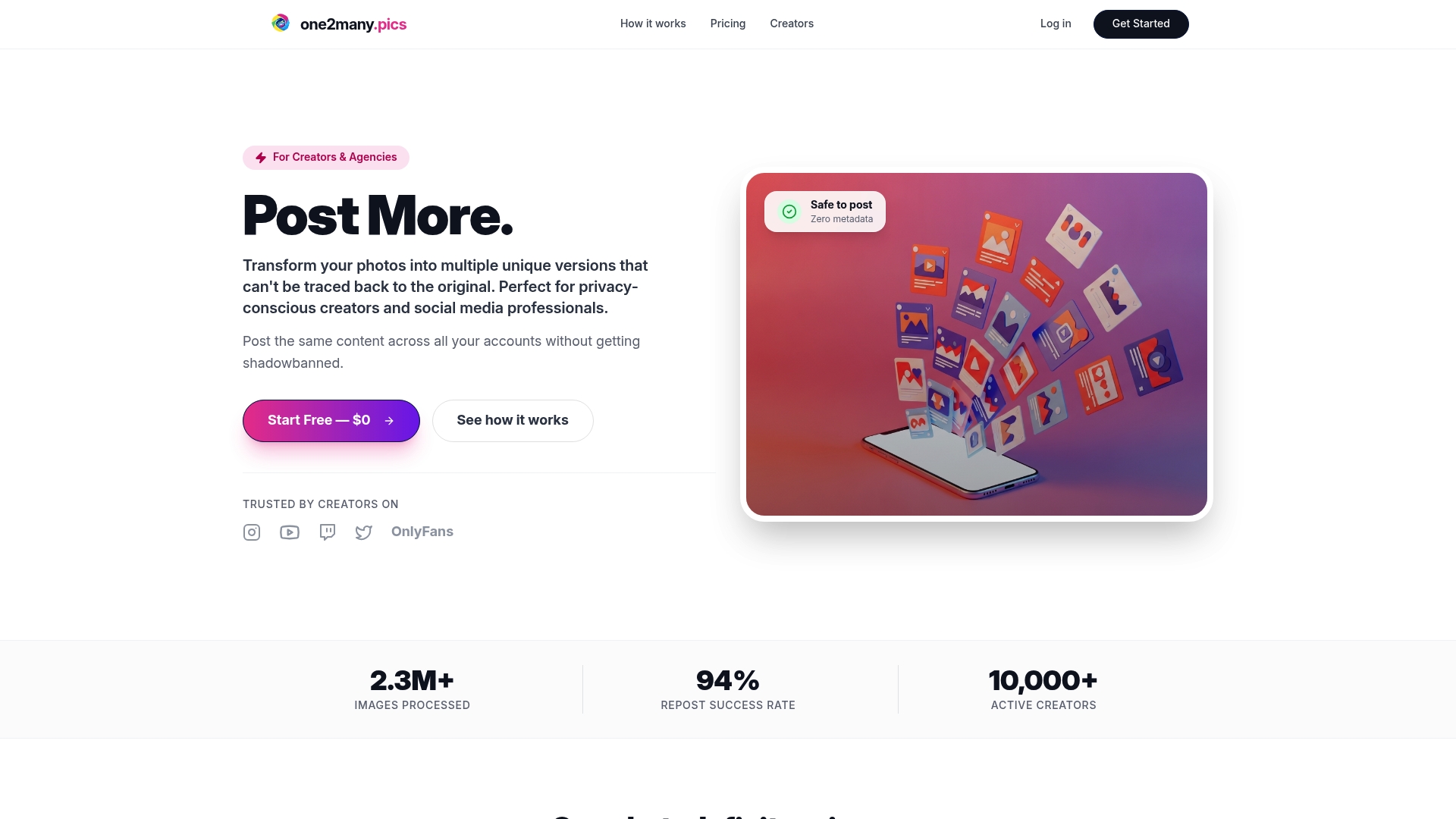
Automate safe cross-posting with a platform that transforms your original images into multiple unique versions automatically. One2Many.pics removes metadata such as location, device info, and timestamps, and generates visual variations through image spoofing, so every upload looks native to the platform receiving it. Whether you're managing a single creator account or scaling across dozens of client profiles, the platform's bulk processing and workflow integrations handle the technical variation work so you can focus on strategy and content quality. If you're building an audience in the content creation space, the affiliate program for image creators also offers a way to earn while sharing a tool your audience genuinely needs.
Frequently asked questions
What is the best way to avoid suppression when posting the same images on multiple platforms?
Identical files trigger fingerprint matching across platforms, so the most effective approach is to slightly alter each image before uploading by adjusting crop, resolution, or filters, and always remove watermarks and metadata before posting.
Do all platforms penalize TikTok watermarks?
Most platforms, especially Instagram, suppress posts with visible TikTok watermarks because avoiding the TikTok watermark on Reels is essential to preventing algorithmic deprioritization and protecting your reach.
Should I use the same caption text for every platform?
Customizing captions for each platform is strongly recommended because external links in Instagram captions reduce distribution, and identical copy across all platforms signals automated syndication rather than native posting, which hurts engagement.
What is digital fingerprinting and how does it affect cross-posting?
Digital fingerprinting is the process by which platforms create a unique hash from an uploaded file's data to detect duplicate content. Because identical files trigger fingerprint matching, uploading the same file to multiple platforms can cause algorithms to suppress the post as recycled or low-value content.