

Most creators assume social media compliance means reading the platform's terms of service and clicking "agree." That assumption is expensive. The real exposure comes from federal marketing law, global privacy regulations, and a growing FTC enforcement apparatus that treats influencer posts as advertising. Get it wrong and you're looking at fines, account bans, and lasting damage to your brand. Get it right, and you build the kind of audience trust that actually survives algorithm changes. This guide breaks down every major rule you need, the edge cases that trip up even experienced creators, and the practical steps you can take right now to protect your content and your career.
Table of Contents
- What is social media compliance?
- Key compliance rules every creator must follow
- Privacy laws you need to know: GDPR, CCPA, and more
- Common mistakes and edge cases (AI, Reels, influencer traps)
- Why most creators get compliance wrong and how to really protect your brand
- Create safer, smarter content with one2many.pics
- Frequently asked questions
Key Takeaways
| Point | Details |
|---|---|
| Disclose all material connections | Always state when you are paid, gifted, or affiliated with a brand for social media posts. |
| Comply with privacy laws | Understand GDPR and CCPA rules to protect audience data and avoid legal risks. |
| AI content and metrics need special care | AI-generated or manipulated content and fake engagement must be clearly labeled or avoided. |
| Platform tags alone aren't enough | Layer your disclosures—don't rely solely on Instagram, TikTok, or YouTube's internal tags. |
| Transparency builds trust | Openness about sponsorships and practices protects your brand's reputation and audience relationships. |
What is social media compliance?
Social media compliance isn't just about avoiding a community strike on YouTube or getting flagged on TikTok. It's a broader legal and regulatory framework that governs how you market, advertise, and collect data through your content. That distinction matters enormously for creators who treat every brand deal or affiliate link as just another post.
At its core, compliance for creators and influencers covers three major areas:
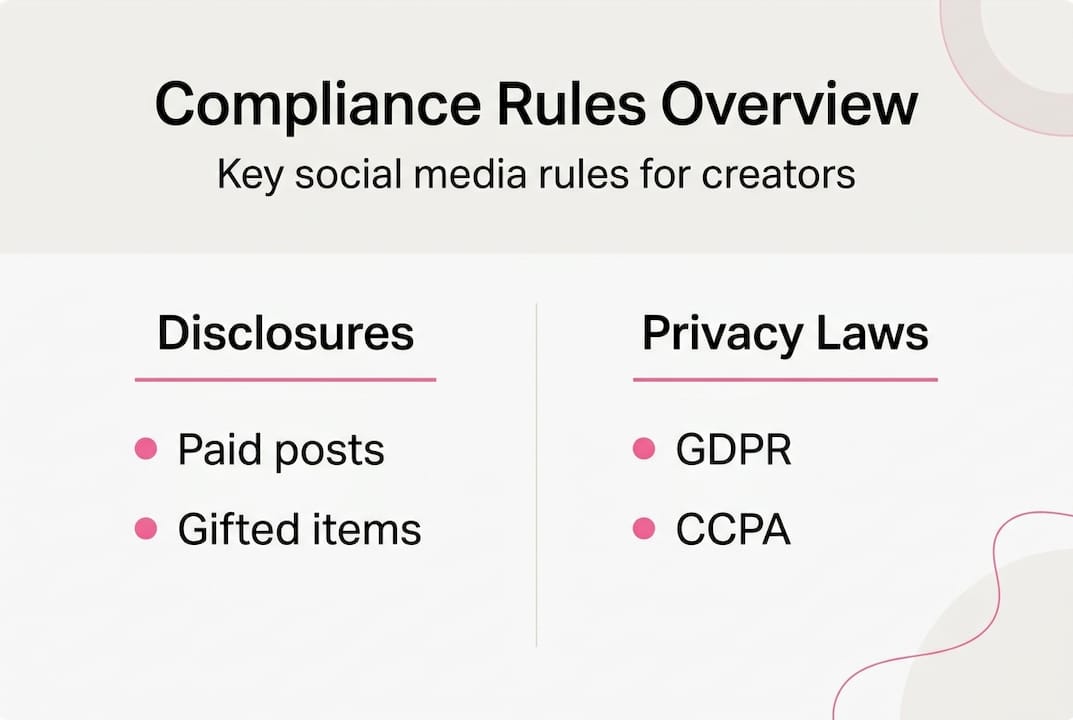
- FTC Endorsement Guides: These federal rules require you to disclose any relationship you have with a brand when promoting their products. This includes paid partnerships, free products, affiliate commissions, and even close personal friendships with founders.
- Privacy laws: GDPR (the EU's General Data Protection Regulation) and CCPA (California Consumer Privacy Act) regulate how your content, pixels, and tracking tools interact with your audience's personal data.
- Platform-specific policies: Community guidelines, branded content tools, and ad policies from Instagram, TikTok, YouTube, and others layer on top of federal law. These are the minimum floor, not the ceiling.
A common misconception is that turning on Instagram's "Paid Partnership" tag or YouTube's paid promotion checkbox is enough. It isn't. Those tools satisfy platform requirements, but the FTC operates independently. Disclosure for sponsored content must meet the "clear and conspicuous" standard under federal law, which means it needs to be impossible to miss regardless of which platform tool you use.
"Social media compliance for content creators and influencers primarily involves adhering to FTC Endorsement Guides requiring clear and conspicuous disclosure of any 'material connection' with brands to avoid deceptive practices."
Non-compliance has real consequences. The FTC can issue fines up to $51,744 per violation. Brands that work with non-compliant influencers face co-liability, which means they'll start dropping creators who aren't airtight on disclosures. Platforms can suspend or permanently ban accounts for repeated violations.
Pro Tip: Treat every post as a potential legal document. Before you hit publish, ask: "Would a regulator reviewing this post immediately understand every financial relationship I have with any brand mentioned here?"
Key compliance rules every creator must follow
Understanding the framework is step one. Knowing the specific rules that apply to your content is where compliance becomes practical.
Here's a checklist of the most important requirements:
- Disclose all material connections up front, in plain language ("I was paid for this" or "gifted product" work; "#sp" buried in hashtags does not).
- Never fabricate or exaggerate results tied to a product or service you promote.
- Disclose AI-generated content when it's part of a sponsored post, both the sponsorship and its AI origin.
- Follow employee and insider rules: If you work for a brand and promote it, disclose that relationship explicitly.
- Don't buy fake engagement. Purchased followers, likes, or views are a violation of FTC deceptive practices rules and increasingly detectable by both platforms and brands.
| Content type | Required disclosure | Where to place it |
|---|---|---|
| Sponsored posts | "Ad," "Paid partnership," or "Sponsored" | Beginning of caption or video |
| Gifted products | "Gifted" or "free product" | Start of caption or first 30 seconds |
| Affiliate links | "Affiliate link" or "I earn a commission" | Before or adjacent to the link |
| AI-generated visuals | "AI-generated" + sponsorship disclosure | Caption and/or on-screen text |
| Reels and Stories | Verbal or on-screen disclosure | Opening frame or first spoken words |
The FTC disclosure guidance is straightforward: disclosures must be placed where consumers will actually see them, not hidden below a "more" button or sandwiched between hashtags. If your audience has to hunt for it, it doesn't count.
The FTC requires disclosures to be "clear and conspicuous" — meaning they must stand out and be hard to miss in the context of the post.
Creators who ignore these rules face more than regulatory penalties. Brands increasingly audit influencer compliance before signing deals, and a single viral non-disclosure incident can end lucrative partnerships overnight. The reputational cost often exceeds any fine.

Privacy laws you need to know: GDPR, CCPA, and more
Privacy compliance is the second major pillar for creators, and it's frequently overlooked until something goes wrong. If your content reaches global audiences — and most creators' content does — you're almost certainly subject to multiple overlapping privacy laws.
GDPR applies to anyone processing data from EU residents. As a creator, this affects you in more ways than you might expect:
- If your website uses a Meta Pixel, Google Analytics tag, or any similar tracking tool, you need explicit user consent before activating it for EU visitors.
- Custom audiences built from your email list or website traffic require a documented lawful basis for processing.
- Your website needs a compliant privacy notice that explains what data you collect and why.
CCPA applies when you have California-based audience members. Key requirements include providing a "Do Not Sell My Personal Information" option, honoring data deletion requests, and disclosing what categories of data you collect.
| Requirement | GDPR | CCPA |
|---|---|---|
| Consent for tracking pixels | Required | Not required, but must disclose |
| Privacy notice | Required | Required |
| Data deletion rights | Required | Required |
| "Do Not Sell" option | Not required | Required |
| Geographic scope | EU residents worldwide | California residents |
For social media privacy compliance, the practical rule is to apply the highest standard across the board. If GDPR is stricter on a specific point, default to GDPR for all users. This simplifies your compliance posture and future-proofs you as more states adopt CCPA-like laws.
Pro Tip: Use geo-targeting settings in your ad tools and landing page platforms to serve different consent banners to EU vs. US visitors. This takes less than an hour to set up and eliminates one of the most common audit findings.
Privacy law violations carry serious financial consequences. GDPR fines can reach 4% of annual global turnover or 20 million euros, whichever is higher. CCPA penalties run up to $7,500 per intentional violation. For a creator running a growing brand, those numbers are significant.
Common mistakes and edge cases (AI, Reels, influencer traps)
Even creators who know the basic rules get tripped up by less obvious scenarios. These edge cases are where the most damaging compliance errors happen.
Common compliance traps:
- Burying disclosures in hashtags. Writing "#gifted" at the end of a 30-hashtag block doesn't meet the clear and conspicuous standard. Put it first.
- Forgetting short-form video disclosures. For Reels, TikToks, and YouTube Shorts, the AI content disclosure details and sponsorship disclosures must appear in the first few seconds, either verbally or on screen. A caption disclosure alone is not sufficient.
- Missing the employee affiliation rule. If you work for a company and post about their products even on your personal account, federal rules require you to disclose that relationship.
- Using platform tools as a substitute for real disclosure. Instagram's paid partnership tag and YouTube's disclosure checkbox satisfy platform policies. They don't automatically satisfy FTC requirements.
- Treating AI-generated content as disclosure-free. Any AI-generated content used in a sponsored context needs dual disclosure: one for the sponsorship and one labeling it as AI-created.
Fake metrics are another major trap. Buying followers or likes isn't just a platform violation. It's a federal offense under 16 CFR 465.8, and brands now routinely use third-party audit tools to detect inflated engagement before signing deals. Getting caught means losing partnerships and potentially facing legal action.
Pro Tip: Disclose early and in plain, conversational language. "This video is sponsored by [Brand]" in the first 10 seconds does more for your credibility than any platform tag. Audiences respect honesty, and regulators reward it.
Short-form video is the fastest-growing enforcement area. Regulators are actively reviewing creator content in this format, and the requirement to disclose at the start of the video, not the end or only in the caption, is non-negotiable.
Why most creators get compliance wrong and how to really protect your brand
Here's the uncomfortable reality: most creators approach compliance as a minimum-viable-effort task. They turn on the platform's paid partnership tag, throw a "#ad" somewhere in the caption, and consider it done. That logic works until it doesn't, and by the time it doesn't, the consequences are already in motion.
The FTC's clear and conspicuous standard deliberately goes beyond platform tools because platforms have commercial incentives to keep disclosure friction low. The FTC does not share that incentive. Layering your own plain-language disclosure on top of every platform tool is not paranoia. It's the actual requirement.
Many creators avoid prominent disclosures because they fear reach suppression or audience backlash. That's a short-term calculation with long-term costs. Audiences who discover undisclosed sponsorships don't just unfollow. They talk about it. The creators who are radically transparent about brand relationships consistently build stronger, more loyal audiences than those who hedge.
Looking ahead, AI detection tools and stricter FTC enforcement cycles mean the compliance bar is rising, not staying flat. Getting ahead of it now, building disclosure habits that are automatic and visible, protects your brand across whatever platform shifts come next.
Create safer, smarter content with one2many.pics
Compliance protects your legal standing, but protecting your content's privacy and uniqueness across platforms is equally important for long-term creator success. Metadata embedded in your images, such as location data, device information, and timestamps, can expose your digital footprint and trigger duplicate detection or shadowbanning across accounts.
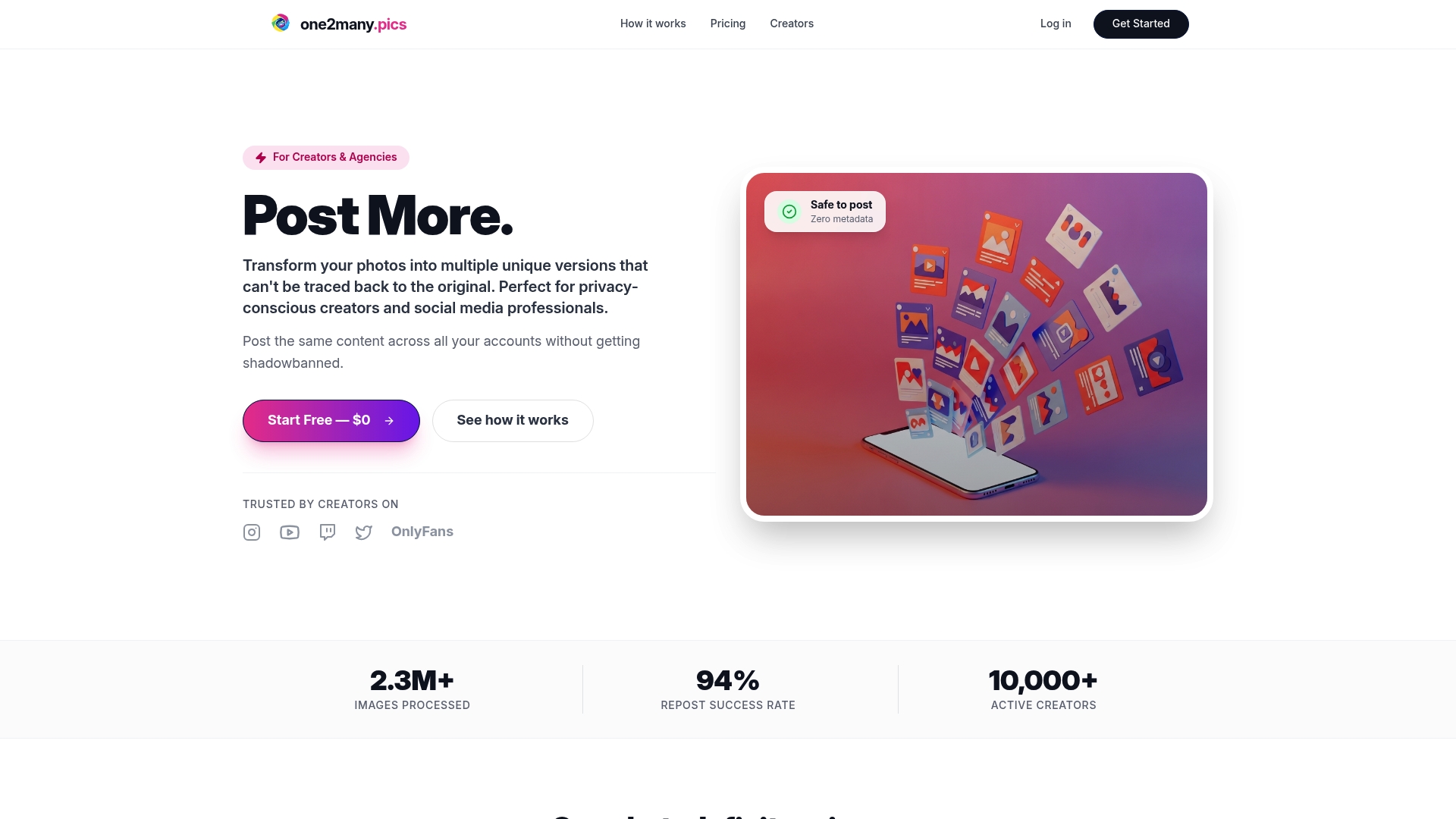
Protect your social media assets with One2Many.pics, a platform built specifically for creators who need to post strategically without leaving a traceable trail. By removing metadata and generating unique image variations, you stay compliant with privacy best practices while keeping your content fresh and suppression-free. Whether you're managing multiple accounts or scaling a content operation, One2Many.pics gives you the tools to post smarter, safer, and with total control over your digital identity.
Frequently asked questions
Do I need to disclose gifted products on social media?
Yes, any gifted product counts as a material connection and requires clear disclosure under FTC rules. Under 16 CFR 465.8, even receiving a free item with no payment creates a disclosure obligation.
How does GDPR affect my social media campaigns?
If you target EU audiences, you need consent for tracking pixels, privacy notices, and strict data collection limits under GDPR. Specifically, tracking pixels like Meta Pixel require explicit opt-in consent before activating for EU visitors.
Is it illegal to buy followers or likes for my content?
Yes, purchasing fake metrics like followers or likes is banned under federal regulations and risks penalties. Fake engagement is prohibited under 16 CFR 465.8 and can lead to account suspension and legal consequences.
Do I have to disclose AI-generated sponsored content?
Absolutely. Both the sponsorship and the AI-generated nature of the content must be disclosed clearly to your audience. Dual disclosure is required under federal rules whenever AI creation intersects with sponsored material.