

Posting across multiple platforms while keeping your personal data locked down is one of the sharpest tensions in modern content creation. Algorithms reward volume and consistency, yet every public post is also a potential data point that data brokers, scrapers, and bad actors can exploit. Creators who ignore this trade-off often find themselves either shadowbanned from oversharing identical content or exposed in ways they never intended. This article breaks down exactly how to build a posting strategy that grows your audience, protects your digital footprint, and keeps your accounts running smoothly across every major platform.
Table of Contents
- Define your posting goals and target platforms
- Master ideal posting frequency for each platform
- Prioritize high-engagement content formats
- Leverage analytics to optimize timing and engagement
- Maximize privacy without sacrificing engagement
- A smarter approach: Where most marketers miss the balance
- Level up your posting strategy with one2many.pics
- Frequently asked questions
Key Takeaways
| Point | Details |
|---|---|
| Platform selection matters | Focus on two or three platforms where your audience is most engaged and where your content shines best. |
| Follow evidence-based posting habits | Use recommended posting frequencies and adjust based on your analytics for best results. |
| Prioritize content format | Short-form video and carousels drive higher engagement than basic images or static posts. |
| Privacy is as important as reach | Adopt privacy controls and secure your accounts to protect your personal and brand information online. |
| Analytics fuel smarter strategies | Regularly review your analytics to optimize timing, format, and frequency for continual improvement. |
Define your posting goals and target platforms
Now that you see the big-picture stakes, it's crucial to start with the right foundation. Before you schedule a single post, get clear on what you actually want: brand awareness, direct sales, community growth, or all three? Each objective shapes which platforms deserve your time and which metrics matter.
Start by mapping your audience. Where do they already spend time? A B2B marketer will find LinkedIn indispensable, while a lifestyle creator may live or die by Instagram and TikTok. Trying to maintain a polished presence on six platforms at once is a recipe for burnout and mediocre content everywhere.
A smarter move is to pick two or three platforms and go deep. Managing multiple accounts effectively means tailoring content for each platform's culture and format, then using scheduling tools like Buffer, Hootsuite, or Sprout Social to handle the logistics without losing your mind.
Here's a quick checklist to anchor your platform strategy:
- Define success: growth rate, engagement rate, or conversion rate
- Audit your current audience: use native insights to see where engagement is highest
- Choose 2 to 3 core platforms and treat the rest as secondary repurposing channels
- Use scheduling tools to batch content and maintain consistency without daily scramble
- Review your privacy exposure on each platform with a social media security guide before going fully public
Pro Tip: Set a monthly calendar reminder to audit your platform analytics. Audience behavior shifts fast, and the platform that drove 60% of your traffic six months ago may not be your best bet today.
Master ideal posting frequency for each platform
With your platforms chosen, the next step is knowing how often to engage your audience. Frequency is one of the most misunderstood levers in social media strategy. Post too little and algorithms deprioritize you. Post too much and your audience starts tuning you out.

Platform benchmark data shows optimal posting frequency varies significantly by platform:
| Platform | Recommended frequency |
|---|---|
| 3 to 5 posts per week | |
| 1 to 2 posts per day | |
| TikTok | 2 to 5 per week or 1 to 3 per day |
| X (Twitter) | 3 to 5 posts per day |
| 2 to 5 posts per week | |
| 15 to 25 pins per day |
These numbers are starting points, not mandates. Your specific audience may respond differently, so treat them as a baseline and test from there.
Watch for these warning signs that you're posting too often:
- Engagement rate drops consistently over 2 to 3 weeks
- Follower growth stalls or reverses
- Saves and shares decline even when likes hold steady
- Comments become shorter and less substantive
Overposting is a real risk. Posting frequency insights confirm that excessive posting leads to audience fatigue and lower reach, making quality far more important than hitting an arbitrary number every day.
Pro Tip: Every week, pull your top three and bottom three performing posts. Look for patterns in timing, format, and topic. Adjust your schedule based on what the data actually tells you, not what a generic best-practices article says.
Prioritize high-engagement content formats
Once you've dialed in your frequency, next comes picking what kinds of posts will truly stand out. Not all content formats are created equal, and the gap between the best and worst performers is wider than most creators realize.
Short-form video is the dominant force right now. 2026 engagement trends point clearly to Reels, TikTok clips, and native LinkedIn video as priority formats for maximizing reach and interaction. Carousels are the second-strongest format on Instagram, keeping users swiping and boosting time-on-post signals.
Here's a quick format comparison to guide your content planning:
| Format | Best platform | Avg. engagement rate |
|---|---|---|
| Reels / short video | Instagram, TikTok, Facebook | Up to 67% higher than images |
| Carousels | ~4.2% average ER | |
| Native video | ~3.9% average ER | |
| Static images | All platforms | Lowest across most platforms |
These numbers come from social media benchmarks and reflect real aggregated data, not guesses. Reels generating 67% higher engagement than static images is not a marginal difference. It's a strategic signal you can't afford to ignore.
A few format priorities worth building into your content calendar:
- Instagram: Lead with Reels, support with carousels, use static images sparingly
- LinkedIn: Native video first, then text posts with strong hooks, then articles
- TikTok: Raw, high-energy short clips outperform overly produced content
- Facebook: Reels carry over from Instagram; live video still punches above its weight
If privacy is part of your strategy, remember that every image you post carries metadata. Exploring anonymizing images for social posts before uploading is a practical step that protects you without affecting the visual quality your audience sees.
Leverage analytics to optimize timing and engagement
But how do you know your strategy is working? Vanity metrics like follower counts look good in screenshots but tell you almost nothing about actual performance. The metrics that move businesses forward are engagement rate, reach, saves, and shares.
Engagement rate (ER) is your north star. Using benchmark analytics means tracking likes, comments, shares, and saves divided by total reach or impressions for each post. This gives you a real signal of how resonant your content is, independent of account size.
Here's a practical four-step process to make analytics work for you:
- Review your native analytics every week. Instagram Insights, LinkedIn Analytics, and TikTok Studio all show you when your specific audience is most active.
- Spot patterns in your top performers. What time did they go live? What format? What topic?
- Adjust your posting schedule to align with your real audience's active windows, not generic "best time to post" articles.
- Measure results over a minimum of four weeks before drawing conclusions. Single-week data is too noisy.
Don't overlook saves. On Instagram especially, saves are one of the strongest signals the algorithm uses to measure content value. A post with 50 saves and 200 likes often outperforms one with 500 likes and zero saves in the algorithm's eyes.
Pro Tip: Build a simple weekly dashboard, even just a spreadsheet, that logs your top five posts by ER each week. After 90 days you'll have a clear picture of what your audience actually wants, not what you think they want.
Maximize privacy without sacrificing engagement
It's also essential to protect your brand and personal presence as you grow. Privacy and engagement are not opposites. With the right settings and habits, you can reach a wide audience while keeping your personal data, location, and device information out of the wrong hands.
Privacy best practices for creators in 2026 include:
- Disable location tags on every post and story, permanently
- Strip EXIF metadata from images before uploading
- Limit who can tag you and require approval before tags appear publicly
- Restrict direct messages to followers only or use filtered request folders
- Enable two-factor authentication (2FA) on every account, no exceptions
- Audit connected apps quarterly and revoke access to anything you no longer use
Public accounts give you reach, but they also expose you to data brokers that scrape public posts for personal information. A professional public account with tight content controls, stripped metadata, and no personal location signals gives you the best of both worlds.
"The strongest social media strategies in 2026 treat privacy not as a restriction but as a competitive advantage. Creators who protect their data build more durable brands."
Apply security best practices at the account level, and pair them with safe image sharing habits at the content level. Together, these two layers close most of the vulnerabilities that trip up even experienced creators.
A smarter approach: Where most marketers miss the balance
With best practices in hand, it's time for a fresh look at what really works in the long run. Most content advice defaults to one message: post more, share more, be everywhere. And that logic made sense when organic reach was abundant. It no longer does.
The creators who burn out fastest are the ones chasing volume while ignoring the slow erosion of their privacy and data security. They wake up one day to find their location data scraped, their device fingerprint flagged across platforms, or their content suppressed because duplicate detection caught what they thought were "slightly different" posts.
The uncomfortable truth is that sustainable reach comes from consistency and protection, not just volume. Hybrid strategies, where you maintain a public-facing presence while actively controlling what metadata and patterns your content reveals, outperform raw high-frequency posting in the long run. Smart anonymization of your visual content is not a niche tactic. It's a professional standard that top creators and agencies are quietly adopting.
Trust is built when your audience consistently receives quality. Loyalty compounds when they never have a reason to question your credibility or security. Those two things together are more powerful than any algorithm hack.
Level up your posting strategy with one2many.pics
Ready to take your privacy and engagement to the next level? Everything covered in this article points toward one reality: growing your presence and protecting your identity are not separate projects. They work best when they're part of the same workflow.
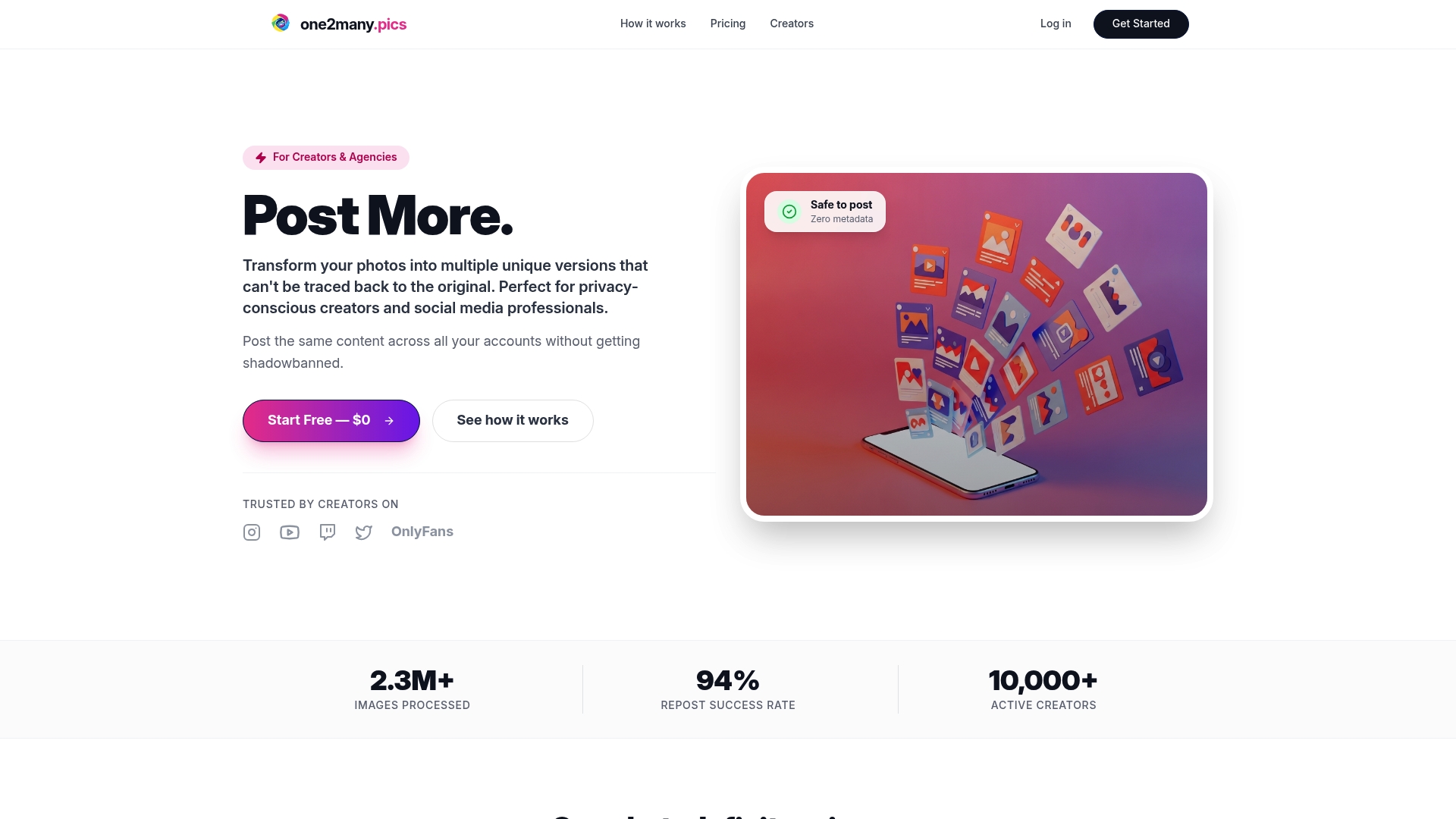
One2Many.pics helps creators and agencies generate unique image variations with all metadata stripped, so every post you share is clean, untraceable, and safe from duplicate detection. Whether you're managing one account or thirty, the platform scales with your needs. Pair it with the insights from our complete guide to social security for a posting strategy that's both high-performing and fully protected.
Frequently asked questions
What times are best for posting on each platform?
Peak times vary by platform and audience. Use your native analytics to find when your audience is most active and schedule posts to match those windows specifically.
How can I protect my personal details while growing my brand?
Keep personal info off public profiles, disable location tags, strip metadata from images, and enable 2FA on every account without exception.
What's the first metric I should track to measure my posting success?
Start with engagement rate: add up likes, comments, shares, and saves, then divide by your total reach or impressions for each post.
Can posting too much hurt my engagement?
Yes. Overposting causes fatigue, lowers your engagement rate, and can reduce algorithmic reach. Consistent quality always outperforms raw posting volume.