

A digital footprint is the permanent trail of data you leave across the internet through every post, login, and platform interaction. For digital content creators and social media professionals, common digital footprint mistakes fall into two categories: active errors like publishing content that leaks location data, and passive ones like ignoring metadata embedded in image files. The good news is that full deletion is impossible but meaningful risk reduction is entirely within your control. Tools like 1Password, Google's removal request portal, and platforms like One2many exist precisely to help you manage what you expose.
1. Common digital footprint mistakes that expose your location
Posting photos or videos without checking the background is one of the most frequent digital footprint errors creators make. A street sign, a recognizable storefront, or a reflection in a window can pinpoint your location as precisely as GPS coordinates. KQED advises a pre-publish review habit to catch these details before content goes live, including re-recording or editing out identifiable landmarks. This mistake is especially common among creators who shoot content quickly and prioritize speed over scrutiny.
Beyond visual clues, image metadata carries EXIF data that records the exact GPS coordinates, device model, and timestamp of every photo taken on a smartphone. Uploading that file directly to Instagram, TikTok, or a blog post hands that data to the platform and potentially to anyone who downloads the image. Stripping metadata before upload is not optional for privacy-conscious creators. It is a baseline requirement.

Pro Tip: Before publishing any visual content, run it through a metadata viewer like ExifTool or use a platform like One2many that automatically strips location and device data from images before distribution.
2. Ignoring privacy settings on social platforms
Privacy settings on platforms like Meta, TikTok, LinkedIn, and X are updated frequently, and most creators never revisit them after initial account setup. Default settings on most platforms favor data collection over user privacy, meaning your audience visibility, location sharing, and ad targeting preferences may be far more open than you realize. Ignoring these controls invites unauthorized tracking and data collection that compounds over time. A quarterly review of every platform's privacy dashboard takes under an hour and closes significant exposure gaps.
Location access granted to social apps on your phone is a separate and equally serious issue. Many apps request "always on" location permission and continue tracking even when the app is closed. Disabling unnecessary location access is one of the fastest wins in protecting your online presence.
3. Reusing weak passwords across multiple accounts
Password reuse is a major repeated mistake that cybersecurity experts identify as the single most preventable cause of account breaches. When one platform in your network is compromised, attackers run automated credential stuffing tools that test your username and password combination across hundreds of other sites within minutes. For creators managing brand accounts, sponsored partnerships, and payment platforms, a single reused password can cascade into a catastrophic breach.
The fix is straightforward. Password managers like LastPass, Dashlane, or 1Password generate and store unique, complex passwords for every account so you never need to reuse one. These tools also flag accounts where your credentials have appeared in known data breaches. Using a password manager is not a technical skill. It is a professional habit.
Pro Tip: Audit every third-party app connected to your social accounts at least once per quarter. Revoke access for any app you no longer use actively, since those connections remain live entry points even after you stop using the service.
4. Skipping multi-factor authentication
Multi-factor authentication (MFA) is the single most effective account hardening measure available to creators, yet adoption remains inconsistent across the industry. MFA and phishing awareness are the two defenses a cybersecurity specialist identifies as critical for protecting creator accounts from takeover. Phishing attacks succeed not through technical sophistication but by exploiting reused passwords and the absence of a second verification layer.
Enable MFA on every account that holds financial data, audience access, or brand partnerships. Authenticator apps like Google Authenticator or Authy are more secure than SMS-based codes, which are vulnerable to SIM-swapping attacks. The extra ten seconds per login is a negligible cost compared to losing access to an account with hundreds of thousands of followers.
5. Failing to manage or delete old accounts
Every dormant account you have forgotten about is an active liability. Old forum profiles, defunct brand pages, early-career blog accounts, and abandoned social handles all remain publicly indexed and searchable. These accounts often contain outdated personal information, old email addresses, and in some cases, content that no longer reflects your professional brand. They also represent unlocked doors into your digital identity if the platform is ever breached.
The process for closing old accounts varies by platform, but the priority list is clear: start with accounts that hold payment information or personal contact details, then move to any account with public-facing content. For accounts where deletion is not possible, update the profile to remove personal data and make it private. Reducing visibility through de-indexing and source removal is the realistic goal, not total erasure.
6. Misconfiguring cookie consent and tracking tools
Cookie consent is not just a legal checkbox. It is a direct reflection of your digital footprint governance. UK PECR violations now carry fines of up to £17.5 million or 4% of global turnover under changes that took effect in February 2026. That scale of financial exposure elevates cookie compliance from a web developer task to a board-level risk, particularly for agencies and media teams running multiple client properties.
The most common configuration errors include:
- Placing analytics or advertising pixels on a page before consent is granted
- Designing cookie banners that make "accept all" easier to click than "reject all"
- Misconfiguring third-party tag managers or pixels in ways that trigger tracking without explicit user consent
- Failing to distinguish between strictly necessary cookies and optional analytics cookies in the consent interface
- Never auditing the consent management platform (CMP) after initial setup
A routine audit of your CMP, tag manager, and consent workflows every six months catches configuration drift before it becomes a compliance violation.
7. Overlooking the aggregate picture of your digital trail
Individual posts, accounts, and data points may seem harmless in isolation. The aggregate picture is what creates real exposure. A creator who shares their gym location on Instagram, their home neighborhood on TikTok, and their daily schedule through LinkedIn activity has effectively published a detailed personal profile across three platforms without ever intending to. This is one of the most underestimated digital identity pitfalls in the industry.
Conduct a periodic search of your own name, handles, and associated email addresses across Google, Bing, and image search. What you find is what a brand partner, a bad actor, or a platform algorithm sees. Use that information to prioritize what to remove, suppress, or update. Suppression through stronger content is a legitimate strategy when removal is not possible. Publishing authoritative, well-optimized content pushes older or unwanted results further down search rankings.
8. Avoiding cleanup mistakes that make things worse
Cleaning up your digital footprint requires a strategic approach, not a reactive one. The most common cleanup mistakes include submitting random removal requests without a clear priority order, paying for unverified services that claim to erase your online history, and deleting content from one source without addressing cached versions or search index entries. Buying dubious removal services is a documented pitfall that wastes money and sometimes makes the problem worse by drawing attention to the content.
The layered cleanup framework works as follows:
| Method | Best used when |
|---|---|
| At-source removal | You control the platform or can contact the publisher directly |
| Google removal tools | Content is removed at source but still appears in search results |
| Noindex / robots.txt | You manage the site and want to prevent future indexing |
| Suppression via new content | Removal is not possible and you need to push results down |
Start with high-impact content: anything that includes personal contact details, financial information, or content that misrepresents your current brand. Work methodically through the list rather than attempting everything at once.
9. Skipping regular digital hygiene routines
Digital hygiene is not a one-time project. It is an ongoing practice. Harvard Business School recommends 20 to 30 minute privacy tune-ups focused on settings and permissions as a regular habit for anyone managing a significant online presence. That time investment, done monthly or quarterly, prevents the kind of compounding exposure that takes months to undo.
A practical hygiene routine for creators includes:
- Review app permissions on your phone and revoke location, microphone, and camera access for apps that do not need it
- Clear cookies and browsing data from your primary browser on a set schedule
- Check audience settings on every active social account and confirm they match your current privacy preferences
- Search your name and primary handles to monitor what is publicly visible
- Review connected third-party apps and integrations across all platforms
Improving internet privacy through these steps is less about achieving invisibility and more about maintaining deliberate control over what you share and with whom.
Pro Tip: Set a recurring calendar reminder every 90 days labeled "Privacy Audit." Treat it with the same priority as a content planning session. The creators who stay ahead of digital footprint risks are the ones who schedule the work, not the ones who react to problems after they occur.
Key takeaways
Avoiding digital footprint errors requires consistent, layered habits across content review, account security, cookie compliance, and cleanup strategy.
| Point | Details |
|---|---|
| Pre-publish content review | Check every image and video for location clues and strip metadata before uploading. |
| Password and MFA discipline | Use a password manager and enable MFA on every account that holds sensitive access. |
| Cookie compliance is high-stakes | UK PECR fines now reach £17.5M, making consent configuration a formal governance issue. |
| Cleanup requires a layered strategy | Use source removal, Google tools, and suppression in sequence rather than random requests. |
| Hygiene is ongoing, not one-time | Schedule quarterly privacy audits to catch permission drift and outdated account exposure. |
What working with creators has taught us about digital footprint risks
The pattern we see most often at One2many is not recklessness. It is speed. Creators who move fast, post frequently, and manage multiple accounts simultaneously are not ignoring privacy. They are prioritizing output, and privacy review gets compressed into the margins.
The uncomfortable reality is that the mistakes with the highest consequences, like metadata exposure, cookie misconfiguration, and password reuse, are also the ones that feel invisible until something goes wrong. A brand deal falls through because a partner ran a background check. An account gets flagged for duplicate content. A platform suppresses reach without explanation. These outcomes trace back to digital footprint errors that were entirely preventable.
What actually works is building privacy checks into the production workflow rather than treating them as a separate task. Reviewing metadata before upload, auditing permissions on a schedule, and using tools designed for creator-scale privacy are not extra steps. They are the professional standard for anyone operating at volume across multiple platforms.
The goal is not perfect invisibility. It is deliberate, informed control over what you expose and when. That mindset shift, from reactive cleanup to proactive hygiene, is what separates creators who scale safely from those who hit avoidable walls.
— one2many.pics
Protect your digital footprint with One2many
Every image you upload carries data you did not intend to share. One2many strips that data automatically.
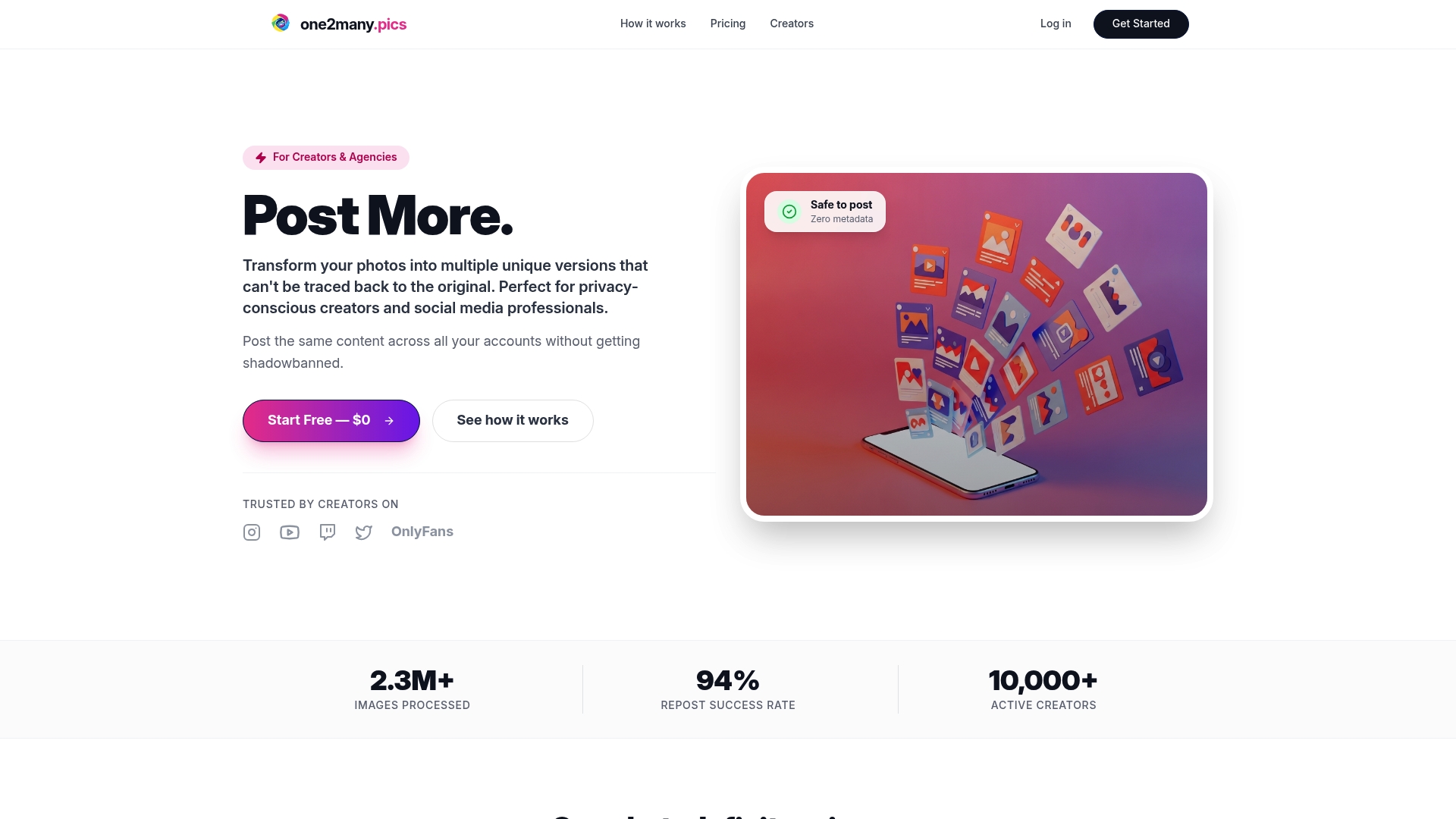
One2many is built for creators and social media professionals who post at volume and cannot afford to manually review every file for metadata exposure. The platform removes location data, device information, and timestamps from images, then generates unique visual variations to prevent duplicate detection across accounts and platforms. Whether you manage one account or fifty, protecting your visual content starts before the upload. Explore One2many's plans to see how bulk processing, automation integrations, and secure downloads fit your current workflow. For a deeper look at the full picture, the creator's privacy guide covers every layer of digital footprint management in one place.
FAQ
What are the most common digital footprint mistakes?
The most frequent errors include posting images with embedded metadata, ignoring platform privacy settings, reusing passwords across accounts, and failing to close old or dormant accounts. Each mistake individually is manageable. Combined, they create significant exposure.
Can you fully delete your digital footprint?
Full deletion is not possible. Cached pages, search indexes, and third-party archives retain data even after source removal. The realistic goal is reducing visibility through layered cleanup methods including source removal, Google's removal tools, and content suppression.
How does cookie misconfiguration affect my digital footprint?
Improperly configured cookie banners or tag managers can trigger tracking without user consent, creating both a privacy liability and a legal one. Under 2026 UK PECR rules, violations now carry fines up to £17.5 million, making correct consent workflows a professional requirement for any creator running a website or client properties.
How often should creators run a privacy audit?
Harvard Business School recommends 20 to 30 minute privacy tune-ups on a regular schedule, focusing on app permissions, account settings, and connected integrations. For active creators, a quarterly audit is the practical minimum.
Does stripping image metadata actually protect privacy?
Yes. EXIF data embedded in smartphone photos includes GPS coordinates, device model, and timestamp. Removing this data before upload prevents platforms and third parties from accessing location and device information tied to your content.