

Every time you browse a website, post a photo, or open an app, you leave behind data. That data is your digital footprint, and most people dramatically underestimate how much of it exists and how long it sticks around. The idea that you can delete a post and make it disappear is one of the most common and costly misconceptions in online privacy. Understanding your digital footprint is not about paranoia. It is about knowing the rules of the environment you already live in and making smarter choices because of it.
Table of Contents
- Key takeaways
- What is a digital footprint, exactly
- How your digital footprint grows every day
- The real impact of your digital footprint
- How to manage your digital footprint effectively
- The future of digital footprints
- My perspective on digital footprints
- Take control with One2many
- FAQ
Key takeaways
| Point | Details |
|---|---|
| Two types of footprint | Active footprints are intentional; passive footprints are collected automatically without your knowledge. |
| Deletion is not erasure | Closing an account rarely removes your data from third-party archives or behavioral profiles. |
| Real consequences exist | Digital footprints affect employment, education admissions, and personal reputation years after content is created. |
| Management beats avoidance | Selective visibility and layered privacy tools work better than trying to disappear from the internet entirely. |
| Image metadata matters | Photos carry hidden data including location and device info that expands your footprint without you realizing it. |
What is a digital footprint, exactly
A digital footprint is the collection of data that exists about you as a result of your activity online. Think of it as every trace you leave behind each time you interact with a digital system, whether you meant to leave it or not.
There are two distinct categories, and understanding both changes how you think about your online presence.
Active digital footprints are the data you deliberately create. This includes social media posts, comments, form submissions, emails you send, product reviews, and profile information you fill out. You chose to put this information out there.
Passive digital footprints are far more extensive and far less visible. These are automatically collected metadata, including your IP address, browser cookies, device identifiers, and your full browsing history. Websites collect this data in the background without asking and, in many cases, without your practical awareness of it happening.
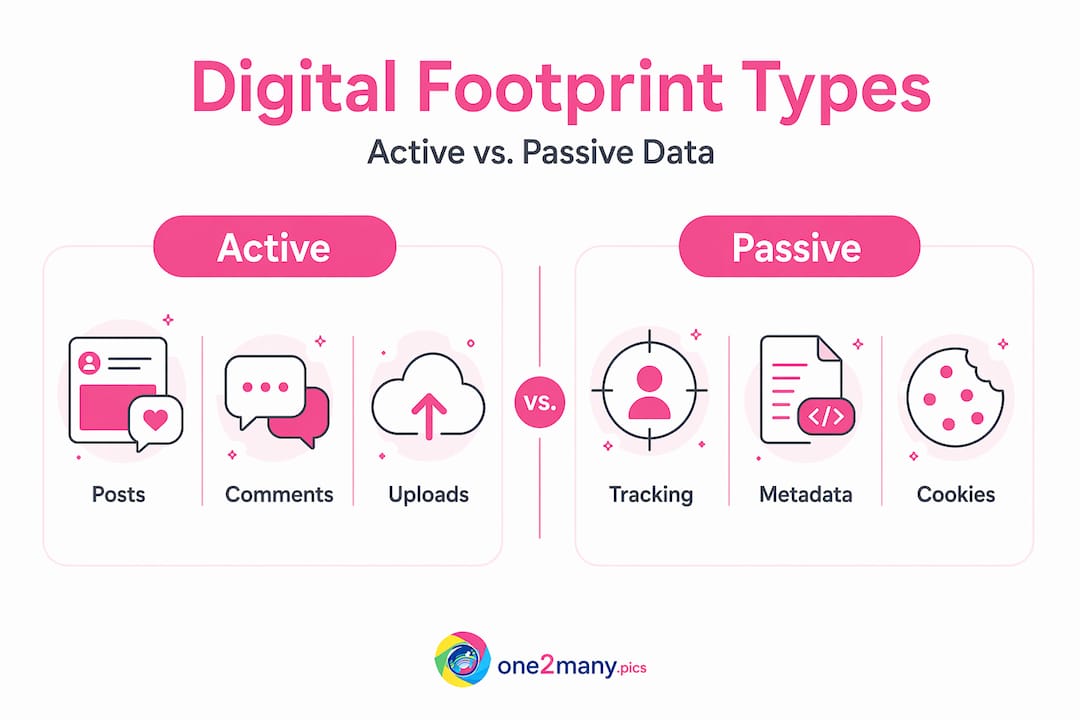
Here is a quick comparison of both types:
| Category | How it's created | Common examples |
|---|---|---|
| Active footprint | Deliberate user action | Posts, emails, account sign-ups, reviews |
| Passive footprint | Automatic system collection | Cookies, IP address, location data, metadata |
The two types combine to create something more significant than either alone. A data broker, advertiser, or employer looking at your profile does not just see your posts. They see a comprehensive digital profile built from your social media activity, search history, emails, app usage, location data, purchase history, and even metadata attached to photos you have shared. That is the real scope of what a digital footprint includes.
How your digital footprint grows every day
You do not have to do anything unusual for your digital footprint to expand. Routine online behavior is enough.
Here are the most common ways it happens without you thinking about it:
- Browsing history: Every website you visit logs your IP address and session data. Advertising networks connect these visits across sites to build a behavioral profile of your interests.
- Social media activity: Likes, shares, tags, and follows create a detailed map of your relationships, opinions, and habits. Even accounts set to "private" generate metadata.
- Mobile app data: Apps request permissions for your camera, microphone, contacts, and location. Many collect and share this data even when you are not actively using them.
- Email and purchases: Retailers and email service providers track open rates, click behavior, and transaction history. Purchase data is especially valuable and widely sold.
- Invisible tracking tech: Cookies, pixel trackers, and device fingerprinting work silently. Most home networks lack the tools to monitor this third-party tracking, which means most users have no practical way to see it happening in real time.
Photos deserve a special mention here. When you take a photo on your smartphone, the image file contains embedded metadata called EXIF data. This includes the exact GPS coordinates where the photo was taken, the device model, and the timestamp. When you upload that photo to a platform, that metadata often travels with it, adding another layer to your passive footprint.
Pro Tip: Before uploading any image to a public platform, strip the metadata from the file. Free tools exist to do this, and it removes location data that you almost certainly did not intend to share.
The real impact of your digital footprint
Understanding the impact of your digital footprint is where things get serious. This is not a theoretical concern. The consequences are concrete and can affect your life in ways that take years to surface.

Privacy and data exposure
Data aggregation is the process of combining individually harmless data points into a detailed personal profile. Your name is public. Your employer is on LinkedIn. Your neighborhood is visible from your tagged photos. Your political views are implied by what you like and share. Individually, these feel like minor disclosures. Combined, they give advertisers, insurers, or bad actors a detailed picture of who you are.
The regulatory environment around this is shifting. The FTC has escalated enforcement on data brokers selling sensitive data to foreign adversaries, with penalties reaching up to $53,088 per violation as of early 2026. That enforcement pressure matters, but it does not undo data that has already been collected and shared.
Employment and education consequences
Content posted online may resurface years later during background checks, job screenings, or college admissions reviews. Recruiters and admissions officers routinely search applicants online. A photo from five years ago, a comment taken out of context, or a defunct blog post can influence a decision made today. The timeline between posting something and facing consequences for it can be years long.
"Your digital footprint is permanent in ways that most people have not fully accepted. Even content you have deleted may exist in cached versions, screenshots, or third-party archives you never had access to."
The persistence problem
Closing an account is not the same as erasing your data. Data brokers keep archived data even after the original account is closed, often linked to persistent device IDs or behavioral profiles that continue to exist in their systems. You can delete your profile. You cannot delete the profile that someone else built about you.
How to manage your digital footprint effectively
The goal is not to disappear. The goal is control. High-profile individuals, including people with the most to lose from data exposure, do not try to avoid technology. They practice selective visibility and layered security to manage what is known about them and by whom.
Here is a practical framework for doing the same:
- Audit your accounts. Search your name across major search engines and see what comes up. Identify old accounts you no longer use and submit deletion requests where available. Be aware that deletion may not be complete.
- Tighten privacy settings. Review the privacy settings on every active social media account. Limit audience reach for older posts. Disable location sharing in apps that do not need it.
- Manage app permissions. Go through your phone's app permission settings and revoke access to location, microphone, and contacts for apps that have no clear reason to need them.
- Strip metadata from images. Before sharing photos, remove embedded EXIF data. This is especially relevant for content creators who post across multiple platforms. Resources like One2many's guide to visual content privacy explain exactly how this works in practice.
- Use privacy tools beyond a VPN. VPNs mask your IP address, but they do not stop cookie tracking, device fingerprinting, or metadata collection. Managing digital footprints requires a broader set of tools including browser extensions that block trackers, encrypted email, and regular data broker opt-out requests.
- Monitor your footprint over time. Set up Google Alerts for your name. Check if your email has appeared in known data breaches using publicly available breach checkers. Passive tracking is invisible by design, so you need active monitoring to counteract it.
Pro Tip: Data broker opt-out requests are tedious but worth the time. Services like DeleteMe or simple manual requests to the major brokers can significantly reduce how much personal data is publicly available about you.
The future of digital footprints
The data trail you leave online is not getting smaller. The tools used to collect it are getting more precise, and the systems analyzing it are becoming more capable.
A few trends worth paying attention to:
- AI-powered profiling is now capable of inferring personality traits, health status, and financial vulnerability from behavioral data collected passively. The gap between what you share and what is known about you is growing.
- Platform algorithms shape not just what you see but what becomes visible about you. Understanding how platform algorithms work helps you understand why certain content gets suppressed and why your data trail influences your visibility.
- Regulatory expansion is accelerating in the US and globally. Data protection laws are broadening, but enforcement lag means your data may be exposed long before any legal remedy catches up.
- IoT devices including smart speakers, connected appliances, and wearables are adding entirely new passive data streams to your footprint that most people have not started thinking about.
The practical takeaway is this: proactive management today is significantly easier than reactive damage control later.
My perspective on digital footprints
I have spent a lot of time working in the space where content, privacy, and online identity intersect. What I have found is that most people know their digital footprint exists but treat it as an abstract concern rather than an immediate one. That is a mistake.
The biggest misconception I see is that deletion equals erasure. It does not. What truly matters is not whether data exists but who has access to it and in what context. That shift in thinking is where real privacy management starts.
What actually works is selective visibility, meaning you choose deliberately what to put out and in what form. For content creators specifically, this means understanding that every image, post, and interaction contributes to a trail that can affect your reach, your reputation, and your revenue. I have seen creators unknowingly suppress their own content by triggering duplicate detection flags because they did not strip metadata before reposting. They were building a footprint that worked against them.
The uncomfortable truth about digital permanence is that data brokers operate outside the systems you can easily influence. Your best leverage is on the front end: control what enters the system in the first place. That is a habit, not a one-time fix.
— one2many.pics
Take control with One2many
If this article has made you more aware of how your digital footprint grows, the next step is making sure the content you share is not working against you.

One2many was built specifically for creators and social media professionals who need to manage their digital presence with precision. The platform removes metadata from images including location, device info, and timestamps before you post, and generates unique visual variations to prevent duplicate detection across platforms. Whether you manage one account or twenty, every image you upload carries data you probably did not intend to share. One2many's tools let you secure your digital footprint before your content goes live, not after. Explore the full range of privacy tools at one2many.pics and see how much cleaner your content strategy can be when your metadata is not broadcasting your location and device to every platform you post on.
FAQ
What is a digital footprint in simple terms?
A digital footprint is the collection of data that exists about you online, created through everything you do on the internet. It includes content you share deliberately and data collected automatically in the background.
Does deleting my accounts remove my digital footprint?
No. Closing an account rarely erases your data completely. Data brokers and third-party archives often retain behavioral profiles and device-linked data even after an account is deleted.
What are the main types of digital footprints?
There are two types: active footprints, which are data you intentionally share such as posts and emails, and passive footprints, which are data collected automatically such as IP addresses, cookies, and image metadata.
Why is a digital footprint important for my career?
Recruiters and admissions officers routinely search applicants online. Content posted years ago can surface during background checks and influence hiring or admissions decisions long after you have forgotten it exists.
How can I reduce my digital footprint?
Audit your accounts, tighten privacy settings, revoke unnecessary app permissions, strip metadata from images before posting, and submit opt-out requests to data brokers. No single step is sufficient. A layered approach is the only one that actually works.