

Every creator has experienced the same frustration: you post what feels like your best content, and it barely moves. Then a rushed photo from last Tuesday hits 10,000 views with zero explanation. That disconnect isn't random, and it isn't luck. Social media algorithms follow layered logic, and once you understand the signals they actually respond to, you can stop guessing and start building a visibility strategy that holds up even as platforms keep changing the rules.
Table of Contents
- How top social platform algorithms actually work
- Personalization, feedback loops, and negative signals
- Why privacy and interaction history matter more than you think
- Originality, penalties, and platform diversity checks
- Why understanding algorithms isn't enough: What really drives sustainable reach
- Take control: Privacy-first content that protects your reach
- Frequently asked questions
Key Takeaways
| Point | Details |
|---|---|
| Algorithms reward originality | Consistent, original content is more likely to avoid penalties and win reach. |
| Engagement matters most | Early likes, shares, and comments dramatically increase your chances of wide distribution. |
| Interaction history shapes feed | Managing your platform history can refine recommendations and boost your own and your audience's visibility. |
| Diversity checks prevent spam | Algorithms sideline repetitive or duplicate posts—variety is crucial for ongoing growth. |
| No shortcuts to sustainable reach | Lasting success comes from evolving strategies, privacy awareness, and creative experimentation. |
How top social platform algorithms actually work
Algorithms on major platforms aren't just preference engines. They're multi-step prediction systems designed to maximize the amount of time users spend on the platform. Understanding the individual steps helps you position your content at each stage instead of hoping it gets picked up somewhere in the pipeline.
TikTok is one of the most transparent platforms about how it works. The TikTok recommendation system uses a layered process: it selects candidate videos, predicts how a specific user will interact with each one (likes, comments, shares, and crucially, skips), ranks those predictions into a score, applies diversity checks to prevent too much of the same content, then runs content through regional and safety filters. Each step is a gate. If your content doesn't pass the prediction stage, it never reaches the ranking stage.
YouTube runs a similar but satisfaction-focused system. YouTube recommendations personalize what each viewer sees by drawing on their watch history, search history, likes and dislikes, subscriptions, and direct satisfaction surveys. The system optimizes for both viewer satisfaction and total session time. That means a video that keeps people watching consecutive videos after yours gets an indirect boost because it contributes to the session. One video isn't evaluated in isolation.
Facebook has been especially vocal lately about rewarding originality. The Facebook algorithm follows four steps: inventory (all content available), signals (engagement data), predictions (how a specific user will respond), and scoring (final ranking). Meaningful interactions like comments, shares, and saves outweigh passive likes. Original content in Feed and Reels gets boosted, while unoriginal or spammy posts get actively deprioritized. This isn't just a nudge. It's a structural reward system.
Here's a quick comparison of how the major platforms differ in their core ranking logic:
| Platform | Primary optimization goal | Key positive signals | Key negative signals |
|---|---|---|---|
| TikTok | Predicted interactions per user | Likes, shares, comments, replays | Skips, "not interested" |
| YouTube | Viewer satisfaction and session time | Watch time, likes, subscriptions | Dislikes, "not interested", low retention |
| Meaningful interactions + originality | Comments, shares, saves, original content | Unoriginal reposts, spam patterns |
What these platforms share is that they respond to privacy and reach signals embedded in how content is created and received. Metadata, posting patterns, and account history all feed into the system.
"A post isn't just content. It's a data packet that the algorithm reads before a single human does."
Personalization, feedback loops, and negative signals
Understanding the structure is only the beginning. The way your audience interacts with your content determines what happens next. This is where a lot of creators lose ground without realizing it.
Every major platform tests content in phases. A small initial audience receives the post first. If that group engages positively, the algorithm pushes the content to a wider pool. If engagement is weak or users actively skip or mute it, distribution slows or stops. This isn't a bug. It's by design, and knowing it changes how you think about the first 30 to 60 minutes after posting.
YouTube's personalization relies on granular behavioral data from watch history, search history, likes and dislikes, and real-time feedback like "not interested" clicks. These inputs constantly recalibrate what the algorithm shows each user. The same logic applies to your viewers: if they regularly skip your content or watch less than 30% of your videos, the algorithm learns that pattern and shows them your content less often.
Negative signals are what most creators underestimate. When a viewer hits "not interested" or skips within the first few seconds, that's a strong negative data point. Creator analyses consistently highlight that these early interaction failures create feedback loops that are hard to reverse. A post that stumbles in the test phase doesn't just fail once. It conditions the algorithm to be skeptical of similar content from your account going forward.
Here's a practical breakdown of feedback loop stages:
- Initial test phase: A small segment of followers or likely-interested users receives the content first.
- Signal collection: The algorithm tracks clicks, watch time, skips, and direct feedback within the first hour.
- Expansion or throttle decision: Strong early signals push content to a broader audience. Weak or negative signals slow or stop distribution.
- Account-level learning: Over time, patterns from your account affect how aggressively the algorithm promotes future posts.
- Audience-level learning: The system updates each viewer's profile based on their interaction with your content, affecting future impressions.
Pro Tip: Ask a direct question in your caption or the first line of your video. Prompting a response early increases comment velocity, which is one of the strongest positive signals you can generate in that critical first-hour window.
For creators who want to build on this understanding, privacy-focused engagement tips and visual content engagement strategies offer tactical guidance on making every post work harder without exposing your digital footprint.
Why privacy and interaction history matter more than you think
Personalization and feedback are powerful, but there's another factor often overlooked: your interaction history and privacy settings. Most creators think of privacy as something that protects their personal data. In the context of algorithms, it also directly shapes reach.
Algorithms don't just track the content you post. They track everything you interact with on the platform. If an account spends significant time engaging with content outside its niche, the algorithm starts building a confused picture of what that account is about. This affects both the feed the account sees and how the algorithm categorizes the content it posts. A fitness creator who spends 40 minutes watching cooking content will start seeing more cooking recommendations, and their audience segmentation may shift accordingly.

Platforms recognize this problem. YouTube lets you clear watch history and use "not interested" signals to refine what you see, which in turn helps keep your algorithmic profile sharper. Meta platforms offer similar controls. The practical takeaway is that these tools exist for a reason, and smart creators use them deliberately rather than ignoring them.
Here's a breakdown of how different types of interaction history affect algorithmic behavior:
| Interaction type | Effect on your feed | Effect on your content's reach |
|---|---|---|
| Liking off-niche content | Dilutes feed relevance | Indirectly confuses audience signals |
| Watching unrelated content fully | Shifts recommendation profile | May affect how algorithm categorizes your account |
| Clearing watch history | Resets feed personalization | Helps re-establish niche clarity |
| "Not interested" feedback | Immediate feed correction | Signals what your audience doesn't want |
Key actions every creator should take regularly:
- Clear watch history on platforms where you do research outside your niche.
- Use "not interested" deliberately to sharpen what the algorithm shows your audience.
- Audit which accounts you follow, since following off-niche accounts shifts your profile.
- Separate your creator account from your personal browsing habits wherever possible.
Pro Tip: Treat your creator account like a professional instrument. The less noise you feed into it through irrelevant engagement, the cleaner the signal the algorithm builds about you, and the more accurately it distributes your content to the right audience.
For a more detailed look at managing your digital presence, the privacy guide for creators covers the full scope of platform-level privacy decisions. You can also explore image privacy strategies and learn how privacy-first platforms are giving creators new levels of control.
Originality, penalties, and platform diversity checks
Privacy and engagement are tightly linked to originality. Now it's time to get tactical about originality and penalty avoidance.
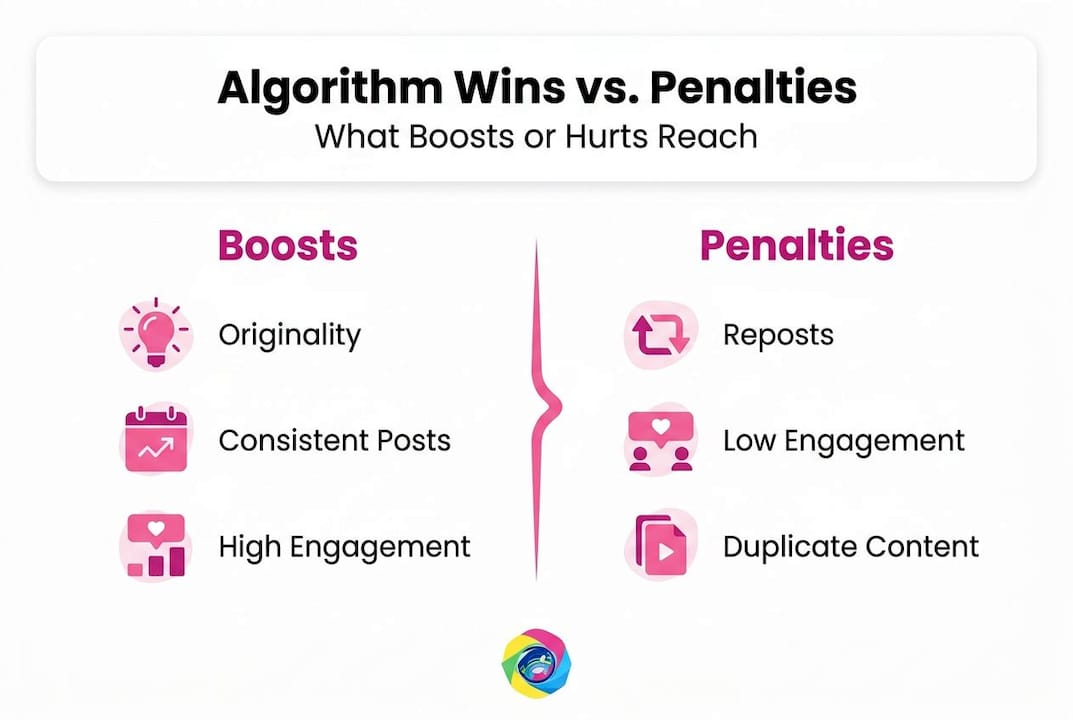
Platforms have become aggressive about detecting and penalizing repetitive content. This isn't limited to obvious copy-paste reposts. Instagram and TikTok apply diversity checks at the algorithmic level, flagging content that looks, sounds, or reads too similar to content already circulating on the platform, including your own previous posts. Unoriginal reposts on Facebook and Instagram face active deprioritization, not just flat performance but reduced distribution. Low engagement velocity in early testing can compound this problem, creating a penalty spiral.
The results for creators who get originality right are significant. Original Reels views on Facebook doubled in the second half of 2025 compared to the same period in 2024, and impersonation reports dropped by 33%. These numbers represent what's possible when the algorithm is actively working in your favor instead of against you.
Diversity checks serve a specific user experience function. Platforms don't want users to scroll through five similar videos in a row, even if they liked the first one. So algorithms deliberately introduce variation into feeds. If your content looks too similar to your last five posts, it may be deprioritized simply because the platform already served something like it recently.
Here's what to watch for and fix:
- Visual repetition: The same background, framing, or color palette across multiple posts signals low creativity to the algorithm.
- Caption patterns: Starting every post with the same phrase or structure can be flagged as templated content.
- Hashtag stacking: Using the identical hashtag block on every post is a known spam signal.
- Reposting without transformation: Sharing the same image or clip across accounts without meaningful modification increases duplicate detection risk.
Pro Tip: Even small visual changes can make a significant difference. Adjusting crop, color grade, lighting, or adding an original element to an image before reposting creates enough uniqueness to clear most similarity checks.
For creators managing multiple accounts or posting across platforms, understanding how to avoid penalties is essential. You should also understand how duplicate content detection works at a technical level, and build content variation strategies into your regular workflow. If you're managing cross-platform posting, treating each platform as a unique distribution channel with its own visual identity is the baseline.
Why understanding algorithms isn't enough: What really drives sustainable reach
Here's the part most algorithm explainers skip entirely: knowing how the system works does not automatically mean your content performs better. That gap between understanding and execution is where most creators actually struggle.
The creators who sustain strong reach over time are not the ones who found a hack and ran it into the ground. They're the ones who treat every post as a dual act: a creative decision and a data signal. Those two things need to work together, not compete.
Algorithm logic changes faster than most creators adapt. What worked six months ago on TikTok may now trigger a diversity check. Facebook's decision to double down on original Reels in 2025 was a significant shift that rewarded creators who had already been prioritizing originality. Those who were still riding reposts got hit hard. Rigid tactics built around a fixed understanding of the algorithm are a liability, not an asset.
The more durable approach is to build habits that align with what every platform fundamentally rewards: originality, consistent engagement, and content that serves a specific audience well. Privacy plays a bigger role in this than most people expect. Keeping your metadata clean, your account history focused, and your visual content varied are not just defensive moves. They're positive signals to the algorithm that you're operating at a professional level.
Content agility matters enormously here. A creator who can take one core piece of content and transform it into multiple unique variations for different platforms, different contexts, or different accounts is far better positioned than one who posts the same thing everywhere and hopes for the best.
The uncomfortable truth is that sustainable reach requires you to stay curious about how platforms are evolving, not just how they currently work. The creators who treat algorithm understanding as an ongoing practice rather than a one-time lesson are the ones still growing a year from now.
Take control: Privacy-first content that protects your reach
Ready to put these insights into practice? Understanding algorithm logic is valuable, but it only pays off when your content strategy backs it up with real execution. That means posting visual content that is genuinely original, metadata-clean, and varied enough to clear platform diversity checks at scale.
One2Many.pics gives you practical tools to generate untraceable social images from your existing content. The platform strips metadata like location, device info, and timestamps, and creates unique visual variations that help your posts look fresh across every account and platform you manage. For agencies and creators handling bulk content, this is the difference between spending hours manually adjusting images and running a streamlined, penalty-resistant workflow that scales. When your content is both algorithmically smart and privacy-first, you're not just protecting your reach. You're actively building it.
Frequently asked questions
How do social media algorithms decide what content goes viral?
Algorithms measure early engagement, originality, and diversity, so posts that quickly earn authentic likes, shares, and positive signals get wider distribution. Facebook prioritizes meaningful interactions and original content, while the TikTok system applies interaction predictions and diversity checks before content reaches a larger audience.
Can I reset my algorithm feed if I've watched or liked irrelevant content?
Yes, most platforms like YouTube and Facebook let you clear watch history or mark "not interested," which refines and resets recommendations. YouTube's privacy controls make this straightforward and have an immediate effect on what the algorithm shows you.
What counts as duplicate content and how do platforms detect it?
Platforms identify duplicate content using similarity checks and machine learning, flagging visually or textually repeated posts, and even subtle copies can trigger penalties. Instagram and Facebook's ranking systems actively deprioritize unoriginal reposts and apply diversity filters across the feed.
Do privacy settings really impact how my posts are recommended?
Yes, privacy settings and interaction history influence who sees your posts and what you see, so managing them can improve both reach and relevance. YouTube's feed controls show how platforms give users tools to shape the algorithm's understanding of their preferences.
Is there a way to "game" the algorithm long-term?
No long-term shortcuts exist since platforms reward consistent originality, strong engagement, and evolving content strategies over fixed tricks. Facebook's data on original creators makes it clear that the algorithm is built to reward authentic effort, not pattern exploitation.