
Creators and digital marketers are posting into a landscape that has fundamentally shifted. A viral image is no longer just an opportunity—it's a potential liability. Platforms now scan images for age verification, and non-compliance can trigger penalties or account restrictions you may never fully recover from. Whether you're managing one profile or fifty, the way you handle image privacy in 2026 will determine your reach, your reputation, and your revenue. This article covers what changed, what works, and exactly what steps to take.
Table of Contents
- Recognize new privacy threats: What changed in 2026
- Top actionable image privacy tips for creators in 2026
- Watermarking, labeling, and AI disclosure: What's required and what really works
- Layered defenses: Beyond the basics for creators facing targeted privacy risks
- Most privacy tips are outdated: What actually works for creators in 2026
- Take advance control: How one2many.pics helps you protect image privacy
- Frequently asked questions
Key Takeaways
| Point | Details |
|---|---|
| AI labeling is mandatory | Label AI-generated images to stay compliant and avoid penalties on major social platforms. |
| Layer your defenses | Combine practical image edits, privacy settings, and monitoring tools to guard against new threats. |
| Watermarking is not foolproof | Use watermarking and other methods together—AI attackers can often bypass basic protections. |
| Regularly audit your content | Delete outdated posts and review app permissions to greatly reduce your privacy risk. |
| Stay ahead of regulations | Keep up with platform policy changes and legal requirements to protect your content and brand reputation. |
Recognize new privacy threats: What changed in 2026
With the privacy landscape more complex than ever, let's break down what's actually changed for image sharing in 2026.
The biggest shift is the depth of platform surveillance. It's no longer about whether your caption is on-brand. Social media platforms now apply AI-driven analysis to the image itself, examining visual content at a pixel level. That means your location, the background of a photo, visible signage, and even synthetic generation artifacts are all being evaluated without you ever knowing it happened.
Three forces reshaping image privacy in 2026:
- Mandatory AI labeling laws. The EU AI Act and similar legislation in several U.S. states now require creators to disclose when images are AI-generated or significantly AI-edited. This isn't just a platform policy. It's the law in many regions.
- Deep image scanning by platforms. Meta, TikTok, and others perform automated content scans that go far beyond basic spam detection. They analyze faces, detect synthetic content, check for age compliance, and flag undisclosed edits.
- Financial and reach penalties for non-compliance. Meta rejected over 2 million ads in Q1 2026 for policy violations, with undisclosed AI content identified as a growing contributor to those rejections. That number should stop every marketer cold.
"The algorithm no longer just reads your hashtags. It reads your image. If your content doesn't match platform expectations at a visual level, you're already at a disadvantage before a single human reviews your account."
Your privacy guide for creators can serve as a solid starting reference point, but the key takeaway here is simple: you cannot afford to treat image privacy as an afterthought. And for marketers running paid campaigns, the stakes are even higher. A rejected ad doesn't just cost money. It can trigger a review of your entire account.
There's also the metadata problem. Every image file carries embedded information, including GPS coordinates, device identifiers, timestamps, and software signatures. Most creators never think about this layer of data. Platforms do. Third parties certainly do. That invisible layer is now part of your digital risk profile, and understanding it is the first step toward controlling it. For a detailed breakdown of what platforms can extract from your files, check out this compliance guide for creators.
Top actionable image privacy tips for creators in 2026
Now that you know what threats to watch, here are proven tactics to keep your visuals safe and compliant.
1. Strip metadata before every upload. Every image you take on a smartphone or DSLR contains EXIF data (Exchangeable Image File Format), which is an embedded record of technical and location details. Use a metadata removal tool before posting. This single step eliminates the most common source of accidental location disclosure.

2. Scan your images for real-world identifiers. Avoid posting images with location clues like license plates, house exteriors, and street signs. These visual cues are readable by AI at scale. Before uploading, review each image manually and blur or crop any identifiable elements.
3. Set up reverse image monitoring. Tools like TinEye and Pixsy let you track where your images appear across the web. Set up alerts so you know immediately if someone is reposting your work without permission. This is especially important for influencers and agencies whose brand identity is tied to original visuals.
4. Review your privacy settings on a schedule. Set social media accounts to private where possible, review app permissions at least once per year, use a VPN when logging in from unfamiliar networks, and delete old posts that no longer serve a purpose. Every old post is a data point that can be scraped, aggregated, and used to build a profile of your behavior.
5. Apply privacy-focused edits before sharing. Cropping, blurring sensitive backgrounds, and adjusting color profiles are not just aesthetic choices. They're privacy choices. The more visually generic an image appears to an automated scanner, the less it reveals about you, your location, and your habits.
6. Audit connected apps annually. Third-party apps with access to your social accounts can read, store, and sometimes modify your image data. Revoke access for any app you no longer actively use.
Pro Tip: Don't rely on a platform's "only friends can see this" setting as your primary defense. Those settings can change with every policy update. Your pre-upload habits are your real first line of protection.
For a structured approach to ongoing protection, essential protection strategies covers the tools and workflows that serious creators are using. The privacy best practices resource is also worth bookmarking for regular review.
"Privacy isn't something you set once and forget. It's a practice, not a setting."
Watermarking, labeling, and AI disclosure: What's required and what really works
Defensive edits and monitoring are key, but what about labeling and watermarking—do they actually work in practice?
The short answer is: they help, but they're not enough on their own. Let's break this down clearly.
What platforms require:
Meta requires "Made with AI" labels on synthetic or significantly AI-edited images. Non-compliance leads to ad rejection, reduced organic reach, or account restrictions. The EU AI Act goes further, imposing fines for undisclosed synthetic imagery in commercial contexts. For creators running monetized content or paid campaigns, this is a hard compliance requirement, not a soft guideline.
How watermarking actually performs:
| Method | Deters casual theft | Survives AI processing | Legally defensible | Invisible to viewer |
|---|---|---|---|---|
| Visible watermark | Yes | Partial | Yes | No |
| Invisible (steganographic) | No | Partial | Conditional | Yes |
| C2PA provenance credentials | No | Yes | Yes | Yes |
| AI-style protection (e.g., Glaze) | No | Minimal | No | Yes |
The table tells an uncomfortable story. AI protections like Glaze can be bypassed by off-the-shelf models, and watermarks embedded with steganography (hidden digital signatures) fare only marginally better against targeted attacks. Visible watermarks remain the most effective deterrent against casual misuse, but they don't protect your content from sophisticated actors.
What actually works in 2026:
- Combine visible watermarks with C2PA provenance credentials (an open standard for content authenticity that embeds verifiable creation data into the file).
- Always use platform-required AI disclosures, even if you believe your edit is minor. Platforms are increasingly aggressive about enforcement.
- Treat watermarking as a legal paper trail, not a technical barrier.
Pro Tip: Use C2PA-compatible tools to embed provenance data at the point of creation. If your image is ever disputed or misused, this credential acts as timestamped proof of original authorship.
For a deeper look at how image modification intersects with your platform reach, explore privacy and reach in marketing. If you need to walk through the actual process step by step, how to anonymize images is a practical walkthrough worth reviewing.
Layered defenses: Beyond the basics for creators facing targeted privacy risks
Once the basics are in place, high-exposure creators need specialized tactics to prevent sophisticated attacks.
High-follower creators and marketing agencies are increasingly being targeted not just by content thieves but by AI-driven impersonation and deepfake attacks. A single high-quality image posted to a public account can be used to generate convincing synthetic likenesses. This is no longer a theoretical risk. It's a documented, growing threat.
Why layered security is the new standard:
AI "undressing" attacks and deepfakes require layered defenses that include DMARC email authentication (to prevent impersonation), provenance embedding, and behavioral hygiene. No single tool provides adequate protection. The approach must be multi-layered.
A layered defense framework for creators:
- Provenance embedding at creation. Embed C2PA credentials at the moment of capture or edit, not after.
- Metadata scrubbing before upload. Remove all EXIF and XMP data from every file before it leaves your device.
- DMARC configuration for your domain. If you have a website or business email, DMARC records prevent bad actors from spoofing your identity in emails that impersonate your brand.
- Account access hardening. Enable two-factor authentication, use unique passwords per platform, and regularly audit active login sessions.
- Selective posting policies. Consider never posting full-face, high-resolution images to public accounts. Use slightly lower resolution or cropped compositions for public-facing content.
- Legal entity protection. Register a business entity to separate your personal legal identity from your creator identity. This shields your real name and address from public business records.
Comparison of layered defense tools:
| Tool or method | Threat it addresses | Difficulty | Cost |
|---|---|---|---|
| C2PA provenance | Content authenticity | Low | Free to low |
| DMARC configuration | Email impersonation | Medium | Free |
| Metadata stripping | Location and device exposure | Low | Free to low |
| Reverse image monitoring | Unauthorized redistribution | Low | Subscription |
| Business entity formation | Identity and legal exposure | High | Moderate to high |
Understanding which threats you're actually facing is the first step to choosing the right tools. Protecting your social media fingerprints matters more than most creators realize, and learning how to create unique images for social media is a practical next step for anyone scaling their content output.
Most privacy tips are outdated: What actually works for creators in 2026
After exploring tips and solutions, let's step back and reframe what really makes a difference for creators in 2026.
Here's the uncomfortable truth most articles won't say directly: the majority of image privacy advice circulating online was written for a threat environment that no longer exists. "Add a watermark" and "check your privacy settings" were reasonable guidance in 2019. In 2026, they're table stakes at best and false security at worst.
The real problem is a compliance-versus-security gap. Creators are being asked to comply with labeling requirements, platform policies, and regional regulations. But compliance doesn't equal safety. Meta emphasizes opt-in privacy and age assurance tools while critics argue that the scanning itself is invasive. Both things can be true simultaneously. Complying with a platform's scanning requirements to protect teens may expose your own biometric data to the platform's AI systems in the process.
What does this mean practically? It means you have to make intentional choices about which risks you're managing. You can't eliminate all of them. But you can prioritize.
Where to focus your energy in 2026:
The creators who are genuinely ahead of the curve are not obsessing over watermarks. They're building privacy into their workflow at the earliest possible point. They're treating every image as a potential data exposure event before it's a creative asset. That mindset shift matters far more than any single tool.
Protecting your creative work on social platforms requires consistent, adaptive behavior. The goal isn't perfect security. It's making your content harder to exploit than the next creator's. That's a realistic, achievable standard that keeps your exposure manageable without paralyzing your output.
Take advance control: How one2many.pics helps you protect image privacy
For those who want to implement best-in-class privacy without guesswork, here's how our platform can help.
Managing image privacy manually across multiple accounts is slow, error-prone, and increasingly difficult to scale. That's exactly the problem One2Many.pics was built to solve.
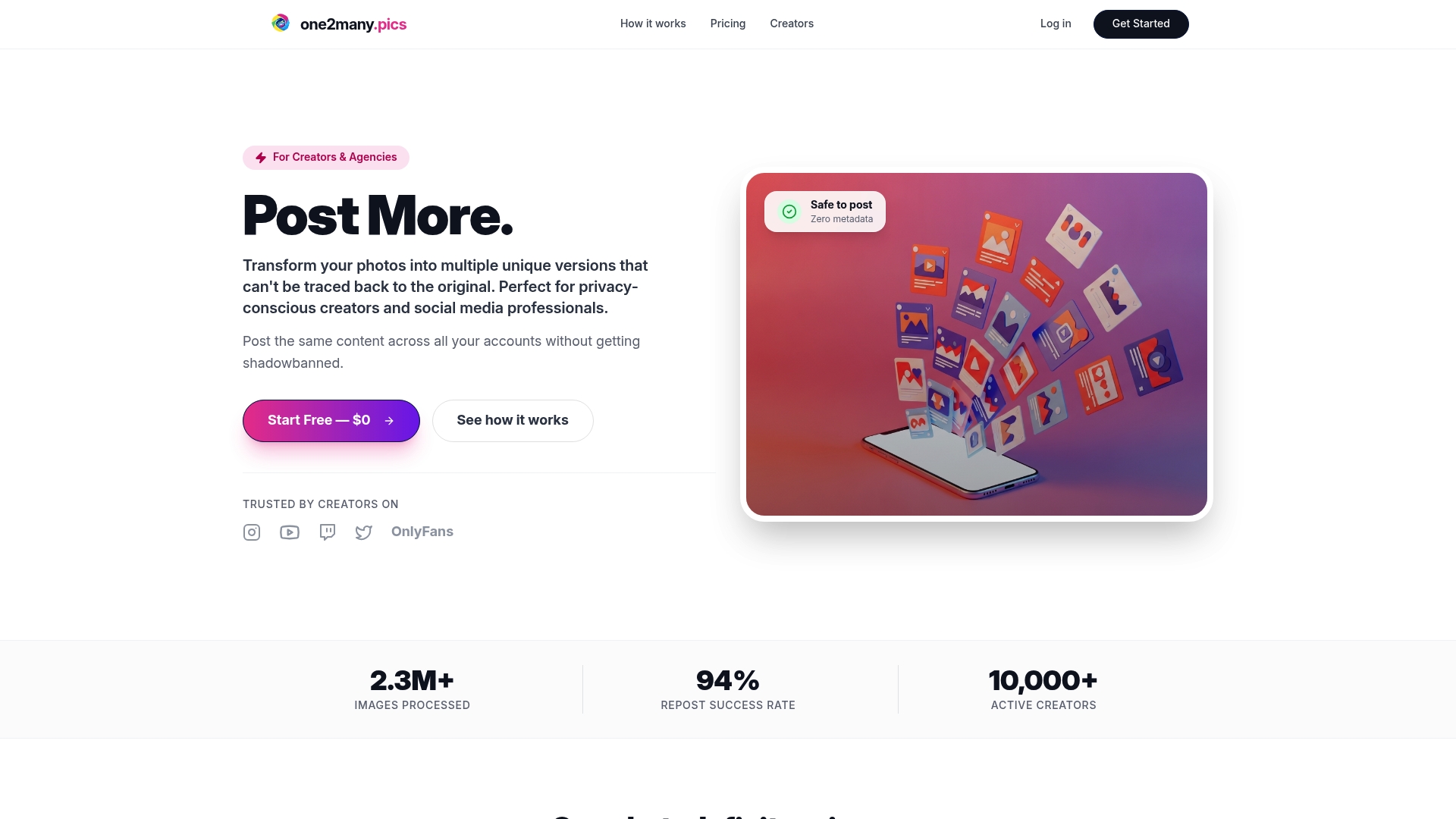
One2Many.pics automatically strips metadata from your images, generates unique visual variations to prevent duplicate detection, and gives you clean, privacy-ready files for every post, every platform, every time. Whether you're a solo creator protecting your location data or an agency running campaigns across dozens of accounts, the platform scales with your needs. You can create untraceable social media images in minutes, with no technical knowledge required. If you work with other creators or want to earn while protecting your community, the affiliate privacy program is worth exploring. Privacy-first content isn't just safer. It performs better.
Frequently asked questions
Do I have to label every AI-generated image on social media in 2026?
Yes, many platforms and regulatory bodies now require clear labeling of AI-generated or synthetic images. Meta requires "Made with AI" labels and the EU AI Act imposes fines for undisclosed synthetic images in commercial contexts.
How do I know if my images are being misused or copied online?
Use reverse image search tools like TinEye or Pixsy to monitor your visuals across the web. Monitor with reverse image search tools and set up alerts for new instances of your content appearing on unfamiliar sites.
Does watermarking still work to protect my images from AI theft?
Watermarking helps deter casual copying but is not a complete solution against AI-driven misuse. AI protections like Glaze can be bypassed by off-the-shelf models, so combining watermarks with provenance embedding and metadata removal is a stronger approach.
What's the fastest way to reduce my social media data footprint?
Delete old posts to reduce your data footprint and set your social accounts to private. Review connected app permissions regularly to cut off third-party access you no longer need.
Is platform image scanning truly privacy-safe for creators?
It depends on the platform and the purpose of the scanning. Meta emphasizes opt-in privacy while critics view automated scanning as invasive. Minimizing personal data visible in your images remains the most reliable way to limit your exposure regardless of platform intent.