

Content duplication is defined as the presence of identical or substantially similar content across multiple URLs, and it directly harms search visibility by diluting ranking signals and wasting crawl budget. This is not a fringe problem. 25–30% of web content exists as duplicate versions, and search engines handle this by grouping pages into canonical clusters rather than issuing formal penalties. The real cost is invisible: your best content competes against itself, backlink equity splits across URLs, and Google's crawlers spend time on pages that add no value. Understanding this content duplication overview gives you the foundation to act before the damage compounds.
What is a content duplication overview and why does it matter?
Content duplication is best understood as an information retrieval challenge, not a rule violation. Duplicate content spans lexical overlap (same words) and semantic overlap (same meaning, different phrasing). Both types confuse search engines trying to determine which page deserves to rank.
Google does not apply a manual penalty for duplicate content. Google's canonical selection uses roughly 40 signals, including redirects, internal linking, HTTPS status, and sitemap inclusion, to pick one URL as the preferred version. Every other duplicate gets suppressed or ignored. That suppression is the real penalty.
The practical consequence is ranking dilution. When two pages compete for the same query, neither ranks as well as one consolidated page would. Content creators and digital marketers who publish across multiple platforms face this risk constantly, especially when repurposing content without variation.

How do search engines detect and handle duplicate content?
Search engines use content fingerprinting to identify duplicates at scale. The dominant technique is SimHash, a method that converts page text into a 64-bit fingerprint. Pages differing by only 3 bits out of 64 in their SimHash fingerprint are flagged as near-duplicates. That is a sensitivity level most content creators underestimate.
Detection focuses on body text, not raw HTML. Boilerplate elements like navigation menus, headers, and footers are stripped before comparison. This means two pages with identical article text but different templates still register as duplicates. The similarity threshold for flagging is typically 85–95% for exact duplicates and 60–90% for near-duplicates.
Once flagged, search engines cluster duplicate URLs into equivalence groups. Google then selects one canonical URL from the cluster to index and rank. The others receive little to no search visibility.
Key signals Google uses in canonical selection:
- 301 redirects: The strongest signal. A redirect tells Google which URL is authoritative.
- Internal linking patterns: Pages linked more frequently from within the site are favored.
- HTTPS vs. HTTP: Secure URLs are preferred when content is otherwise identical.
- Sitemap inclusion: Pages listed in the XML sitemap signal intent to index.
- Historical indexing data: Pages indexed longer tend to retain canonical status.
Pro Tip: Treat rel=canonical as a strong hint, not a command. Google may override your canonical tag if other signals point elsewhere. Audit your internal linking to reinforce the canonical you intend.
What are the SEO and operational impacts of duplicate content?
Ranking signal dilution is the most direct SEO consequence of duplicate content. When backlinks point to multiple versions of the same page, link equity fragments across those URLs instead of concentrating on one. Crawl budget waste compounds this problem. Google's crawl budget is finite, and spending it on duplicate variants means fresh, high-value pages get crawled less frequently.
Large sites face the worst of this. Session IDs appended to URLs, UTM tracking parameters, and filtered product views all generate duplicate variants automatically. A single e-commerce category page can spawn dozens of near-identical URLs without any deliberate duplication by the content team.
"AI content generation increases duplication risk by producing high volumes of similar pages at speed. Without governance anchored on 'one page per intent' editorial policies, AI-assisted teams can inadvertently create content cannibalization at a scale that manual review cannot catch." — Avoiding Duplicate Content With AI
Platform suppression adds another layer of risk for social media creators. When platforms detect visually or textually identical posts across accounts, they reduce distribution. This mirrors how search engines handle web duplication: the original or preferred version gets visibility, and the rest get buried. Creators who cross-post identical content without variation face suppression across feeds, not just search results.
The operational impact extends to authority fragmentation. A site with 50 near-identical blog posts targeting the same keyword does not rank 50 times. It ranks weakly once, if at all, because authority never concentrates.
How can content duplication be identified and analyzed effectively?
A content duplication analysis starts with a site-wide crawl. Crawling tools index every URL and compare page text using similarity metrics. The goal is to surface clusters of pages with overlapping content so you can prioritize which to fix first.
Prioritization matters more than completeness. Fixing the top 10 duplicate clusters by search impressions delivers more SEO value than resolving hundreds of low-traffic duplicates. Start with pages that already attract clicks, then work down.
Detection methods and metrics
| Method | What it measures | Best for |
|---|---|---|
| SimHash fingerprinting | Bit-level text similarity | Large-scale exact and near-duplicate detection |
| Jaccard similarity with n-grams | Lexical overlap using word sequences | Editorial review at 75–80% threshold |
| Semantic similarity scoring | Meaning overlap, not just word match | Catching paraphrased or AI-generated duplicates |
| Manual content audit | Intent and topic overlap | Small sites or high-priority page clusters |
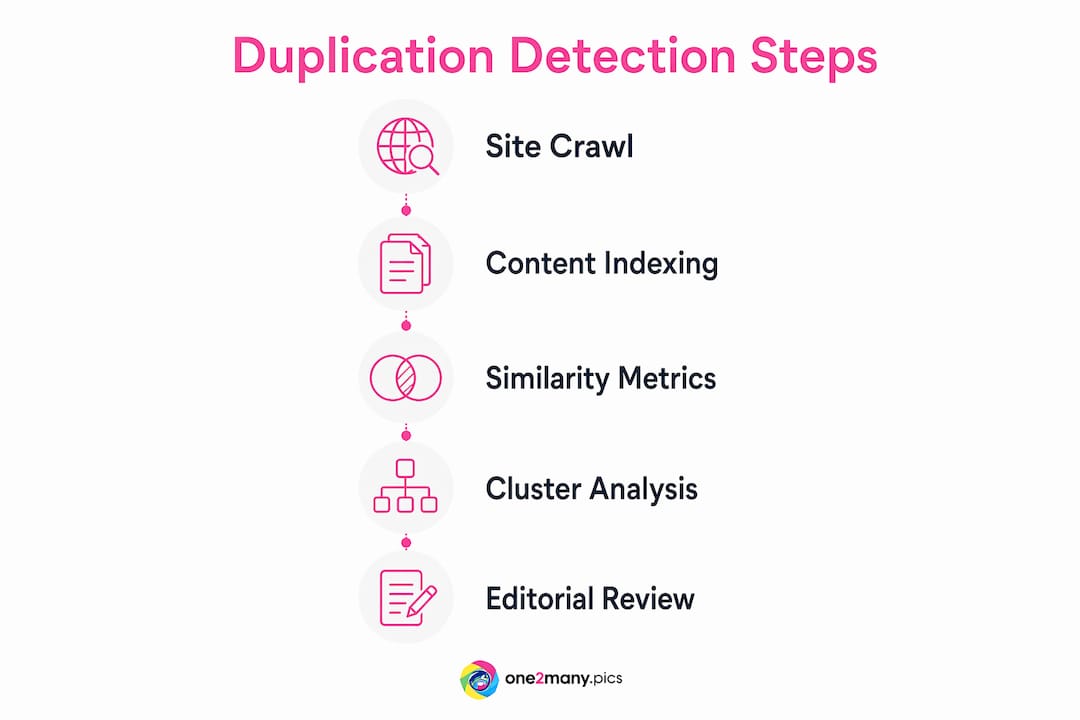
Automated pre-publish checks set at a 75% similarity threshold trigger editorial review before a page goes live. This prevents duplication from entering the index in the first place. Jaccard similarity calculated with 5-word n-grams is a reliable method for this type of check.
Beyond technical tools, editorial de-dupe maps are one of the most underused detection methods. A content registry tracks fulfilled search intents across your site, so writers can check whether a topic is already covered before creating a new page. This is governance, not just detection.
Additional approaches worth building into your workflow:
- Run similarity comparisons against your existing content library before publishing new pieces.
- Flag pages with identical title tags or meta descriptions as a fast proxy for duplication.
- Check for platform detection patterns that apply to both search engines and social platforms.
- Review syndicated content carefully. Content syndication creates legitimate duplicate URLs that require canonical management.
Pro Tip: Set your similarity threshold at 75–80% for editorial review, not 90%. Waiting until content is 90% identical means the damage to your crawl budget and rankings is already done.
What are the best practices to prevent and resolve content duplication?
Prevention is cheaper than remediation. The most effective duplicate content strategies combine technical controls with editorial governance, applied before content goes live.
-
Use 301 redirects for fully duplicate pages. When two URLs serve identical content, redirect the weaker one to the preferred URL permanently. This consolidates link equity and removes the duplicate from Google's index over time.
-
Apply rel=canonical tags for variant pages. Product pages with color or size filters, paginated series, and printer-friendly versions all need a canonical tag pointing to the primary URL. This tells Google which version to index without removing the variant from the site.
-
Use noindex meta tags for utility pages. Tag pages, archive pages, and search result pages within your own site rarely deserve indexing. A noindex tag keeps them out of search results without breaking site functionality.
-
Implement automated pre-publish similarity checks. Set a threshold of 75% similarity or higher to trigger a review before any page goes live. This is the single highest-leverage prevention tactic for teams publishing at volume.
-
Enforce a "one page per intent" editorial policy. Every piece of content should target a distinct search intent. If two planned pages answer the same question, merge them or differentiate them clearly before either goes live.
-
Treat canonicalization as code, not a manual task. Canonical and redirect management should run through middleware and centralized configuration files. Manual fixes break at scale. Automation keeps your SEO signals consistent as the site grows.
-
Build and maintain a content registry. An editorial de-dupe map tracks every fulfilled search intent across your site. Writers check it before creating new content. This prevents internal cannibalization before it starts.
Pro Tip: Build your QA process so that similarity checks run automatically on every draft submitted to your CMS. Catching duplication at the draft stage costs nothing. Fixing it after indexing costs rankings, crawl budget, and time.
For creators managing content across multiple platforms, repurposing content with genuine variation is the practical answer. Effective content repurposing means adapting format, angle, and depth, not just copying and pasting to a new URL.
Key Takeaways
Preventing content duplication requires both technical controls and editorial governance applied before content is published, not after it is indexed.
| Point | Details |
|---|---|
| Duplication dilutes rankings | Duplicate URLs split link equity and ranking signals, weakening all competing versions. |
| No formal penalty exists | Google suppresses non-canonical duplicates rather than issuing manual penalties. |
| Detection uses fingerprinting | SimHash and Jaccard similarity identify near-duplicates at 75–95% overlap thresholds. |
| Prevention beats remediation | Pre-publish similarity checks at 75% stop duplication before it enters the index. |
| Governance scales prevention | Content registries and "one page per intent" policies prevent internal cannibalization at volume. |
What I've learned managing duplication in real content workflows
Most teams treat duplicate content as a technical problem to fix after the fact. That framing is wrong, and it costs them every time.
The teams that manage duplication well treat it as a governance problem. They define search intent before writing begins, not after a crawl reveals cannibalization. They build content registries that writers actually use. They automate canonical tags so no one has to remember to add them manually.
The rise of AI content generation has made this more urgent. When a team can produce 50 articles in a day, the risk of near-identical pages multiplies faster than any manual review process can handle. The answer is not to slow down production. The answer is to build the governance layer first, then scale.
One pattern I see consistently: marketers focus on fixing existing duplicates and ignore the pipeline creating new ones. A 301 redirect audit is useful. A pre-publish similarity check that runs on every draft is transformative.
The future of duplication handling in search will likely move toward semantic detection, catching paraphrased content that shares intent but not exact wording. Teams that build editorial discipline now will be ahead of that shift. Teams that rely on technical fixes alone will keep playing catch-up.
— one2many.pics
How One2many helps creators stay ahead of duplication issues
Content creators and social media managers face a version of the duplication problem that goes beyond SEO. Posting visually identical images across accounts or platforms triggers platform detection systems that suppress reach and flag accounts.

One2many addresses this directly. The platform transforms original images into unique visual variants by removing metadata, including location data, device information, and timestamps, and generating distinct image versions through image spoofing. Each version looks original to platform detection algorithms. Creators can manage visual content across multiple accounts without triggering duplicate detection or risking suppression. For agencies and marketing teams publishing at volume, One2many's bulk processing and workflow integrations make this practical at scale.
FAQ
What is content duplication in SEO?
Content duplication is the presence of identical or substantially similar content across multiple URLs. Search engines group these into canonical clusters and index only the preferred version, which reduces visibility for the others.
Does duplicate content cause a Google penalty?
Google does not issue manual penalties for duplicate content. The impact comes from canonical suppression, where Google selects one URL to rank and reduces visibility for all others in the cluster.
How do I identify content duplication on my site?
Run a site-wide crawl and compare page text using similarity metrics like SimHash or Jaccard similarity. Prioritize clusters with the highest search impressions for remediation first.
What similarity threshold triggers a duplication flag?
Search engines flag pages at 85–95% similarity as exact duplicates and 60–90% as near-duplicates. For editorial pre-publish checks, a 75% threshold is the recommended trigger for review.
How does rel=canonical prevent duplication issues?
A rel=canonical tag signals to Google which URL is the preferred version among similar variants. Google treats it as a strong hint and consolidates ranking signals to the canonical URL, though it may override the tag if other signals conflict.