

Cross-posting risks are defined as the measurable losses in reach, engagement, and content security that occur when identical or poorly adapted material is shared across multiple social media platforms without customization. Platforms like TikTok, Instagram, X, and LinkedIn each run independent algorithms that actively detect and suppress repurposed content. Tools like Buffer and PostKit can help schedule posts, but scheduling alone does not solve the core problem. Watermarked reposts suffer a 40–80% reach reduction compared to native uploads. Understanding why avoid cross-posting risks is the first step toward protecting your audience, your metrics, and your brand.
Why do platforms penalize cross-posted content?
Platforms do not penalize cross-posted content because they secretly communicate with each other. The real mechanism is simpler and more damaging. Algorithms interpret disengagement as a quality signal. When users scroll past a TikTok-watermarked video on Instagram Reels, that scroll-away event tells Instagram's classifier the content is low quality. The platform then throttles distribution.
The numbers back this up. Repurposed content earns 25% fewer likes on Instagram and 15% fewer retweets on X compared to native posts. Those are not minor dips. They represent the difference between a post that builds momentum and one that quietly disappears.
Timing patterns compound the problem. Posting identical videos simultaneously across platforms can trigger spam detection systems, leading to shadowbans. Automated posting at identical timestamps signals bot behavior to platform classifiers. The fix is deliberate staggering.
"Platforms reward content that feels native. The moment your post looks like it was built for somewhere else, the algorithm treats it like a stranger."
Pro Tip: Stagger your cross-posts by 15–60 minutes between platforms and strip any visible watermarks before uploading. This alone can recover a significant portion of suppressed reach.
There is also an audio dimension most creators miss. TikTok-native audio reused on Instagram or YouTube Shorts often triggers automated muting due to licensing incompatibilities. The creator sees no error message. The audience simply hears silence, or the post gets restricted without explanation.
What are the engagement and SEO consequences of identical cross-posts?
Audience burnout is a real and underreported cross-posting pitfall. When a follower sees the exact same post on LinkedIn, Instagram, and X within the same hour, they do not feel informed. They feel spammed. That perception erodes trust faster than any algorithm penalty.
Each platform has its own native language. LinkedIn rewards long-form carousels and professional commentary. Instagram favors vertical video and short, punchy captions. X thrives on brevity and real-time opinion. Posting a LinkedIn carousel as a static image on Instagram is not cross-posting. It is content mismatch. Brands that treat platforms as identical content delivery addresses consistently underperform in both engagement and search visibility.
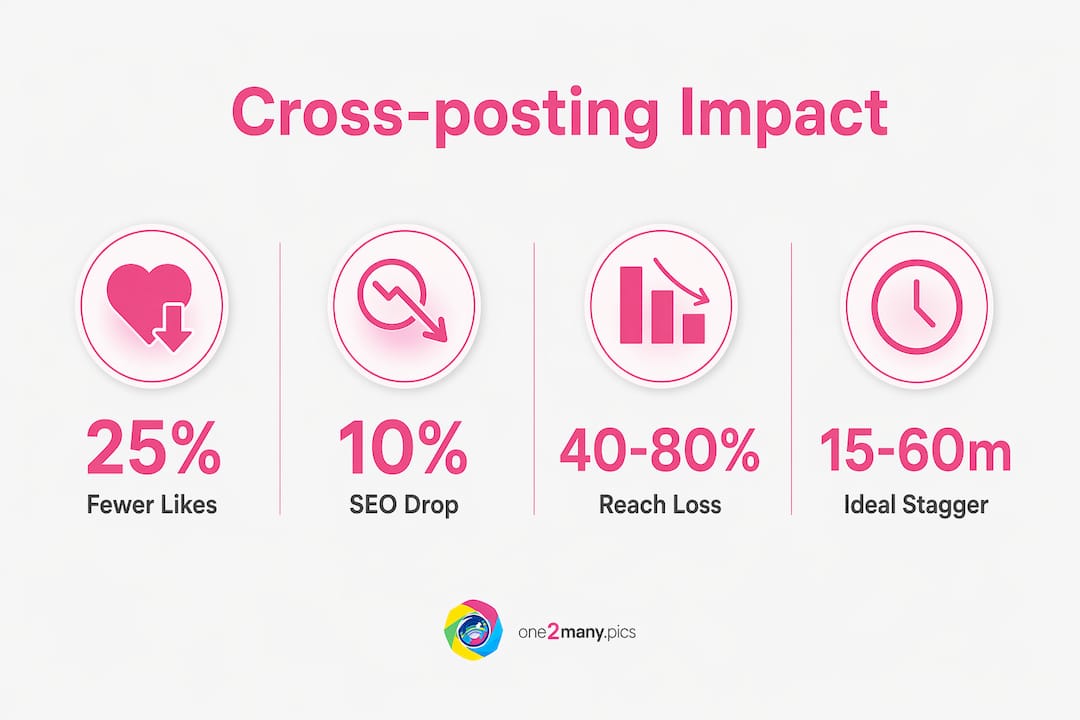
The SEO impact is often overlooked entirely. Repurposed content can cause up to 10% lower search visibility on Google compared to original posts. Search engines interpret thin, duplicated social content as low-value signals. Over time, that compounds into reduced discoverability across the web, not just within a single app.
The table below shows how native content consistently outperforms cross-posted content across key metrics.
| Metric | Native content | Cross-posted content |
|---|---|---|
| Instagram likes | Baseline | 25% fewer |
| X (Twitter) retweets | Baseline | 15% fewer |
| Google search visibility | Baseline | Up to 10% lower |
| Platform reach | Baseline | 40–80% lower (watermarked) |
| Audience trust | High | Reduced over time |
The data tells a consistent story. Native content wins on every measurable dimension. The efficiency gains from simple cross-posting do not offset these losses. For creators managing smart cross-platform posting at scale, the solution is adaptation, not automation alone.
What security and privacy risks come with cross-platform sharing workflows?
Most creators focus on algorithmic penalties and ignore the security layer entirely. That is a mistake. Cross-platform sharing workflows introduce real data exposure risks that can affect both your content and your collaborators.

Cloud-synced clipboard managers are a common vulnerability. Many clipboard sync services lack end-to-end encryption, meaning raw copied content, including API keys, login credentials, or draft captions, is accessible to the service provider and potentially to attackers. If you copy a sensitive caption or a private link and your clipboard syncs to the cloud, that data is no longer fully under your control.
File sharing settings create a separate exposure point. Internal files become publicly accessible when cloud links are set to "anyone with the link" instead of invite-only permissions. A social media manager sharing a content calendar with a client can accidentally expose an entire folder of unreleased campaign assets with one wrong permission setting. The fix is straightforward but requires discipline.
Secure sharing workflows should default to invite-only permissions with time-limited edit rights. Routine auditing of cloud share settings prevents stale links from becoming permanent exposure points. These are not advanced security practices. They are basic hygiene that most teams skip because they feel slow.
Pro Tip: After copying any sensitive content, overwrite your clipboard immediately by copying something neutral. This prevents accidental paste events from leaking private data into public posts or messages.
Security professionals caution that many popular cross-platform tools sacrifice privacy by storing sensitive data without end-to-end encryption. Before adding any new tool to your posting workflow, check its encryption policy. If the documentation does not mention end-to-end encryption explicitly, assume it does not have it.
How can creators adapt their strategy to avoid cross-posting pitfalls?
The core distinction every creator needs to internalize is this: content logistics is not content marketing. Scheduling the same post across five platforms at once is logistics. Adapting that post to each platform's format, culture, and audience expectation is marketing. The first approach is efficient. The second approach actually works.
Platform-native adaptation means more than changing the caption. It means rethinking the format, the aspect ratio, the audio, the hashtag strategy, and the call to action for each destination. A vertical video with trending audio works on TikTok. That same video, stripped of its audio and cropped to square, will underperform on LinkedIn. The content is technically the same. The experience is completely different.
Tools like PostKit and Buffer offer native content generation features that go beyond simple scheduling. They allow you to create platform-specific variations from a single source asset. That is a fundamentally different approach from pure cross-posting. It treats each platform as its own audience, not just another distribution channel. For a deeper look at posting securely across platforms, the adaptation layer and the security layer need to work together.
The table below compares common cross-posting strategies against their risk and benefit profiles.
| Strategy | Risk level | Engagement impact | Best use case |
|---|---|---|---|
| Identical post, same time | High | Significant loss | Never recommended |
| Identical post, staggered timing | Medium | Moderate loss | Low-priority content only |
| Adapted captions, same visual | Low-Medium | Minor loss | Time-sensitive campaigns |
| Platform-native content per channel | Low | Baseline or better | All primary content |
| Unique asset per platform | Minimal | Maximum | High-value launches |
Staggered scheduling remains the minimum viable practice for any cross-posting workflow. Removing watermarks before uploading is non-negotiable. Beyond those basics, the dangers of cross-platform posting are best addressed by treating each platform as a distinct creative brief, not a copy-paste destination.
Key takeaways
Cross-posting identical content without adaptation causes measurable reach loss, engagement decline, and security exposure across every major platform.
| Point | Details |
|---|---|
| Watermarks destroy reach | Watermarked reposts lose 40–80% of potential reach due to active platform suppression. |
| Engagement drops are measurable | Instagram and X penalize repurposed content with 25% and 15% fewer interactions respectively. |
| Timing triggers spam flags | Posting at identical timestamps across platforms signals bot behavior and risks shadowbans. |
| Security risks are real | Clipboard sync tools and insecure cloud links expose sensitive content data in cross-posting workflows. |
| Adaptation beats automation | Platform-native content consistently outperforms cross-posted content on reach, engagement, and SEO. |
The uncomfortable truth about cross-posting I've learned firsthand
Most creators who come to One2many have already paid the price of lazy cross-posting. They noticed their reach dropped, their engagement flatlined, and they could not figure out why. The content was good. The posting was consistent. The problem was invisible until the numbers made it undeniable.
What I have observed consistently is that the biggest cross-posting mistake is not the watermark or the timing. It is the assumption that audiences on different platforms are the same audience. They are not. A LinkedIn follower and a TikTok follower who both follow your brand have completely different expectations, attention spans, and content tolerances. Treating them identically is not efficient. It is disrespectful to both.
The security angle surprises people most. Creators think about algorithm penalties. They rarely think about what happens to their content files, captions, and credentials as they move through scheduling tools, clipboard managers, and cloud folders. That gap in awareness is where real exposure happens.
The balance I recommend is this: use automation for logistics, use judgment for adaptation, and use encryption for everything sensitive. Efficiency and quality are not opposites. They require different tools applied at different stages of the workflow.
— one2many.pics
Protect your content with One2many's privacy-first posting tools
Cross-posting pitfalls cost creators reach, engagement, and sometimes their account standing. One2many was built specifically to address these risks at the image level.
One2many removes embedded metadata including location data, device information, and timestamps from your images before you post. It also generates unique visual variations of each asset, so the same photo does not trigger duplicate detection across platforms or accounts. For social media managers running multiple accounts or agencies handling bulk content, One2many's privacy-focused posting workflow tools reduce platform penalties without sacrificing posting volume. Visit one2many.pics to see how the platform fits your workflow.
FAQ
What is cross-posting and why does it hurt reach?
Cross-posting is sharing identical content across multiple platforms without adapting it to each platform's format or audience. Platforms detect low engagement signals from mismatched content and reduce its distribution, causing reach losses of 40–80% for watermarked reposts.
Does staggering posts really prevent shadowbans?
Yes. Posting identical content at the exact same timestamp across platforms signals automated bot behavior to spam detection systems. Staggering posts by 15–60 minutes significantly reduces the risk of triggering a shadowban.
What security risks exist in cross-posting workflows?
Cloud-synced clipboard managers without end-to-end encryption can expose copied content to service providers or attackers. Insecure cloud link settings can also make internal files publicly accessible if permissions are set to "anyone with the link."
Is there an SEO penalty for cross-posting the same content?
Repurposed content can reduce Google search visibility by up to 10% compared to original posts. Search engines treat thin, duplicated social content as a low-quality signal, which compounds into reduced discoverability over time.
What is the safest cross-posting strategy for creators?
Creating platform-native content for each channel is the lowest-risk approach. When time constraints require reposting, remove watermarks, adapt captions and format, stagger timing, and use tools that strip metadata before upload.