

Content syndication is defined as the practice of republishing or distributing your content across third-party platforms, networks, or partners to extend its reach beyond your owned channels. The four primary types are organic, paid, partner, and intent-based syndication. Each operates on a different model, targets a different audience stage, and delivers a different return. Understanding which type fits your goals is the difference between content that compounds in value and content that disappears after one post. Platforms like NetLine, LinkedIn, Taboola, and Medium each represent a distinct syndication category, and knowing how to use them together is what separates a distribution strategy from a distribution system.
1. What are the types of content syndication?
Content syndication splits into four recognized categories, each with its own cost model, targeting logic, and content format. Organic syndication is free and manual. Paid syndication uses cost-per-lead pricing. Partner syndication relies on reciprocal agreements between brands. Intent-based syndication uses behavioral data to reach audiences actively researching your topic.
These are not interchangeable. A whitepaper gated behind a NetLine campaign serves a completely different purpose than a thought leadership article republished on Medium. Choosing the right type starts with knowing what you want: brand awareness, lead generation, audience trust, or sales pipeline acceleration. Most mature content programs use at least two types in combination.

2. Organic content syndication: free reach with real SEO stakes
Organic syndication is the republishing of your content on third-party platforms at no cost, using sites like Medium, LinkedIn Articles, Reddit communities, or industry forums. The appeal is obvious: zero budget, broader reach, and potential backlinks from high-authority domains. Over time, brand authority and backlinks from authoritative sites build SEO credibility that paid campaigns cannot replicate.
The SEO risk is real, though. Publishing duplicate content across multiple URLs can trigger Google penalties unless you handle it correctly. The fix is straightforward: always request that the syndicating platform add a canonical tag pointing back to your original URL. This tells search engines which version is the source of record and protects your rankings.
Organic syndication works best for long-form articles, opinion pieces, and how-to guides. These formats perform well on LinkedIn Articles and Medium because readers on those platforms expect depth. Short promotional content rarely gains traction organically.
Pro Tip: Reframe your content for each platform rather than copy-pasting. Change the opening hook, adjust the tone, and reference platform-specific context. A LinkedIn audience expects professional framing; a Medium audience rewards narrative. The same article, reframed, will outperform a direct copy every time.
3. How paid content syndication works and when to use it
Paid content syndication is a performance-based content distribution method where you pay a network to promote your content to a targeted audience, typically using a cost-per-lead pricing model. You set audience parameters, the network distributes your content, and you pay only when a qualified lead engages or converts. Networks like NetLine, TechTarget, Madison Logic, Taboola, and Outbrain dominate this space.
The content format matters here. Paid syndication is built for gated assets: whitepapers, ebooks, research reports, and webinars. These formats justify the lead capture form that sits between the reader and the content. Ungated blog posts rarely perform well in paid syndication because there is no conversion mechanism to justify the spend.
Targeting is where paid syndication earns its premium. You can filter by job title, company size, industry, geography, and technology stack. That precision is why syndicated content in B2B generates 31% higher engagement rates compared to non-syndicated content. The audience is pre-qualified before they ever see your asset.
Budget management is the most common failure point. New programs overspend on lead volume without building the nurture infrastructure to convert those leads. Leads from gated paid syndication are almost always at the awareness or consideration stage. They need a pre-built email sequence before they are sales-ready.
Pro Tip: Before launching a paid syndication campaign on NetLine or TechTarget, build your nurture sequence first. Map out at least four to six touchpoints covering education, proof, and offer. Leads that enter a cold CRM without follow-up are wasted spend.
Paid syndication networks at a glance
| Network | Best for | Pricing model | Content type |
|---|---|---|---|
| NetLine | B2B lead generation | CPL | Whitepapers, ebooks |
| TechTarget | Tech buyers | CPL | Research reports |
| Madison Logic | ABM campaigns | CPL + account targeting | Gated assets |
| Taboola | Content discovery | CPC | Articles, native ads |
| Outbrain | Brand awareness | CPC | Blog posts, articles |
4. What is partner content syndication and how can you leverage it?
Partner syndication is a content distribution method built on a direct relationship between two complementary brands. One brand publishes or promotes the other's content, either reciprocally or as a one-way arrangement. Guest posts, co-authored articles, joint webinars, and newsletter features are the most common formats. The Black X platform is one example of infrastructure designed to formalize these creator-brand content partnerships.
The core advantage is audience trust. When a brand you respect shares content from another source, you extend some of that trust to the new source. That borrowed credibility is something paid networks cannot manufacture. Partner syndication consistently delivers higher engagement quality because the audience is warm, not cold.
Finding the right partner requires discipline. You want brands that share your audience but do not compete for the same product or service. A SaaS company selling project management tools and a SaaS company selling time-tracking tools share an audience of operations managers without competing directly.
Key factors to evaluate when selecting a partner:
- Audience overlap: Do their readers match your ideal customer profile?
- Content quality: Does their existing content meet your standards?
- Engagement rate: Are their readers active, or is the audience inflated by bots?
- Distribution size: Newsletter subscribers, social following, and domain authority all matter.
- Reciprocity terms: Define what each party contributes and what each party receives.
Put the agreement in writing. Informal partnerships collapse when one party feels the value exchange is uneven. A simple one-page document covering content rights, attribution, frequency, and performance expectations prevents most disputes.
5. What is intent-based content syndication and why is it powerful?
Intent-based syndication is the most targeted of all content distribution methods. It uses behavioral and firmographic signals to identify audiences who are actively researching topics related to your product or service, then distributes your content directly to those people. The logic is simple: reaching someone who is already in research mode converts at a higher rate than reaching someone who is not.
Platforms collect intent data from content consumption patterns across thousands of B2B sites. When a cluster of users from a specific company starts reading articles about, say, cloud security, that company registers as showing "intent" for cloud security solutions. Your content then gets surfaced to those users through the syndication network.
Intent-based syndication integrates naturally with account-based marketing strategies. Sales and marketing teams can align on a target account list, then use intent data to prioritize which accounts are actively in-market. This is why intent-based syndication is most powerful when marketing and sales operate from the same data.
Content that performs well in intent-based programs:
- Comparison guides that help buyers evaluate options
- ROI calculators and business case templates
- Case studies featuring companies similar to the target account
- Technical deep-dives that address specific buyer objections
- Analyst reports that validate the category
Measuring effectiveness requires tracking beyond the click. Monitor content-influenced pipeline, not just lead volume. A lead that consumed three intent-matched assets before a sales call closes faster than a cold inbound lead. That difference shows up in lead-to-deal conversion rates, which can improve by up to 45% when syndication is integrated into the lead generation process.
6. Comparing all four syndication types: costs, benefits, and best use cases
Choosing between syndication types is not a matter of picking the best one. It is a matter of matching the right method to your current goal, budget, and content format.
| Type | Cost model | Best content format | Primary goal | Targeting precision |
|---|---|---|---|---|
| Organic | Free | Long-form articles, guides | Brand authority, SEO | Low |
| Paid | CPL or CPC | Gated assets, whitepapers | Lead generation | High |
| Partner | Negotiated | Guest posts, webinars | Audience trust, reach | Medium |
| Intent-based | CPL + data fees | Case studies, comparisons | Pipeline acceleration | Very high |
Organic syndication is the right starting point for any program because it costs nothing and builds compounding SEO value. Paid syndication makes sense when you have a proven gated asset and a nurture sequence ready to receive leads. Partner syndication delivers the highest engagement quality but requires the most relationship investment. Intent-based syndication is the right move when you have a defined target account list and a sales team ready to act on warm signals.
The most effective programs combine organic and paid syndication for balanced marketing impact. Organic builds the brand credibility that makes paid campaigns convert better. Paid generates the leads that organic alone cannot produce at scale.
Key takeaways
Effective content syndication requires matching your distribution method to your content format, audience stage, and business goal rather than defaulting to a single approach.
| Point | Details |
|---|---|
| Four core types exist | Organic, paid, partner, and intent-based syndication each serve a distinct purpose. |
| Canonical tags protect SEO | Always use rel=canonical when syndicating full articles to avoid duplicate content penalties. |
| Paid leads need nurturing | Gated content leads are at awareness stage and require a pre-built email sequence to convert. |
| Partner syndication builds trust | Borrowed audience credibility from partners delivers higher engagement quality than cold paid traffic. |
| Combine types for best results | Organic builds authority; paid generates leads; combining both produces the strongest distribution engine. |
Why most syndication programs underperform
Most content teams treat syndication as a one-time distribution tactic. They publish a piece, push it to one or two channels, and move on. That approach misses the compounding value that syndication builds when you treat it as a repeatable distribution system mapped to specific channels before content is even created.
The biggest misconception I see is that more channels automatically means more results. It does not. Distributing mediocre content across five syndication types produces mediocre results at scale. The content has to be genuinely useful before the distribution method matters.
The second mistake is ignoring the platform-specific adaptation requirement. Copying and pasting the same article to LinkedIn Articles, Medium, and a partner newsletter is not syndication strategy. It is lazy distribution. Each platform has a different reader expectation, and content that ignores that expectation gets ignored in return.
What actually works is building a content asset map before you publish. Decide which pieces are suited for organic syndication, which are strong enough to gate for paid campaigns, and which have the depth to anchor a partner collaboration. That pre-publication planning is what separates programs that scale from programs that stall.
One more thing: do not neglect content privacy and security when syndicating visual assets across multiple platforms. Metadata embedded in images can expose location, device, and timestamp data you never intended to share. That is a real operational risk for creators and agencies managing content across accounts.
— one2many.pics
Scale your content distribution with One2many
Syndicating content across multiple platforms is only half the challenge. The other half is doing it without exposing your digital footprint or triggering platform suppression. One2many is built for exactly that problem.
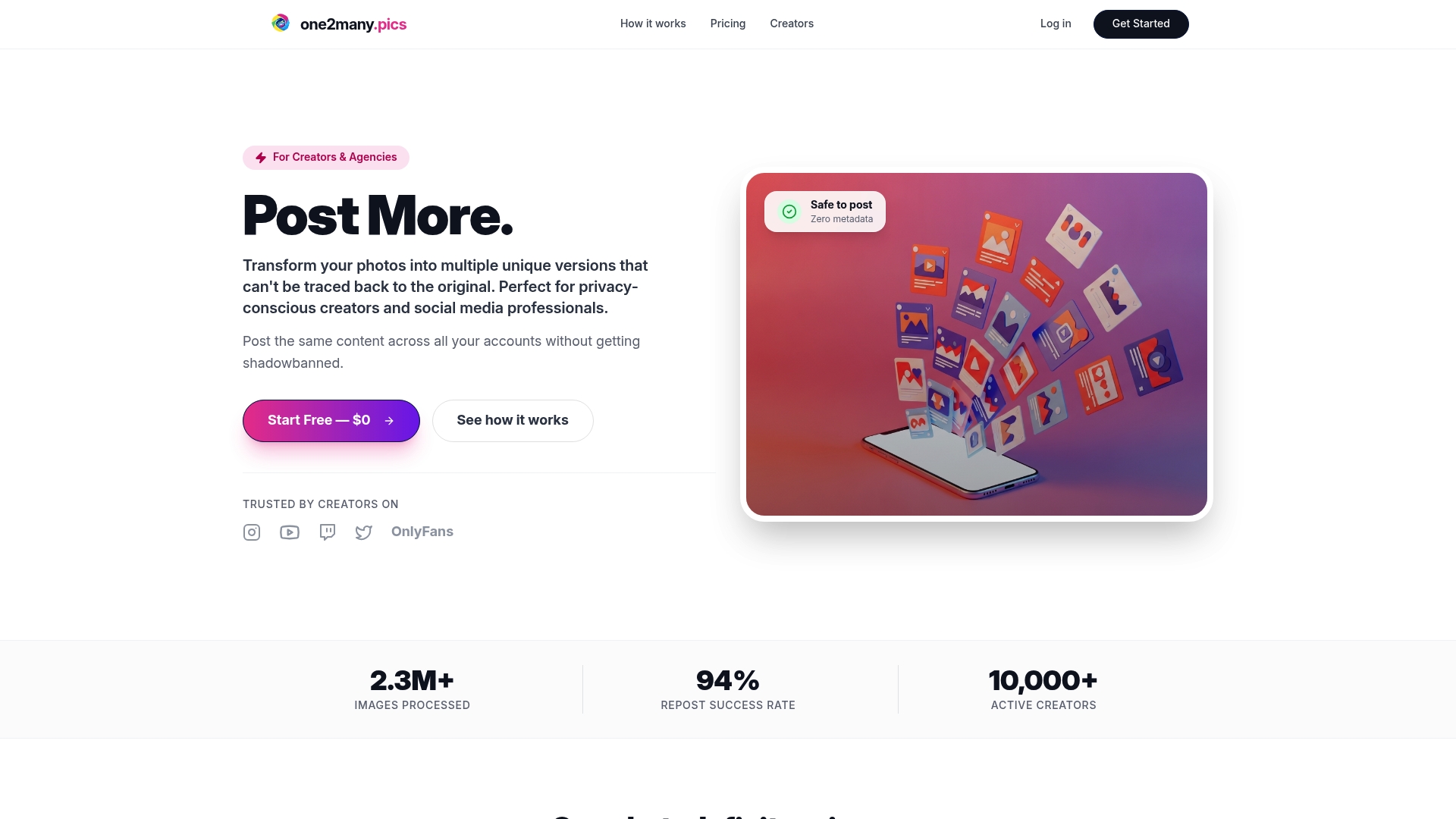
One2many gives content creators, social media managers, and marketing teams the tools to generate unique visual variations from a single original image, strip metadata, and distribute content across accounts without duplicate detection penalties. If you are running a paid or organic syndication program at scale, scalable posting tools like One2many protect your reach while you grow it. Visit one2many.pics to see how the platform fits into your content distribution workflow.
FAQ
What are the four main types of content syndication?
The four main types are organic, paid, partner, and intent-based syndication. Each uses a different distribution model, cost structure, and targeting approach.
Does content syndication hurt SEO?
Organic syndication can hurt SEO if duplicate content is not handled correctly. Using a canonical tag on the syndicated version pointing to your original URL prevents search engine penalties.
What content works best for paid syndication?
Gated assets like whitepapers, ebooks, and research reports perform best in paid syndication networks like NetLine and TechTarget because they justify the lead capture form required for CPL pricing.
How do I measure intent-based syndication results?
Track content-influenced pipeline rather than lead volume alone. Monitor how many target accounts consumed syndicated assets before a sales conversation, since that correlation reveals true conversion impact.
Can small businesses use content syndication?
Organic and partner syndication are accessible to businesses of any size because they require no media budget. Paid and intent-based syndication require budget and a lead nurture infrastructure to deliver a positive return.