

Most content marketers treat privacy as a legal problem to hand off to the compliance team. That assumption is costing them real audience trust and measurable performance. The role of privacy in content marketing has shifted from a checkbox exercise into a genuine strategic differentiator. Brands that understand how data collection, consent, and transparency shape their audience relationships are pulling ahead of competitors who still think cookie banners are an IT problem. This article breaks down exactly how privacy affects every layer of your content strategy and what you can do about it.
Table of Contents
- Key Takeaways
- The role of privacy in content marketing: legal foundations
- How privacy builds audience trust and marketing results
- Balancing personalization and privacy
- Practical tools for privacy-compliant content marketing
- Future-proofing your privacy approach
- My take on privacy as an undervalued marketing asset
- Take your content privacy further with One2many
- FAQ
Key Takeaways
| Point | Details |
|---|---|
| Privacy builds trust | Transparent data practices directly increase audience engagement, loyalty, and long-term content performance. |
| Zero-party data beats behavioral tracking | Voluntarily shared customer data produces higher-quality signals for personalization without compliance risk. |
| Consent design determines data quality | Easy, transparent consent flows raise opt-in rates and generate more reliable first-party data. |
| Tools exist for compliant measurement | Technologies like Google Consent Mode v2 and CDPs make privacy-safe analytics achievable without sacrificing insight. |
| Privacy-first culture is a team sport | Embedding privacy thinking across marketing, creative, and strategy roles reduces risk and improves content relevance. |
The role of privacy in content marketing: legal foundations
Privacy in content marketing starts with a basic question: what data are you collecting, why are you collecting it, and did your audience actually agree? Those three questions map directly to the core principles of every major privacy regulation in use today.
The regulatory environment now includes GDPR in Europe, CCPA and CPRA in California, LGPD in Brazil, and a growing list of US state laws that follow similar patterns. For content marketers, the practical impact is significant. GDPR violations of data processing principles can result in fines up to €20 million or 4% of global annual turnover. Those numbers get attention in boardrooms fast.
The principles that matter most for content teams are:
- Consent: Users must opt in, not opt out. Consent must be freely given, specific, informed, and withdrawal must be just as easy as opting in.
- Purpose limitation: You cannot collect email addresses for a content newsletter and then use them for retargeting campaigns without separate consent.
- Data minimization: Collect only what you genuinely need for a defined purpose. More data sitting unused is more liability.
- Transparency: Tell your audience, in plain language, what you collect and how you use it.
One assumption that trips up content teams regularly is that analytics cookies fall under a "strictly necessary" exemption. They do not. Analytics cookies require prior consent under GDPR, which means your traffic reporting is already affected by your consent flow quality. This is not a legal edge case. It is a daily measurement problem most marketing teams are ignoring.
How privacy builds audience trust and marketing results
Here is the counterintuitive reality: the impact of privacy on marketing is positive when you approach it strategically. Brands that make consent and transparency visible to their audience do not see engagement drop. They see it rise.
The reason is simple. Audiences are increasingly aware that their data has value. When you acknowledge that openly and give them control over how their information is used, you signal respect. That signal translates into higher open rates, longer content engagement, and better conversion quality. Privacy-first marketers treat privacy as a competitive advantage, and the data supports it. Higher lifetime value and lower churn rates track directly with transparent consent practices.

The role of creative content privacy also becomes clear here. Content that respects what your audience shares about themselves, and that uses that information to deliver more relevant experiences, performs better than content built on behavioral inferences the user never agreed to.
Pro Tip: Build a preference center before you need one. Audiences who actively choose their content preferences engage at significantly higher rates than those lumped into broad behavioral segments.
Zero-party data is where this gets really interesting. Zero-party data is the highest-quality signal available to marketers because customers share it deliberately, in exchange for something they find immediately valuable. A quiz that recommends a content path, a survey that personalizes a resource library, a preference form that tailors your email cadence. These interactions generate data that is both more accurate and fully compliant.
Preference centers, when designed for value exchange rather than just legal defense, become genuine engagement touchpoints. Most marketers treat them as the place subscribers go to unsubscribe. Smart marketers treat them as the place subscribers go to tell you exactly what they want.
Balancing personalization and privacy
The fear most marketers have is that privacy restrictions mean generic, irrelevant content. The reality is the opposite. Content marketing privacy strategies built on first-party and zero-party data produce more accurate personalization than behavioral tracking ever did, because the data reflects what people actually said they want rather than what an algorithm inferred.
Here is a practical framework for getting the balance right:
- Audit your data collection. Map every touchpoint where you collect user data and ask whether each one passes the purpose limitation test. If you cannot articulate why you need it and how it improves the audience experience, stop collecting it.
- Shift to contextual personalization. Match content to the immediate context of the user: the page they are on, the topic they searched, the stage of their buying cycle. This requires no personal data and often outperforms behavioral targeting in click-through rates.
- Replace third-party tracking with first-party signals. First-party data and smart segmentation let you personalize effectively without the legal and reputational risk of invasive tracking.
- Design consent flows that earn trust. Avoid dark patterns. Pre-checked boxes, buried opt-out links, and confusing consent language all erode trust and, in many jurisdictions, make your consent invalid.
| Approach | Data requirement | Privacy risk | Personalization quality |
|---|---|---|---|
| Behavioral tracking | Third-party cookies | High | Inferred, often inaccurate |
| First-party segmentation | CRM and site data | Low | Good, behavior-based |
| Zero-party data | User-provided directly | Minimal | Highest, intent-based |
| Contextual targeting | No personal data | None | Good, context-based |
Pro Tip: Segregating raw identifiers from decision-making attributes in your identity graph reduces data exposure risk without limiting the quality of your personalization workflows.
Practical tools for privacy-compliant content marketing
The role of privacy tools in content has grown dramatically. The good news is that the tools available now make privacy compliance far less painful than it was in 2018 when GDPR first went into effect.
Here is what a modern privacy-respecting content marketing stack looks like in practice:
- Google Consent Mode v2: This tool adjusts how your tags behave based on user consent status. Consent Mode v2 recovers 70-80% of conversion data even when users decline cookies, using modeled data to fill gaps. That is a significant recovery rate that removes one of the biggest objections to strict consent enforcement.
- Customer Data Platforms (CDPs) with privacy governance: Modern CDPs like those with built-in consent signal propagation let you manage first-party data at scale while maintaining audit trails for compliance. Automated data governance controls embedded in your marketing automation reduce human error and keep campaigns moving without creating compliance bottlenecks.
- Privacy-preserving measurement: Cohort analysis and conversion modeling let you understand campaign performance at the aggregate level without exposing individual user data. This is now standard practice among performance-focused content teams.
- Consent management platforms (CMPs): A well-configured CMP does more than display a cookie banner. Consent experience quality directly determines opt-in rates and the usability of the resulting data. A transparent, easy-to-navigate consent flow is a revenue-generating design decision, not just a legal one.
The role of privacy in content strategy also extends to visual content. Metadata embedded in images can expose creator locations, device types, and timestamps, creating both security risks and platform-level exposure. This is particularly relevant for agencies managing content across multiple accounts.
Future-proofing your privacy approach
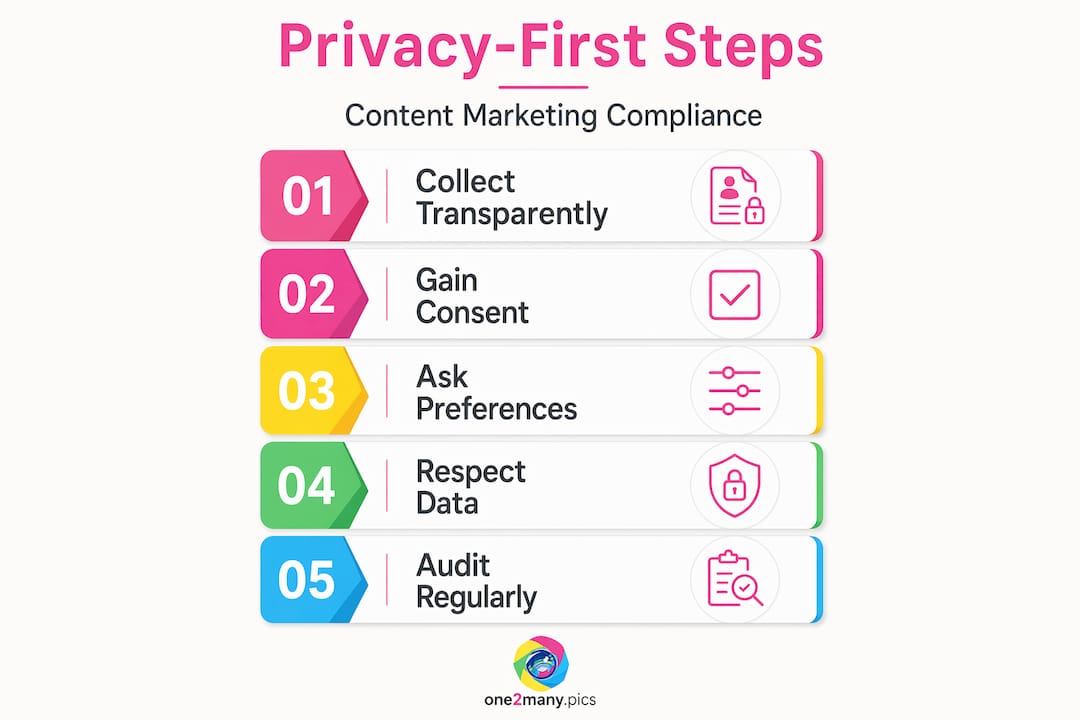
Content marketing privacy strategies cannot be set-and-forget. Regulations evolve, enforcement priorities shift, and audience expectations around data keep rising. Getting ahead of this requires building privacy into how your team operates, not just into which tools you use.
The most common mistakes marketers make right now:
- Assuming that because a regulation does not specifically mention their content tactic, they are exempt.
- Over-collecting data during lead generation and then letting it sit unused in a CRM.
- Treating privacy updates as one-time projects rather than ongoing practice.
Building a privacy-first culture means training content writers, social media managers, and campaign strategists alongside your legal and technical teams. Everyone who touches audience data, even indirectly, should understand what they can and cannot do with it. Staying current with social media compliance rules is no longer optional for professional content operations.
Pro Tip: Schedule a quarterly privacy audit of your active campaigns. Check consent status, data freshness, and whether your personalization logic still reflects what your audience actually consented to share.
Testing privacy impacts is also essential. Run A/B tests on consent flows, track opt-in rate changes after copy updates, and monitor how audience segmentation quality shifts when you remove low-consent data from your targeting pools. The numbers will usually surprise you in a good way.
My take on privacy as an undervalued marketing asset
I have spent a lot of time thinking about why so many marketers treat privacy as a constraint instead of a foundation. My honest conclusion is that the fear is backward.
What I have seen repeatedly is that when teams stop chasing every available data signal and start focusing on the signals their audience chose to share, their content actually gets better. Not because the data volume increased but because the signal quality did. The shift from "more data" to better-quality data is one of the most underrated improvements a content team can make.
The disconnect I encounter most often is marketers who believe privacy-first means losing personalization capabilities entirely. That belief keeps teams clinging to tracking methods that their audiences increasingly resent and that regulators are steadily closing off. Privacy-first personalization is not a compromise. It is a better model.
My strongest recommendation is to stop framing privacy as what you cannot do and start framing it as what you are offering your audience. Transparency is a feature. Consent is a relationship signal. Image modification for privacy and metadata removal are not just technical safeguards. They are part of how serious content professionals protect themselves and their audiences at every layer of their operation.
— one2many.pics
Take your content privacy further with One2many
If you are managing content across multiple platforms and accounts, privacy does not stop at consent forms and analytics tools. It extends to the visual content you publish and the metadata it carries.
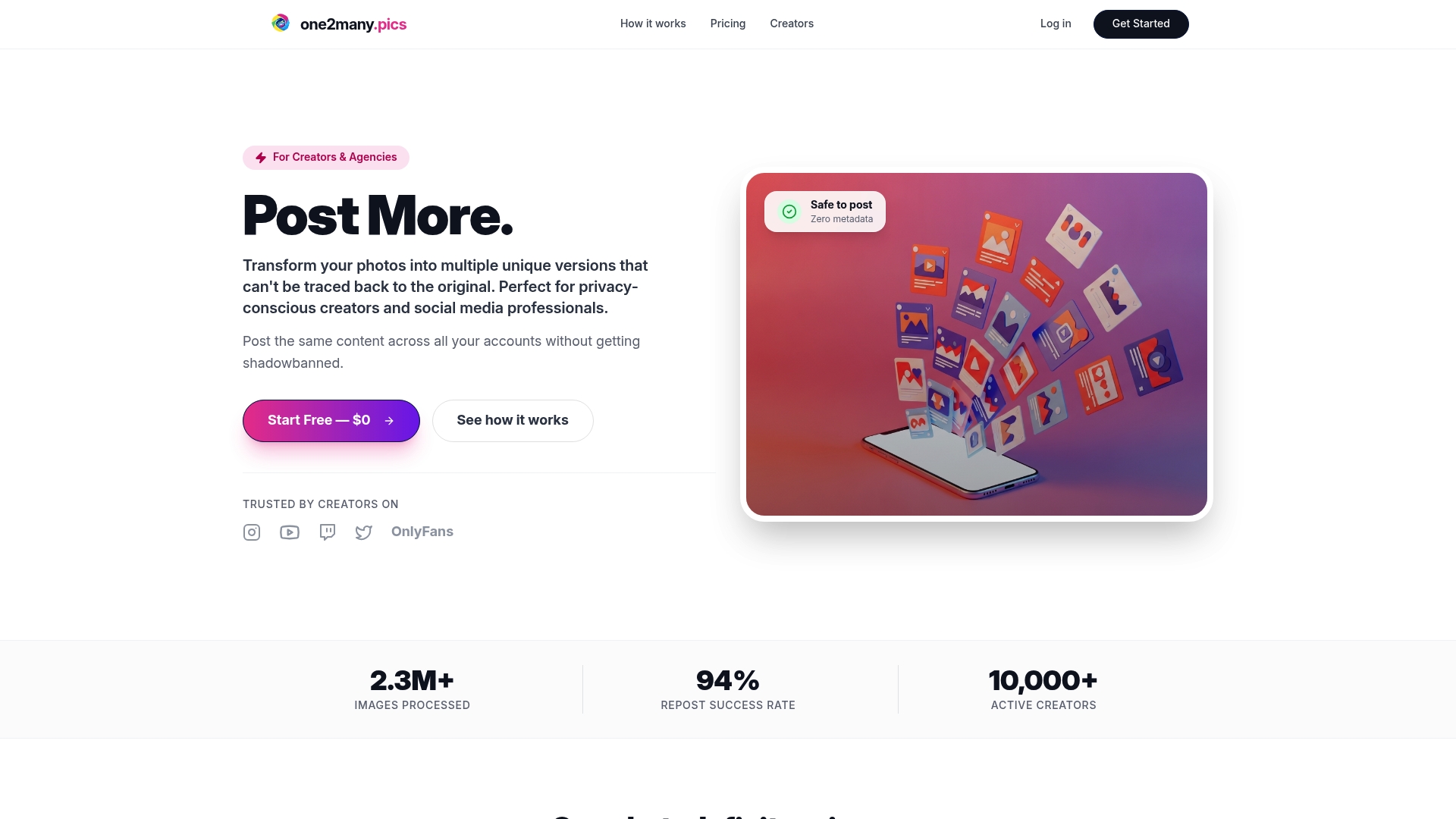
One2many is built specifically for content creators, social media managers, and agencies who need to protect their digital footprint at scale. The platform removes embedded metadata from images, including location data, device information, and timestamps, and generates unique visual variations to prevent duplicate detection across accounts. Whether you are managing a single brand or a portfolio of clients, One2many's privacy tools give you the control your content strategy requires. Explore the platform and see how privacy-first content management works in practice.
FAQ
What is the role of privacy in content marketing?
Privacy in content marketing governs how you collect, use, and protect audience data across every content touchpoint. Treating it as a trust-building strategy rather than just a compliance obligation improves engagement and content performance.
How does privacy affect consumer trust?
Brands that practice transparent data collection and give audiences control over their preferences consistently earn higher loyalty and better engagement rates. Audiences are more likely to share data when they understand how it will be used and can change their minds easily.
What is zero-party data and why does it matter?
Zero-party data is information customers share deliberately in exchange for something valuable, like personalized recommendations or tailored content. It is the highest-quality marketing signal available because it reflects actual intent rather than behavioral inference.
How can marketers personalize content without violating privacy?
Contextual personalization, first-party data segmentation, and zero-party data exchanges all enable relevant content experiences without relying on invasive behavioral tracking or third-party cookies.
What tools help with privacy-compliant content marketing?
Google Consent Mode v2, customer data platforms with built-in consent management, and privacy-preserving measurement techniques like cohort analysis and conversion modeling are the core tools for compliant, data-informed content marketing in 2026.