

Most social media creators assume that scaling their content output means posting more often. More posts, more reach, more growth. That logic collapses fast when your team burns out, your quality drops, and your brand starts sounding inconsistent across platforms. Scalable posting, the practice known in enterprise circles as scalable content distribution, is something entirely different. It's about building repeatable systems that let you publish quality content across multiple accounts and channels without proportionally increasing your workload. This guide breaks down exactly how that works.
Table of Contents
- Key takeaways
- What scalable posting really means
- Bulk posting and multi-channel workflows
- Governance and approval workflows at scale
- Building content assets that scale
- My honest take on scalable posting
- Scale your posting with One2many
- FAQ
Key takeaways
| Point | Details |
|---|---|
| Scalable posting is a system | It's about repeatable workflows for creation, review, and distribution, not just higher post frequency. |
| Multi-channel bulk posting saves time | Uploading batches once and scheduling across platforms cuts manual work and keeps messaging aligned. |
| Governance prevents quality drift | Structured approval tiers and audit trails keep brand consistency intact as your volume grows. |
| Reusable assets are the foundation | One piece of cornerstone content can feed weeks of posts across multiple platforms when built correctly. |
| Timing matters more than you think | Posting simultaneously across all platforms often reduces reach; staggered scheduling per platform wins. |
What scalable posting really means
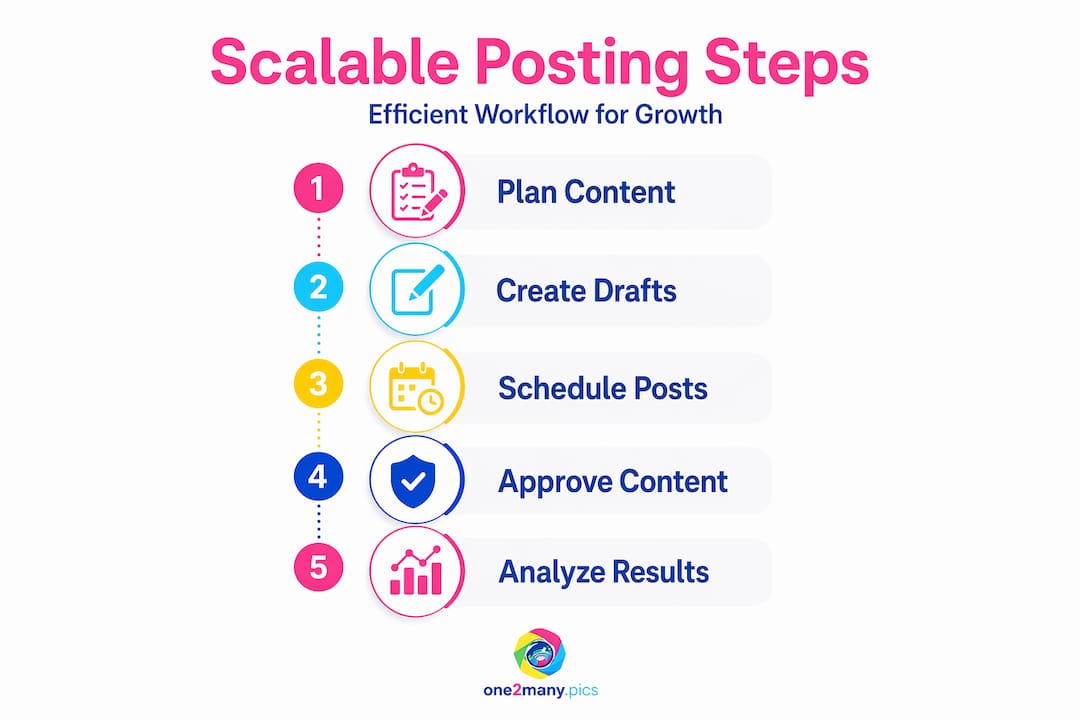
Scalable posting is not a frequency goal. It's a systems goal. Hootsuite defines it as building processes for creation, review, approval, storage, and sharing across platforms and regions, so that content volume can increase without stretching your team thin or lowering quality.
Think about what that means in practice. A solo creator juggling three platforms might post manually and survive. A marketing team managing eight accounts across five platforms, in multiple time zones, will hit a wall without structure. That wall shows up as missed posts, inconsistent brand voice, approval bottlenecks, and content that gets reused carelessly without proper variation.
Scalable content distribution solves this by separating the creation of content from its distribution and governance. Instead of recreating each campaign from scratch, you build assets once and deploy them through a defined workflow.
The core components of a scalable posting system include:
- Workflow automation: Tools that schedule, queue, and publish posts without manual intervention at each step
- Multi-channel scheduling: A single dashboard that distributes content across LinkedIn, Instagram, TikTok, and other platforms in one workflow
- Reusable content libraries: A centralized bank of approved copy, visuals, and templates that teams pull from instead of rebuilding
- Brand governance rules: Style guides, tone parameters, and approval checkpoints baked into the process itself
- Audit and permissions controls: Clear records of who approved what, and when
System improvements across the workflow matter more than raw volume increases. That shift in mindset is what separates teams that scale successfully from those that just get louder and messier.
Pro Tip: Before buying any scheduling tool, map your current workflow on paper first. Automating a broken process just makes the chaos faster.
Bulk posting and multi-channel workflows
Bulk posting is one of the most practical expressions of scalable social media in action. Instead of scheduling posts one by one, you upload a batch, set platform parameters, and let the system distribute them across your chosen channels.
Bulk scheduling across platforms reduces manual work and keeps messaging consistent globally while still allowing local tailoring. That last part matters. A brand running campaigns in the U.S. and in Southeast Asia needs the same core message but different timing, visuals, and sometimes different copy tones. Bulk multi-channel workflows handle that without requiring a separate manual process for each market.

Here's a direct comparison of how single-platform and multi-channel bulk posting differ in practice:
| Feature | Single-platform bulk posting | Multi-channel bulk posting |
|---|---|---|
| Upload process | One batch per platform | One batch for all platforms |
| Scheduling flexibility | Platform-specific settings | Cross-platform scheduling in one workflow |
| Brand consistency | Consistent on one channel | Consistent across all channels simultaneously |
| Reporting | Per-platform analytics | Unified cross-channel analytics |
| Best for | Focused channel strategies | Teams managing multiple platforms at once |
One detail that catches teams off guard: posting simultaneously across all platforms can actually reduce your reach. Each platform has its own peak engagement windows. Instagram audiences are most active at different times than LinkedIn professionals. Posting the same content at the exact same moment to every channel ignores those differences and leaves engagement on the table.
The fix is staggered scheduling. You create content once, then set platform-specific publish times based on your audience analytics. For smart cross-platform posting, this level of timing precision is what separates average reach from strong reach.
Pro Tip: Use your platform analytics to identify the top two engagement windows per channel, then build a scheduling template you reuse every month. You'll stop guessing and start compounding results.
Governance and approval workflows at scale
Here's where most content teams underestimate the complexity of scaling. When you're posting three times a week, manual approval feels fine. When you're posting thirty times a week across six platforms, that same manual process becomes a liability.
Governance in a scalable posting workflow means building structured review steps directly into your content pipeline. Approval workflows with permissions and tiers allow only reviewed content to move to the publish queue, with a full history of who approved each piece and when.
The key governance elements worth building into your system:
- Permission layers: Not everyone needs publish access. Separate creator, editor, and approver roles reduce errors at the source.
- Approval tiers: A junior social post might need one approver. A campaign launch might need legal, brand, and executive sign-off. Build both paths into your workflow.
- Audit trails: External approvals that happen outside your posting tool still need auditable records tied to specific posts. Tools that document these bypassed approvals prevent compliance gaps.
- Version control: Keep a record of what got published versus what was drafted, especially for content that gets edited after approval.
The balance to strike is speed versus control. Rigid approval chains slow everything down. No oversight creates brand risks. The answer is tiering your content by risk level. Routine posts get a lighter approval path. Campaign content and anything touching sensitive topics gets a full review chain.
For teams managing privacy-focused publishing, building governance into your content workflow for privacy also means controlling what metadata and footprint accompany your posts at each stage.
Pro Tip: Document your approval workflow as a simple checklist, not a policy document. People follow checklists. They ignore policy documents.
Building content assets that scale
Scalable content is not the same as high-volume content. Scalable content means creating adaptable assets that get repurposed across formats and channels, rather than producing new material for every post from scratch.
The practical approach follows a tiered asset structure:
- Create cornerstone content first. A 10-minute video explaining your product, a long-form article covering a key topic, or a detailed infographic becomes the root asset. Everything else branches from it.
- Break it into format-specific derivatives. That 10-minute video becomes a 60-second Reel, a series of quote graphics, three LinkedIn text posts, and a podcast clip. Same research, different packaging.
- Store assets in a centralized library. Approved copy blocks, resized visuals, platform-specific captions, and brand templates all live in one place. Teams pull from the library rather than recreating.
- Separate content creation from distribution. Assembling campaigns from existing assets via a defined pipeline means you're never starting from zero. You're remixing and deploying.
- Tag assets by topic, format, and platform. Metadata-rich libraries let you find the right asset in seconds. Disorganized folders kill the efficiency you worked to build.
Video content is worth calling out specifically. Repurposing video across platforms is one of the highest-leverage moves in a scalable content strategy because a single video shoot produces assets for months of posting across multiple channels.
For visual content specifically, the challenge is that identical images posted across multiple accounts trigger duplicate detection on many platforms. Tools that generate visual variations from a single source image solve this without requiring a full reshoot every time. That's the difference between a library that scales and one that creates platform penalties.
My honest take on scalable posting
I've worked alongside enough social media teams to know that the biggest scalability failures rarely come from the wrong tool. They come from skipping the workflow design entirely and going straight to automation.
What I've seen consistently is this: teams adopt a scheduling platform, dump all their content in, and call it a scalable system. Then the approvals happen in Slack threads, the brand voice drifts by month three, and no one can tell you what was actually approved versus what just went out. The tool didn't fail. The process wasn't there to begin with.
My honest advice is to treat governance as the actual product you're building. Automation is just the layer on top. When you have clearly defined roles, approval tiers that match content risk levels, and a content library your team actually uses, scaling feels natural. It doesn't feel like controlled chaos.
The benefit that surprises people most is what happens to creative quality once the operational noise disappears. When your team isn't manually copying post captions into five different platforms every morning, they have cognitive space to write better copy, test new formats, and notice what's actually resonating. That's the real payoff of getting your posting workflow built right from the start.
— one2many.pics
Scale your posting with One2many
Ready to put this into practice? One2many is built specifically for creators, marketers, and agencies who need to post at scale without triggering duplicate detection or leaving metadata trails that compromise privacy.
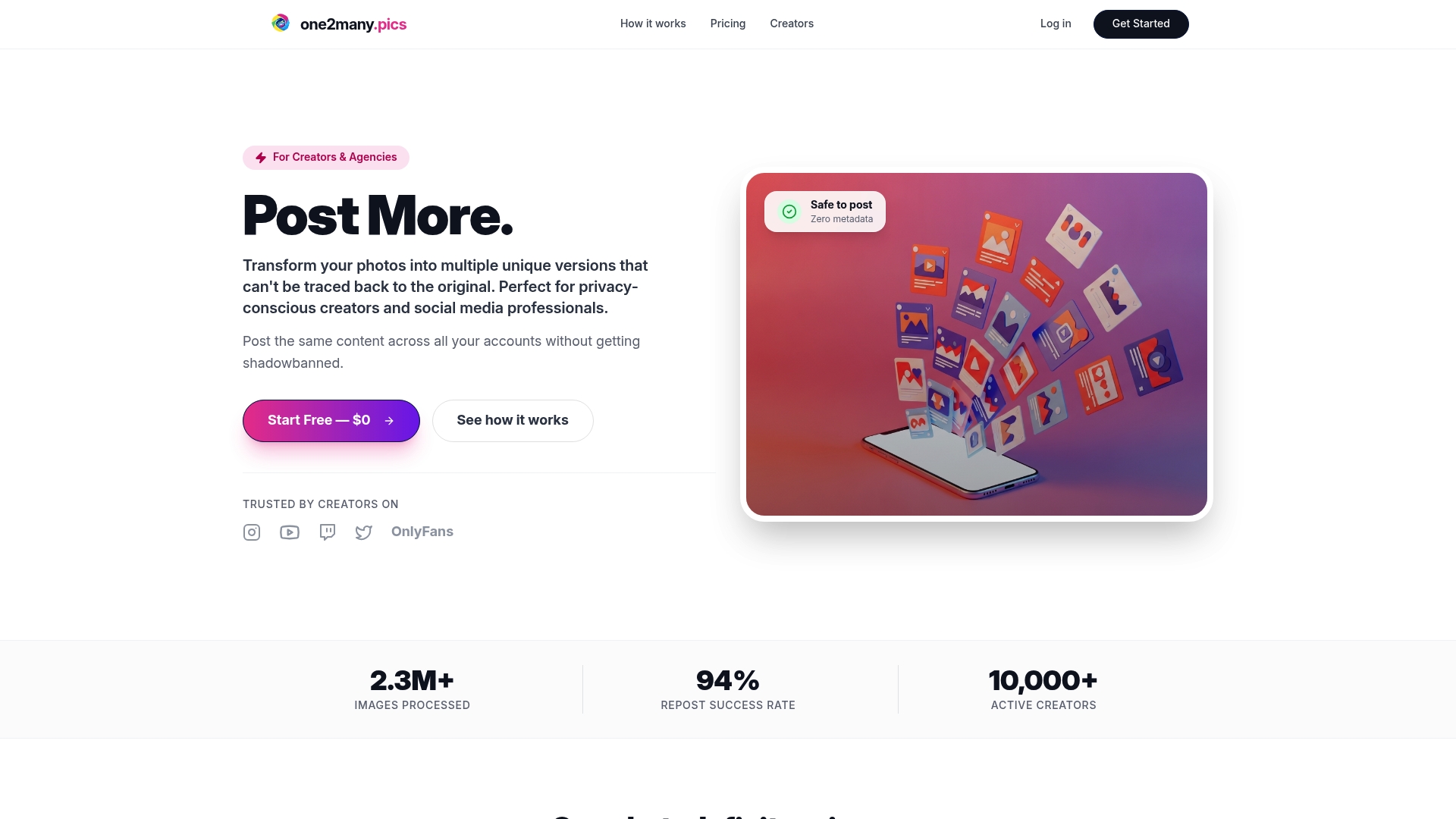
The platform transforms your original images into unique visual variations, removing device data, location info, and timestamps before you publish. This means you can distribute the same core visual across multiple accounts and platforms without risking content suppression. For teams managing bulk visual content, One2many also supports workflow integrations that fit directly into the scalable posting systems covered in this article. Explore what One2many can do for your workflow and start posting smarter, not harder.
FAQ
What is scalable posting in social media?
Scalable posting means building repeatable systems for creating, approving, and distributing content across multiple platforms or accounts without proportionally increasing manual effort or sacrificing quality.
How is scalable posting different from just posting more often?
Posting more often increases volume. Scalable posting improves the underlying workflow, so you can increase volume without extra manual work, brand inconsistency, or team burnout.
What tools support scalable content posting?
Scheduling and bulk posting platforms, centralized content libraries, approval workflow tools, and image variation tools like One2many all support a scalable content strategy by separating creation from distribution.
Why does posting the same content simultaneously across platforms reduce reach?
Each platform has distinct peak engagement windows. Simultaneous cross-platform posts miss platform-specific timing, which reduces visibility and engagement compared to staggered scheduling.
How do approval workflows fit into scalable posting?
Approval workflows prevent off-brand or unapproved content from publishing at volume. Tiered approval systems with audit trails keep governance intact even as posting frequency grows.