

Personalized content is the practice of tailoring messages, visuals, and experiences to individual users based on their behavior, preferences, and context. 75% of consumers are more likely to buy from brands that personalize their outreach, and companies that excel at it generate up to 40% more revenue than their peers. For content creators and marketers, understanding why personalized content matters is no longer a competitive advantage. It is the baseline expectation of every audience you serve. This article covers the measurable business case, the psychological mechanics, the ethical guardrails, and the practical steps to build personalization that actually works.
Why personalized content matters for engagement and revenue
The business case for personalization is concrete and well-documented. Basic website content personalization drives a 14% increase in sales, which means even modest segmentation efforts produce measurable returns. That number alone justifies the investment for most marketing teams.
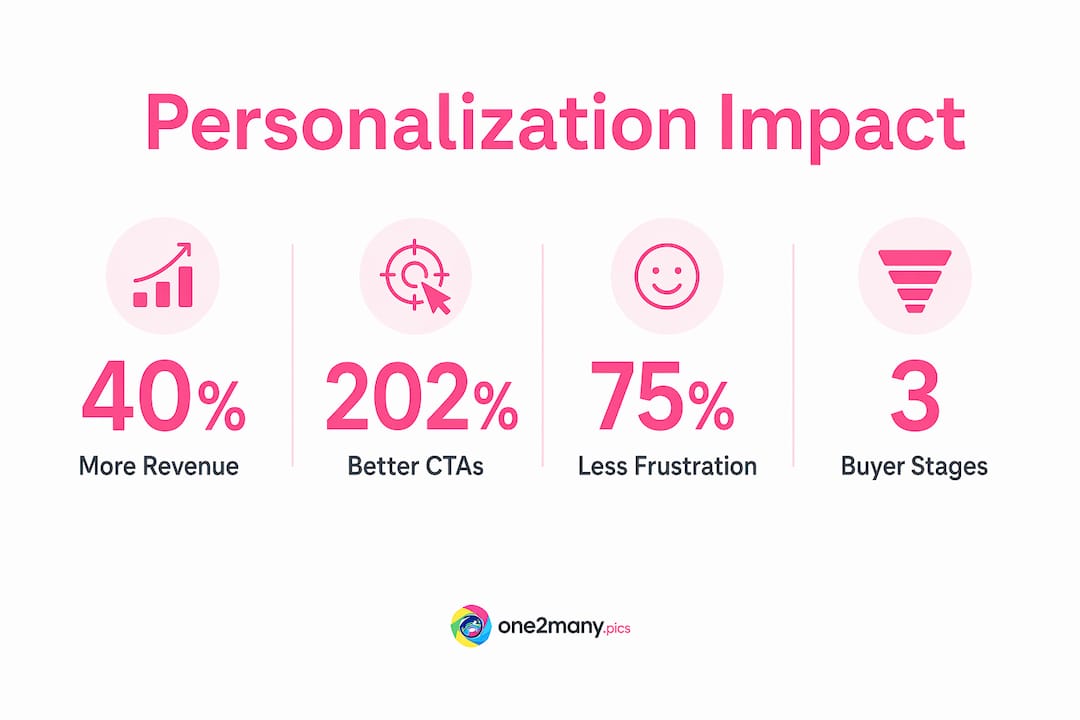
The conversion impact goes deeper than homepage banners. Personalized CTAs perform 202% better than generic default calls-to-action. That gap exists because personalization reduces decision friction. When a first-time visitor sees a "Learn More" button and a returning customer sees "Pick Up Where You Left Off," each message matches where that person is in the buying journey. The offer feels earned rather than broadcast.

| Metric | Generic content | Personalized content |
|---|---|---|
| CTA conversion rate | Baseline | Up to 202% higher |
| Sales lift | No measurable change | ~14% increase |
| Revenue vs. peers | Average | Up to 40% more |
| Customer frustration | Lower | Eliminated for 75%+ |
The revenue premium from McKinsey's research is not a rounding error. Forty percent more revenue than peers compounds over time. A brand generating $10 million annually that closes that gap earns $4 million more, not from a new product line, but from delivering the right message to the right person at the right moment.
Pro Tip: Map your content to three buyer journey stages: awareness, consideration, and decision. Assign distinct CTAs, offers, and messaging to each. This single structural change is where the highest ROI personalization gains come from, not superficial name-swapping in email subject lines.
How personalized content improves user experience and trust
Personalization works because of a well-established psychological principle: relevance signals intent. When content feels crafted for you specifically, your brain registers it as useful rather than intrusive. Personalization taps into psychological relevance, making outreach feel intentional rather than algorithmic. That perception of intentionality is what separates brands people trust from brands people ignore.
The frustration data is equally telling. Over 75% of customers are frustrated when personalization is absent. This means a generic experience is not neutral. It actively damages the relationship. Contentful's 2026 research frames this clearly: missing personalization should be treated as a core product failure, not a missed optimization.
Omnichannel consistency amplifies this effect. When a customer sees a relevant product recommendation on Instagram, receives a follow-up email referencing that same product, and lands on a website that surfaces related reviews, the experience feels coherent. Omnichannel personalization increases repeat purchase rates and long-term loyalty precisely because consistency builds trust across every touchpoint.
What customers actually expect from personalization in 2026:
- Content that reflects their past behavior and stated preferences, not just their demographic segment
- Recommendations that update in real time as their interests shift
- Messaging that matches the channel they are using, whether that is SMS, email, or social media
- Privacy controls that let them see and adjust what data is being used
- Experiences that feel helpful rather than surveillance-driven
Connecting data across the customer journey is what makes this possible. Fragmented profiles produce fragmented experiences. A customer who browses running shoes on your app but receives an email about winter coats has not been personalized. They have been spammed with extra steps.
What are the ethical risks of personalization?
Personalization is not inherently benign. Ethical risks include reduced autonomy and exposure to tailored misinformation when AI-driven systems optimize purely for engagement without guardrails. Kellogg Insight's 2026 analysis of AI persuasion identifies a specific danger: systems that learn what emotionally resonates with an individual can exploit psychological vulnerabilities rather than serve genuine needs.
The narrowing-of-choice problem is real. When an algorithm decides what a user sees, it can create filter bubbles that limit exposure to new ideas, competing products, or corrective information. For marketers, this is both an ethical issue and a long-term brand risk. Audiences who feel manipulated do not stay loyal. They leave and they talk about it.
Responsible personalization requires three non-negotiable commitments. First, transparency: tell users what data you collect and how it shapes their experience. Second, user control: give people the ability to adjust, pause, or reset their personalization profile. Third, governance: build internal review processes that audit whether your personalization logic is serving users or exploiting them. Trust in personalization depends on privacy safeguards and disclosure mechanisms. Without them, even technically impressive personalization erodes the confidence it was designed to build.
Pro Tip: Before deploying any AI-driven personalization feature, run a "manipulation audit." Ask: does this content help the user make a better decision, or does it pressure them toward a decision that primarily benefits us? If the answer is the latter, redesign the logic before launch.
Explore how privacy in content marketing intersects with personalization strategy to understand where the boundaries should sit.
How to implement personalized content strategies that scale
Personalization built as a one-off campaign fails. Personalization built as an experience system scales. The distinction matters because one-off efforts require manual rebuilding every quarter, while systems generate ongoing lift from the same infrastructure investment.
Start with data architecture. Three types of data drive effective personalization:
Behavioral data captures what users do: pages visited, content consumed, products clicked, time spent. This is the most predictive signal for intent.
Contextual data captures the circumstances of a visit: device type, location, time of day, referral source. A user browsing on mobile at 11 p.m. has different needs than the same user on desktop at 9 a.m.
Declared data captures what users tell you directly: survey responses, preference centers, account settings. This data is the most accurate and the most underused.
AI-driven segmentation takes these inputs and identifies patterns no human analyst would find manually. AI-powered personalization can reduce marketing cost-to-serve by 20 to 30% by targeting customers more precisely. That efficiency gain means you spend less to reach the right person and more of your budget goes toward creative quality rather than volume.
| Approach | Best for | Key tools | Measurement focus |
|---|---|---|---|
| Rule-based segmentation | Small teams, clear segments | Mailchimp, HubSpot | Open rate, click rate |
| AI-driven segmentation | Large catalogs, complex journeys | Klaviyo, Salesforce Marketing Cloud | Revenue per contact |
| Dynamic content blocks | Web and email personalization | Contentful, Optimizely | Conversion lift |
| Predictive analytics | Churn prevention, upsell timing | Adobe Experience Platform | Retention rate, LTV |
Dynamic personalization goes further than static segments. Real-time content adaptation during user sessions requires architecture that updates quickly and measures impact continuously. A homepage that reconfigures itself based on a visitor's browsing history from the last 48 hours outperforms a homepage built around last quarter's top-performing segment.
Measure beyond clicks. Evaluating personalization success should include cost-to-serve reductions and revenue efficiency improvements. A campaign that generates fewer clicks but higher average order value is more valuable than one that drives traffic without intent. Build your measurement framework before you launch, not after.
For practical guidance on visual content personalization strategies that work across platforms, the approach to image variation and format selection matters as much as copy personalization.
Key takeaways
Personalized content drives measurable revenue gains, deeper user trust, and long-term loyalty when it is built on real data, ethical guardrails, and a system-level architecture rather than one-off campaigns.
| Point | Details |
|---|---|
| Revenue impact is proven | Companies excelling at personalization generate up to 40% more revenue than peers. |
| CTAs are the highest-leverage touchpoint | Personalized calls-to-action outperform generic ones by up to 202%. |
| Missing personalization actively damages trust | Over 75% of customers report frustration when personalization is absent. |
| Ethics require transparency and user control | Responsible personalization discloses data use and gives users the ability to adjust their profile. |
| Systems outperform campaigns | AI-driven personalization built as infrastructure reduces cost-to-serve by 20 to 30%. |
The uncomfortable truth about personalization most marketers miss
At One2many, we work with creators and social media teams who are scaling content across multiple accounts and platforms. What we see consistently is that marketers invest heavily in message personalization while ignoring the layer beneath it: the visual and metadata signals that platforms use to classify and distribute content. You can write the most precisely targeted copy in the world, and it still gets suppressed if the platform's algorithm flags your image as a duplicate or your metadata as a privacy risk.
The second pattern we see is personalization theater. Teams add a first name to an email subject line and call it personalization. That is not personalization. It is mail merge. Real personalization changes the offer, the format, the timing, and the channel based on where someone is in their relationship with your brand. The psychological relevance that drives conversion comes from matching intent, not from inserting a variable.
The ethical dimension is where most teams are least prepared. The same AI systems that make personalization powerful also make it possible to exploit. We think the marketers who will build lasting audience relationships in 2026 are the ones who treat privacy and transparency as features, not compliance checkboxes. Audiences are more sophisticated than they were five years ago. They know when they are being profiled, and they reward brands that are honest about it.
The future of personalization is dynamic and real-time, but the foundation is still trust. Build the trust first. The technology will follow.
— one2many.pics
Scale your personalized content without sacrificing privacy
Content personalization only works when your content actually reaches your audience. If platform algorithms suppress your posts due to duplicate detection or metadata fingerprinting, your personalization strategy never gets the chance to perform.
One2many is built for creators and marketing teams who need to scale visual content across accounts and platforms without triggering duplicate detection or exposing location and device metadata. The platform transforms original images into unique versions by stripping identifying metadata and generating visual variations, so each post reads as original to platform algorithms. For teams running personalized campaigns across multiple channels, this means your content gets seen before it gets judged. Visit One2many to see how privacy-first content management supports your personalization workflow at scale.
FAQ
Why does personalized content matter more than generic content?
Personalized content matches the user's intent, context, and journey stage, which reduces decision friction and increases conversion. Research shows personalized CTAs perform up to 202% better than default versions.
What is the revenue impact of personalization in digital marketing?
Companies that excel at personalization generate up to 40% more revenue than competitors, according to McKinsey research cited by HBR in 2026. That gap comes from higher conversion rates, stronger retention, and more efficient ad spend.
How does personalized content improve customer loyalty?
Omnichannel personalization builds loyalty by delivering consistent, relevant experiences across every touchpoint. Salesforce's 2026 research confirms that real-time personalized messaging increases repeat purchase rates and long-term customer retention.
What are the main ethical risks of AI-driven personalization?
The primary risks are reduced user autonomy and exposure to tailored misinformation when systems optimize for engagement without oversight. Kellogg Insight identifies manipulation of psychological vulnerabilities as a specific danger when AI personalization lacks ethical guardrails.
What data types should marketers collect to personalize content effectively?
The three most effective data types are behavioral (actions taken on your platform), contextual (device, location, time of day), and declared (user-stated preferences). Combining all three produces the most accurate personalization signals and the lowest rate of irrelevant recommendations.