

Posting the same image with the same caption across every platform is the fastest way to both bore your audience and trigger algorithmic flags that quietly bury your content. Creators and managers who rely on repetitive patterns often notice a slow decline in reach, engagement, and discoverability, even when their content quality hasn't dropped. The good news is that strategic diversification solves all three problems at once. This guide walks you through exactly how to vary your posts effectively, protect your privacy, and stay on the right side of every platform's algorithm.
Table of Contents
- Why diversify: Benefits for reach, privacy, and algorithm resilience
- What you need: Content-mix frameworks, tools, and requirements
- Step-by-step: How to diversify your social media posts
- Common mistakes and how to troubleshoot them
- Measuring results: Have you really diversified your social content?
- Hard-won lessons: What most creators get wrong about diversification
- Take the next step with safer, more creative social posting
- Frequently asked questions
Key Takeaways
| Point | Details |
|---|---|
| Mix content pillars | Rotate between educate, entertain, inspire, and promote to keep your feed fresh and valuable. |
| Tailor by platform | Use native formats and unique captions for each social channel to optimize privacy and engagement. |
| Avoid automation patterns | Vary your posting style and avoid repetitive behaviors to reduce suppression risk. |
| Audit monthly | Regularly check how diversified your content is by reviewing format use and engagement metrics. |
Why diversify: Benefits for reach, privacy, and algorithm resilience
Content diversification, in the social media context, means deliberately varying what you post, how you format it, which platforms receive it, and what purpose each post serves. It is not just about aesthetics. It is a core strategy for protecting your account health and expanding your reach at the same time.
The risks of uniform posting are real and measurable. When your content follows the same pattern every time, platforms register it as low-effort or potentially automated behavior. Audiences stop engaging because there are no surprises. And when engagement drops, algorithms interpret that as a signal to reduce your distribution.
Specific risks include:
- Lower engagement rates because followers become desensitized to predictable content
- Algorithmic suppression triggered by repetitive captions, identical image hashes, or copy-pasted text
- Privacy vulnerabilities from consistent metadata patterns that expose your device, location, or posting schedule
- Brand stagnation where your account feels static and stops attracting new followers
To avoid these traps, posting best practices consistently point to one solution: build a content mix framework. Specifically, rotating posts across four content pillars (educate, entertain, inspire, and promote) keeps your feed dynamic without requiring you to invent new ideas from scratch. The repeatable content-mix framework is what keeps your brand voice consistent even as your formats and topics rotate.
Privacy is equally important here. Your privacy guide for creators explains how metadata embedded in images can reveal more than you intend. And on the algorithmic side, spam-shaped behaviors like copy-pasted captions or automation-like posting patterns are among the primary triggers for shadowbanning across major platforms.
"Repetitive copy-pasted captions and automation-like patterns create exactly the kind of spam signals that cause platforms to limit your reach. Authenticity and variation are your best defenses."
The measurable upside of diversification is significant. Accounts that rotate formats and content themes consistently outperform single-format accounts in reach and follower growth. Variety signals to algorithms that your account is active, human, and worth distributing.
What you need: Content-mix frameworks, tools, and requirements
Understanding the benefits, it's smart to assemble resources and frameworks that make diversification practical and sustainable before you post a single thing differently.

The starting point is a clear picture of how different platforms accept different content types. Here's a quick reference:
| Platform | Best content types | Posting frequency benchmark |
|---|---|---|
| Carousels, Reels, Stories, single images | 3 to 5 times per week | |
| TikTok | Short video, trending audio, text overlays | 5 to 7 times per week |
| Carousels, text posts, documents, short video | 3 to 4 times per week | |
| Infographic pins, idea pins, video pins | 5 to 10 times per week | |
| X (Twitter) | Short text, threads, image cards, polls | 1 to 3 times per day |
| Video, link previews, events, groups | 3 to 5 times per week |
The content pillar framework recommended by Hootsuite uses four categories to keep your mix intentional. Each pillar serves a different audience need:
- Educate: Tutorials, how-to posts, tips, explainers
- Entertain: Behind-the-scenes, humor, trending formats, personality-driven content
- Inspire: Success stories, quotes, transformations, community spotlights
- Promote: Product features, offers, testimonials, CTAs
Beyond the framework, you need a practical toolkit. Minimum requirements for sustainable diversification include:
- A content calendar or scheduling tool to visualize your rotation
- Basic analytics access on each platform (native dashboards work fine to start)
- A creative app for quick image resizing and caption variations
- A process for stripping or varying image metadata before cross-platform posting
- A folder system for organizing repurposed assets by platform and format
You can also explore visual content variations as a practical way to reuse core creative assets without triggering duplicate detection.
Pro Tip: Start with one framework and two formats. Most creators overwhelm themselves by trying to reinvent everything at once. Pick two platforms, assign one pillar to each post slot for two weeks, and build from there. Complexity scales naturally once the habit is established.
Step-by-step: How to diversify your social media posts
With your foundations set, you're ready to implement. Follow these steps to create and execute a truly diversified, privacy-conscious content plan.
-
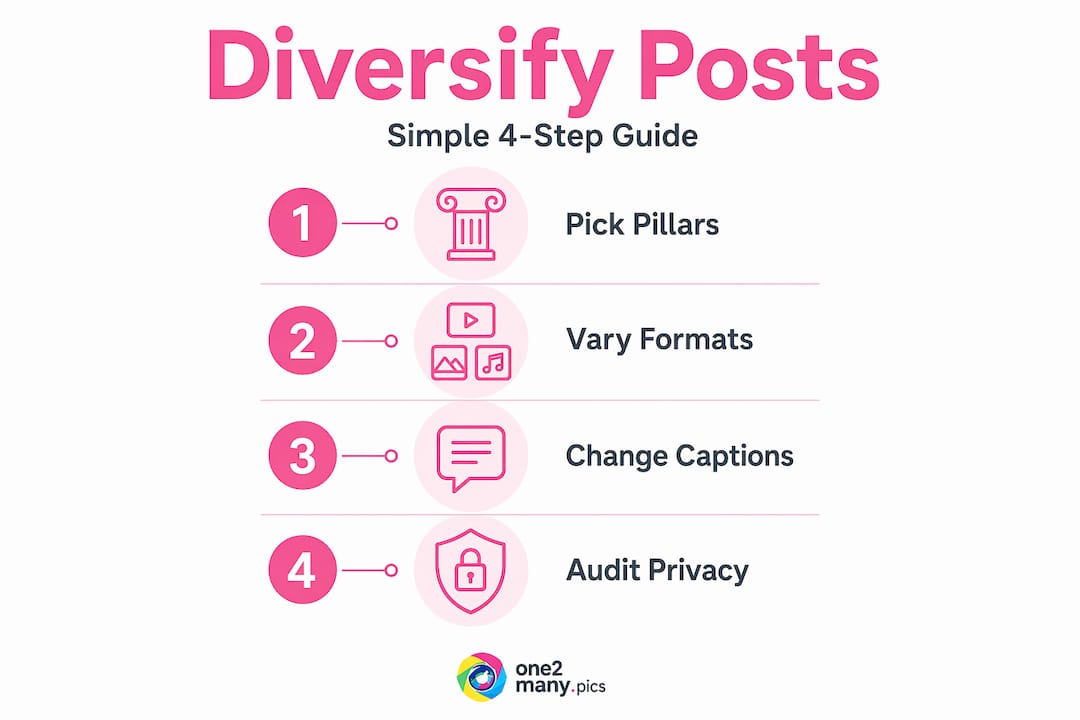
Choose your content pillars. Assign the four pillars across your weekly posting slots. Aim for roughly 30% educate, 30% entertain, 20% inspire, and 20% promote as a starting ratio. Adjust based on your audience's response over time.
-
Assign formats to each pillar. For example, educational posts could be carousels on Instagram and text threads on LinkedIn. Entertainment content might be short video on TikTok and a poll on X. Assigning formats upfront removes daily decision fatigue.
-
Design a rotation schedule. Use a content calendar to map out which pillars and formats go live on which days across which platforms. A rotating content calendar prevents the drift back into repetitive patterns that happens when you post reactively.
-
Repurpose one core idea into native formats. A single blog post can become a carousel on Instagram, a short-form video script for TikTok, a professional opinion piece for LinkedIn, and a visual pin for Pinterest. The key is that each version feels native to its platform, not like a copy-paste job. Repurposing into native formats is more effective than identical cross-posting every time.
-
Vary your captions and hooks per platform. The tone, length, and structure of effective captions differ significantly by network. LinkedIn captions can be thoughtful and longer. TikTok hooks need to front-load curiosity in the first two seconds. Instagram benefits from conversational, emoji-friendly copy.
-
Strip metadata and create visual variations before posting. This is where most creators skip a critical step. Posting the same image file across platforms leaves behind metadata and hash signatures that platforms use for duplicate detection. Making intentional visual content choices at this stage protects your reach.
-
Monitor results at the two-week mark. Track engagement rate by post type, reach per format, and follower growth by platform. This tells you which pillar-format combinations are performing and where to double down.
Here is a concrete example of one idea diversified across three platforms:
| Core idea: "5 tips for morning productivity" | Platform | Format | Caption style |
|---|---|---|---|
| Carousel (5 slides) | Casual, visual, emoji-friendly | ||
| Text post with bold formatting | Professional, insightful, one CTA | ||
| TikTok | 30-second video with text overlays | Hook-first, fast-paced, trending audio |
See more cross-platform posting examples for additional ideas you can adapt to your own content strategy.
Pro Tip: Always rewrite your caption hook for each platform specifically. The Instagram audience and the LinkedIn audience are different people in a different mindset. A hook that works in one place may completely underperform in another, and platform algorithms reward native-feeling content.
Common mistakes and how to troubleshoot them
Even careful planning can lead to hiccups. Here's how to course-correct before issues hurt your brand or reach.
The most common mistakes creators make when attempting diversification include:
- Using identical captions everywhere. This is the single fastest way to trigger suppression. Each platform's algorithm looks for copy-paste behavior as a spam signal.
- Over-automating without human review. Scheduling tools are helpful, but fully automated posting without manual checks can create robotic patterns that platforms penalize.
- Trendjacking without brand alignment. Jumping on every trend sounds like diversification but often creates content that feels inauthentic. Trendjacking works when it connects genuinely to your brand identity, not when it is used as a volume play.
- Skipping measurement. Diversification without tracking means you cannot tell what is working. You end up guessing instead of refining.
- Posting at the same time with the same file. Even if your caption varies, using the exact same image file across platforms at the same moment creates a detectable pattern.
Review your content types for privacy impact when auditing your current approach. And if you want to understand why suppression happens at a deeper level, platform algorithm insights explain how content signals get interpreted differently across networks.
"Spam-shaped behavior, including repetitive copy-pasted captions and automation-like patterns, gives platforms the signal they need to limit your distribution. Varying your content and keeping engagement authentic is the clearest path out of a shadowban."
The fix for most of these mistakes is intentional manual variation. Review every post before it goes live. Ask: does this look and feel different from the last three posts? Does the caption use a different hook structure? Has the image been adapted for this platform's format?
Measuring results: Have you really diversified your social content?
After implementation, use regular audits to verify your diversified approach is performing and not drifting toward old habits.
Here is a practical monthly audit checklist:
- Review your last 30 posts per platform. Count how many different formats appear. If more than 60% use the same format, you are drifting back toward uniformity.
- Pull engagement rate by post type. Compare carousels vs. single images vs. video. If one format is pulling far ahead, consider whether you are underusing it or overexplaining others.
- Audit your captions for uniqueness. Copy your last 10 captions into a document. Read them sequentially. If they sound like variations of the same sentence, your copy is becoming repetitive even if the images vary.
- Check your posting times. If every post goes live at the same time of day, it signals automation. Vary your posting windows by 30 to 90 minutes across days.
- Compare follower growth rate before and after diversification. This is your long-term signal that the strategy is working.
For posting cadence, platform benchmarks give you a starting point, but sustainable capacity matters more than hitting an arbitrary number. Posting less frequently with more variety outperforms high-frequency uniform posting every time.
Scaling your output efficiently without sacrificing quality is covered in detail in how to scale posting efficiently.
Pro Tip: Focus your audits on originality, not volume. The goal is not to post 50% more often. The goal is to make sure no two consecutive posts feel like the same post wearing a different outfit.
Hard-won lessons: What most creators get wrong about diversification
Let's be honest about something most content guides won't say directly: the advice to "just diversify your content" often gets interpreted as "just post more stuff on more platforms." That interpretation leads to burnout, brand dilution, and ironically, more algorithmic risk, not less.
Real diversification is not about output volume. It is about strategic intent. Every format choice, every platform you post to, and every caption structure should serve a specific purpose for a specific audience. When creators try to be everywhere doing everything, they end up being nowhere in particular. Their accounts look scattered, and platforms have a hard time categorizing their content for distribution.
The most effective creators we observe are highly selective. They pick two or three platforms where their audience genuinely lives. They master two or three formats that align with their strengths. And they protect their creative assets carefully, including stripping metadata and creating visual variations, because they understand that content suppression is often invisible until significant damage is done.
There is also a privacy dimension that gets overlooked. Many creators do not realize that every image they post carries embedded data, and consistent posting patterns across platforms can expose their location, device type, and workflow habits. Understanding how privacy-focused platforms approach this problem gives creators a more complete picture of what true content security looks like.
The uncomfortable truth is that less intentional content will always outperform more random content. Ten highly varied, purposeful posts beat thirty inconsistent ones every time.
Take the next step with safer, more creative social posting
You now have the framework to diversify your content strategy in a way that protects your privacy and keeps algorithms on your side. The next challenge is executing it consistently at scale without creating new risks in the process.
One2Many.pics was built specifically for creators and managers who need to create privacy-safe social content across multiple accounts and platforms. The platform removes metadata from your images, generates unique visual variations from a single source file, and makes it simple to post confidently without leaving a detectable digital footprint. Whether you manage one account or fifty, it turns the principles in this article into a repeatable, scalable workflow.
Frequently asked questions
What are content pillars and how do they help diversify posts?
Content pillars are core themes like educate, entertain, inspire, and promote; using them ensures your feed delivers value through different types of posts and avoids monotony. Hootsuite recommends assigning posts across these pillars to maintain variety while keeping your brand voice consistent.
How can I avoid algorithmic suppression when diversifying my posts?
Vary your formats and captions per platform, avoid copy-pasting across networks, and keep engagement authentic to prevent being flagged for repetitive or automated behavior. Spam-shaped patterns are among the leading causes of reach limitation and shadowbanning on major platforms.
Which content format performs best on each major platform?
The best format differs by platform since format preferences vary significantly and carousels tend to lead on LinkedIn while video dominates on TikTok and Pinterest. Always test formats with your specific audience before committing to a single approach.
Do I have to post more often to diversify effectively?
No. Focus on variety and rotation of content types rather than increased frequency. Platform benchmarks are a starting point, but sustainable capacity and genuine content variation matter far more than raw posting volume.