

A privacy checklist for marketers is a structured set of steps, controls, and tools that keeps marketing activities compliant with data protection laws while maintaining consumer trust. 69% of customers abandon transactions due to data privacy concerns. That number alone makes privacy compliance a direct revenue issue, not just a legal one. Frameworks like GDPR and CCPA set the legal floor, while platforms like OneTrust and DataGrail help marketers build programs that actually hold up under scrutiny. This guide gives you a prioritized, practical compliance checklist built for 2026 realities.
1. What belongs on a privacy checklist for marketers?
A complete privacy checklist covers consent mechanisms, data flow documentation, vendor agreements, deletion workflows, and audit trails. Each element addresses a distinct compliance risk. Missing even one creates a gap that regulators or consumers can exploit.
The checklist items below are ordered by operational priority. Start with data mapping because every other step depends on knowing what data you hold and where it flows.
1. Map your data flows and build a living inventory. Document every data point you collect, where it goes, and who touches it. True compliance requires a dynamic data inventory, not a static spreadsheet updated once a year.
2. Implement real-time consent collection. Use a consent management platform (CMP) to capture and record consent at every touchpoint. Consent collected without a timestamp or version record is legally worthless under GDPR.

3. Document your legal basis for each data use. For every marketing activity, record whether you rely on consent, legitimate interest, or another legal basis. This documentation is the first thing a regulator requests.
4. Audit tags, pixels, and third-party scripts regularly. Regular audits of cookie banners, tags, and pixels with a repeatable cadence catch compliance gaps before they become violations. Run this audit at least quarterly.
5. Apply role-based access controls. Limit who can access personal data within your marketing stack. Fewer access points mean fewer breach vectors.
6. Build consent record-keeping and deletion workflows. Every consent record needs a clear retention period and a deletion path. Data subject access requests (DSARs) must be fulfilled within the timeframes GDPR and CCPA specify.
7. Align with the strictest applicable framework. Build your program to GDPR standards and handle local exceptions from there. This approach prevents the fragmentation that comes from managing separate programs for each jurisdiction.
Pro Tip: Run a 15-point compliance audit before every major campaign launch. This pre-launch check catches legal, technical, and operational risks before they go live.
2. Which tools best support marketing privacy compliance?
The right tool depends on your team's size, the number of jurisdictions you operate in, and how deeply your marketing stack is integrated. The table below compares the leading consent management and privacy compliance platforms.
| Platform | Core strength | Best for |
|---|---|---|
| OneTrust | End-to-end consent management, vendor risk, DSAR automation | Enterprise marketing teams |
| DataGrail | Real-time data mapping, automated DSARs, integrations | Mid-market teams with complex stacks |
| Securiti | AI-driven data discovery, consent orchestration | Teams with large unstructured data sets |
| Ethyca | Developer-first privacy engineering, API-driven consent | Technical teams building privacy into products |
Beyond CMPs, marketers need tools that cover three additional areas:
- Automated audit tools that scan your site for undeclared cookies and rogue pixels on a scheduled basis
- Data inventory platforms that update automatically when new SaaS tools are added to your stack
- Vendor management tools that track data processing agreements (DPAs) and flag when vendor contracts expire or change
Treating consent as a real-time data point with a canonical preference API is the technical standard that makes all of these tools work together. Without API-driven consent propagation, a user's opt-out on your website may not reach your email platform or ad network for hours or days.
Pro Tip: Before adding any new SaaS tool to your marketing stack, check whether it supports consent API integration. Tools that cannot receive consent signals in real time create compliance gaps by default.
3. How to operationalize privacy in daily marketing workflows
Privacy compliance fails most often not in the policy document but in the day-to-day execution. The gap between what your privacy policy says and what your campaigns actually do is where violations live.
Embed privacy checkpoints directly into your campaign planning process. Before a campaign goes live, confirm that consent has been collected for the audience segment you plan to target, that your tracking setup matches your declared cookie policy, and that any new vendors have signed DPAs.
Sync consent status in real time across all channels. 68% of marketers have shifted to first-party data after third-party cookie deprecation. First-party data is only as valuable as the consent records behind it. If your CRM, email platform, and ad platform are not receiving the same consent signals simultaneously, you are running on stale permissions.
Keep your privacy policy current and visible. Update it every time you add a new data use, a new vendor, or enter a new market. A policy that does not reflect your actual practices is a compliance liability, not a protection.
Train your marketing team on the basics of GDPR and CCPA at least once a year. Marketers do not need to become lawyers, but they do need to recognize when a campaign idea triggers a compliance review. For deeper context on how privacy intersects with content strategy, the role of privacy in content marketing is worth reviewing.
Handle DSARs promptly. Assign ownership of data subject requests to a specific person or team, not a generic inbox. Missed deadlines on deletion or access requests carry direct regulatory penalties.
Pro Tip: A/B test your consent recovery messaging. Optimized UX and clearer consent language can recover 10–15% of lost consent while staying fully GDPR-compliant.
4. What common pitfalls do marketers encounter in privacy compliance?
Most marketing privacy failures come from the same recurring mistakes. Recognizing them is the first step to avoiding them.
- Treating compliance as a one-time checkbox. Privacy regulations change. GDPR guidance evolves, CCPA amendments pass, and new state laws take effect. A program built in 2023 is not automatically compliant in 2026.
- Tool sprawl and inconsistent consent propagation. Tool sprawl causes compliance gaps when each platform holds its own consent records that do not sync with each other. Every new tool you add without checking its consent API integration is a potential gap.
- Vague consent language. "We may share your data with partners" does not meet GDPR's specificity requirement. Consent must name the purpose and, where required, the specific recipients.
- Ignoring vendor compliance. Your data processors are your responsibility under GDPR. If a vendor mishandles data you shared with them, you share the liability. Audit your vendors annually and require updated DPAs when their practices change.
- Poor deletion workflows. Many marketing teams can collect data but cannot reliably delete it across all systems when a user requests erasure. Test your deletion workflow end-to-end at least twice a year.
- Inadequate geo-specific compliance. Running a single global consent banner that meets only one jurisdiction's standard creates violations in others. Use geo-targeted consent logic to serve the right banner to the right user. For creators and social media managers, the social media compliance guide covers platform-specific rules in detail.
Key takeaways
A privacy checklist for marketers works only when consent is treated as live data, audits run on a fixed cadence, and compliance is built into every campaign workflow rather than added after the fact.
| Point | Details |
|---|---|
| Map data flows first | Build a living inventory of every data point before addressing any other checklist item. |
| Use real-time consent APIs | Consent changes must propagate instantly to every platform in your marketing stack. |
| Audit before every campaign | A pre-launch compliance audit catches legal and technical risks before they go live. |
| Build to GDPR standards | Designing your program to the strictest framework prevents fragmentation across jurisdictions. |
| Assign DSAR ownership | Designate a specific person or team for data subject requests to avoid missed deadlines. |
Privacy compliance is a marketing advantage, not just a legal obligation
The marketers who treat privacy as a burden are the ones who scramble every time a new regulation drops. The ones who treat it as a live operational discipline are the ones who build durable audience relationships.
What I have seen working with content teams and digital marketing operations is that the biggest compliance failures are not from bad intent. They come from disconnected tools, stale consent records, and campaigns that outpace the compliance process. The fix is not more legal review. It is building consent management and data audits into the campaign workflow itself, so compliance happens in parallel with execution, not after it.
The shift to first-party data has actually made this easier in one respect. When your audience data comes directly from people who chose to share it, the consent record is cleaner and the relationship is stronger. The challenge is maintaining that consent record accurately across every platform you use. A preference API that pushes consent changes in real time is not a luxury for enterprise teams. It is the baseline for any marketer running campaigns across more than two channels.
Privacy is also becoming a visible brand signal. Consumers notice when brands are transparent about data use. They notice even more when they are not. Building a program that you can explain clearly to a customer is the same program that will hold up to a regulator. Those two goals are not in conflict.
— one2many.pics
How One2many supports privacy-focused marketing teams
Marketing teams managing visual content across multiple accounts face a specific privacy risk that most compliance guides overlook: image metadata. Every photo carries embedded data including location, device information, and timestamps.
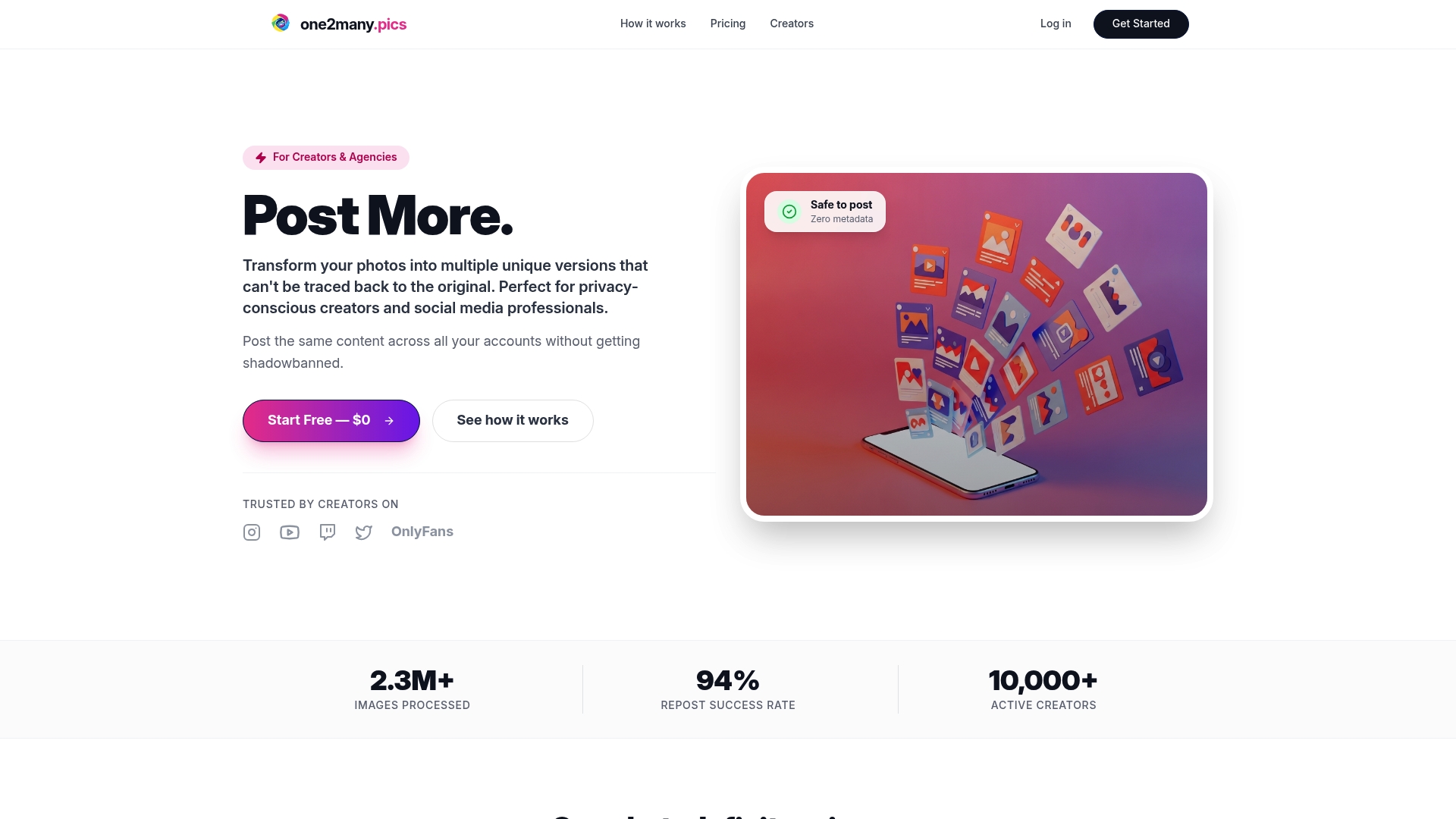
One2many removes that metadata and generates unique visual variations of your images, so your content does not expose your digital footprint when posted across platforms. For agencies and social media managers running content at scale, this is a practical layer of content privacy protection that sits alongside your broader compliance program. The platform handles bulk processing with workflow integrations, making it straightforward to apply privacy controls to every asset before it goes live.
FAQ
What is a privacy checklist for marketers?
A privacy checklist for marketers is a structured list of compliance steps covering consent collection, data mapping, vendor management, deletion workflows, and regular audits. It keeps marketing activities aligned with GDPR, CCPA, and other applicable data protection laws.
How often should marketers run a privacy audit?
Run a full compliance audit at least quarterly and a targeted pre-launch audit before every major campaign. Cookie banners, tags, and pixels should be reviewed on a repeatable cadence to catch gaps before they become violations.
What is the biggest privacy compliance mistake marketers make?
The most common mistake is treating compliance as a one-time setup rather than an ongoing process. Regulations change, new tools get added, and consent records go stale without active maintenance.
Do marketers need a consent management platform?
Yes. A consent management platform like OneTrust or DataGrail is the technical foundation for capturing, recording, and propagating consent in real time across your marketing stack. Manual consent tracking does not scale and creates audit trail gaps.
How does image metadata affect marketing privacy compliance?
Image metadata including GPS location, device model, and timestamps can expose personal and operational information when photos are shared publicly. Removing metadata before publishing is a practical step in any digital creator privacy program.