

Privacy tips for digital creators are proactive, practical steps that protect your personal identity, content, and communications from unauthorized access or exposure. Most creators treat privacy as a reaction to a crisis. The smarter approach treats it as a design principle built into every workflow from day one. This guide covers the tools, habits, and strategies that actually work, from self-audits and tracker blocking to doxxing prevention and privacy-first content management. Whether you post on Instagram, YouTube, or OnlyFans, these practices apply directly to your situation.
1. privacy tips for digital creators: start with a self-audit
A digital self-audit is the fastest way to see exactly how much of your personal information is already public. Most creators are surprised by what they find.
Start by searching your name, email address, and phone number on Google, then run your email through Have I Been Pwned to check for credential leaks. Regular self-audits that remove old geotags and leaked emails block 78% of organized crime breaches targeting creators. That number means one thing: basic hygiene stops most attacks before they start.
Next, search for old posts that contain location data. Many creators forget that photos uploaded years ago still carry embedded GPS coordinates in their metadata. Platforms like Instagram strip some of this data, but not all third-party reposts do. Review your digital footprint mistakes and correct them systematically.
Data broker sites like Spokeo, Whitepages, and BeenVerified aggregate your personal details and sell them publicly. Submit opt-out requests to each one, or use a service like DeleteMe to automate the process. Repeat this audit every 90 days.
Pro Tip: Set a quarterly calendar reminder titled "Privacy Audit" and treat it like a tax deadline. Skipping it is how exposure compounds over time.
2. block trackers and lock down your browser
Your browser is the most leaky tool in your workflow. Every site you visit for research, sponsorship outreach, or competitor analysis can track your IP address and browsing behavior.
uBlock Origin blocks up to 99% of web trackers without slowing down browsing. Install it on Chrome or Firefox immediately. Pair it with Privacy Badger from the Electronic Frontier Foundation for a second layer of tracker blocking. These two extensions together cover the vast majority of tracking scripts that ad networks and analytics platforms deploy.
Beyond extensions, switch your default search engine to DuckDuckGo or Brave Search. Both avoid building a profile on your queries. Use Firefox or Brave as your primary browser since both have stronger default privacy settings than Chrome.
Pro Tip: Use a separate browser profile exclusively for creator work. Keep your personal browsing in a different profile entirely. Cross-contamination of cookies and sessions is a common and invisible leak.
3. use strong passwords and two-factor authentication
Weak passwords and SMS-based two-factor authentication are the two most exploited entry points for creator account takeovers. Fix both today.
Use Bitwarden or 1Password to generate and store unique, 20-character passwords for every account. Never reuse a password across platforms. A single breach on one site becomes a master key to every account where you used the same credentials.
Replace SMS-based two-factor authentication with an authenticator app. Google Authenticator, Authy, and Aegis all work well. SMS codes are vulnerable to SIM-swapping attacks, where a bad actor convinces your carrier to transfer your number to their device. Authenticator apps generate codes locally and cannot be intercepted this way. Apply this to every platform: Instagram, YouTube, TikTok, your email provider, and your domain registrar.
4. use a VPN and encrypted messaging
A VPN masks your IP address and encrypts your internet traffic, which matters most when you connect to public Wi-Fi at coffee shops, hotels, or events. Without one, anyone on the same network can monitor your unencrypted traffic.
Choose a VPN with a verified no-logs policy. Mullvad and ProtonVPN both publish independent audits confirming they do not store user activity. Avoid free VPNs. Free services typically monetize your data, which defeats the purpose entirely.
For private communications with collaborators, editors, and brand partners, use Signal. Signal uses end-to-end encryption by default and does not store message metadata. For team communications, consider Element, which runs on the open-source Matrix protocol. Both are far more secure than standard email or direct messages on social platforms.
5. build privacy-by-design into your content workflow
Privacy-by-design means embedding privacy controls early in content workflows, setting privacy-friendly defaults, and documenting all data flows. This concept comes from software engineering, but it applies directly to how you create and distribute content.
Start by mapping your data ecosystem to identify where sensitive content moves, which reveals common leak points for actionable protection. Draw a simple diagram showing every tool, platform, and person that touches your content from raw file to published post. You will likely find three or four unnecessary stops where data could leak.
The table below compares a standard creator workflow against a privacy-first one:
| Workflow Step | Standard Practice | Privacy-First Practice |
|---|---|---|
| File storage | Google Drive or Dropbox | Encrypted repository (Cryptomator + cloud) |
| Sharing drafts | Send original files via email | Share watermarked, metadata-stripped previews |
| Fan data collection | Collect all available fields | Collect only what you actively use |
| Collaboration | Open folder access | Role-based access with expiration dates |
| Content backup | Single cloud backup | Encrypted offline backup plus cloud |
Metadata in shared files such as location, timestamps, and device info leaks data invisibly. Strip metadata before sharing any draft using tools like ExifTool or ImageOptim. Automated leak monitoring across 500+ platforms, combined with forensic watermarking and encrypted content vaults, protects your work against theft at scale.
6. protect your visual content from metadata exposure
Every photo and video you shoot contains embedded metadata that can reveal your location, device model, and shooting time. This is one of the most overlooked image privacy risks for creators who post frequently across multiple platforms.
Turn off location services for your camera app on both iOS and Android. This prevents GPS coordinates from being embedded at the point of capture. For existing files, use ExifTool to batch-strip metadata before uploading. This single habit removes a significant layer of passive exposure.
When you post similar content across multiple accounts or platforms, platforms use duplicate detection algorithms to flag and suppress that content. Stripping metadata and creating unique visual variations of each image solves both the privacy problem and the suppression problem simultaneously. The guide to visual content privacy covers this in detail for creators managing multiple channels.
7. prevent doxxing with identity separation
Doxxing, the public exposure of a creator's private personal information, is one of the most damaging attacks you can face. The defense is strict identity separation before an attack happens, not after.
Here are the core steps every creator should implement:
- Register your domain with WHOIS privacy enabled. Domain privacy protection masks your personal information from public WHOIS lookups. Registrars like Namecheap, GoDaddy, and Cloudflare offer this free or at minimal cost.
- Use a business email for all public-facing contact. Never list a personal email on your website, press kit, or social bio. Create a dedicated creator email through Google Workspace or ProtonMail.
- Get a P.O. Box for any physical mail. Brand partnerships, PR packages, and legal correspondence should never go to your home address.
- Use Google Voice or a similar service for a public phone number. Separating personal and creator contact info using business emails, P.O. Boxes, and burner phone numbers prevents identity leaks at the most basic level.
- Audit your background details. Street signs, license plates, distinctive landmarks, and school logos in your content all narrow down your location. Review every video and photo before posting.
- Use separate email domains, recovery phones, and payment methods for your creator identity versus your personal identity. Strict separation prevents large-scale identity exposure when one account is compromised.
- Opt out of data broker sites regularly. Services like Kanary and DeleteMe automate this process across hundreds of aggregator databases.
Key takeaways
The most effective privacy strategy for digital creators combines proactive self-audits, technical defenses like uBlock Origin and authenticator apps, and privacy-by-design workflows that strip metadata and separate personal from creator identity.
| Point | Details |
|---|---|
| Self-audits block most breaches | Scanning for leaked credentials and old geotags stops 78% of targeted attacks. |
| Metadata is a silent leak | Strip location, timestamps, and device data from every file before sharing or posting. |
| Identity separation prevents doxxing | Use separate emails, P.O. Boxes, and phone numbers for creator versus personal use. |
| Authenticator apps beat SMS codes | App-based two-factor authentication cannot be intercepted via SIM-swapping attacks. |
| Privacy-by-design beats reactive fixes | Mapping your data ecosystem and setting privacy defaults reduces breach risk at the source. |
Privacy is a workflow, not a checklist
Most creators I work with come to privacy after something goes wrong. An account gets compromised, a location gets exposed, or a draft leaks to a competitor. The pattern is consistent: most creators react to security incidents rather than proactively planning, and a formal security plan detailing assets, access, and protocols is what separates the ones who recover quickly from the ones who don't.
The uncomfortable truth is that no single tool fixes this. uBlock Origin, Bitwarden, and a VPN are all necessary, but they are not sufficient on their own. Privacy requires you to treat your content operation like a small business with real operational security. That means writing down your incident response plan before you need it. It means knowing which accounts to lock, which platforms to notify, and which contacts to alert within the first hour of a breach.
What I've found actually works is treating privacy best practices as a lifecycle process embedded in your creative routine, not a one-time setup. Creators who do this build stronger fan trust because their audience senses the professionalism. Fans share less with creators they don't trust. Brands pay more to partner with creators who demonstrate operational maturity. Privacy is not just protection. It is a competitive advantage.
— one2many.pics
How One2many protects your visual privacy at scale
Stripping metadata and creating unique image variations manually takes time most creators don't have. One2many solves this directly.
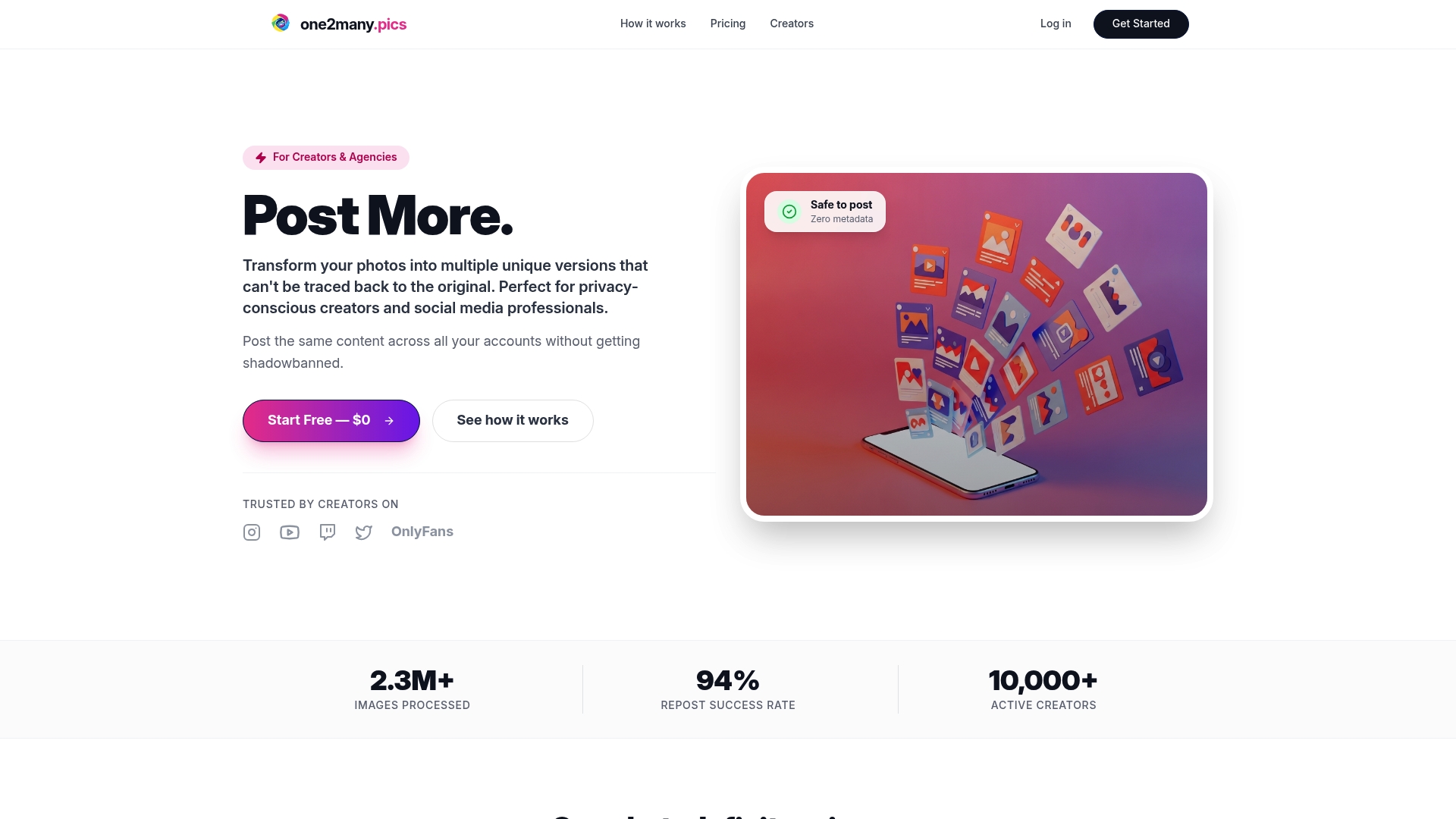
One2many is built for creators who need to post similar content across multiple accounts and platforms without exposing their digital footprint or triggering duplicate detection. The platform removes embedded metadata including location, device info, and timestamps from every image, then generates unique visual variations so each post reads as original to platform algorithms. The upload process is simple, the variation settings are customizable, and downloads are secure. Whether you manage one account or twenty, One2many gives you privacy-focused content tools that fit directly into your existing workflow without slowing you down.
FAQ
What are the most important privacy tips for digital creators?
The highest-impact steps are running regular self-audits using Have I Been Pwned, stripping metadata from all files before posting, enabling app-based two-factor authentication, and separating your personal and creator identities across email, phone, and payment accounts.
How do i remove metadata from photos before posting?
Use ExifTool for batch processing or ImageOptim for individual files. Both remove embedded location, device, and timestamp data before you upload. Platforms like One2many automate this step for creators managing high volumes of visual content.
What is the best way to prevent doxxing as a creator?
Enable WHOIS privacy on your domain, use a P.O. Box for physical mail, list only a Google Voice number publicly, and submit opt-out requests to data broker sites like Spokeo and Whitepages every 90 days.
Why is SMS two-factor authentication unsafe for creators?
SMS codes are vulnerable to SIM-swapping, where an attacker convinces your carrier to transfer your phone number to their device. Authenticator apps like Authy or Google Authenticator generate codes locally, making this attack impossible.
How often should creators audit their online privacy?
Every 90 days is the recommended interval. Each audit should include checking Have I Been Pwned for new credential leaks, reviewing social media privacy settings, and submitting fresh opt-out requests to data broker databases.