

Your content, your audience data, and your platform standing are all at risk every time you skip a privacy step. Influencer privacy strategies are not a legal checkbox. They are operational decisions that determine whether you keep your accounts, retain brand deals, and maintain the trust of your followers. Non-compliance with FTC rules can cost up to $50,120 per violation. Account takeovers, metadata leaks, and shadow suppression are just as damaging. This article gives you a practical, ranked breakdown of what actually works.
Table of Contents
- Key Takeaways
- 1. What influencer privacy strategies actually cover
- 2. Criteria for evaluating any privacy strategy
- 3. Enable two-factor authentication and rotate access regularly
- 4. Use explicit FTC disclosure language every time
- 5. Control your audience data and share only aggregated metrics
- 6. Strip metadata from your content before posting
- 7. Disable geotags and be careful about filming at home
- 8. Audit third-party app permissions every quarter
- 9. Build a formal GDPR and CCPA response workflow
- 10. Choose privacy tools that match your scale
- 11. Adapt your privacy approach based on scale and geography
- My take on where most creators go wrong
- Protect your content privacy with One2many
- FAQ
Key Takeaways
| Point | Details |
|---|---|
| Disclose every partnership clearly | FTC-compliant disclosure language must appear early and visibly in every sponsored post or video. |
| Secure accounts at the system level | Two-factor authentication and regular access audits prevent the most common account breaches. |
| Never share raw audience data | Share only aggregated metrics with brand partners to avoid regulatory and platform penalties. |
| Strip metadata from all content | Location, device info, and timestamps embedded in images expose your identity and enable content tracking. |
| Build a privacy workflow, not just policies | Formal processes for data subject requests and access management protect you long-term. |
1. What influencer privacy strategies actually cover
Most creators think of influencer privacy as protecting their home address or keeping their phone number off the internet. That is a start, but defining influencer privacy at a professional level means something broader. It covers how you manage your account credentials, what metadata travels with your content, how you handle audience data, whether your disclosure practices are legally sound, and how you respond when something goes wrong.
The role of privacy in influencer marketing has grown significantly as platforms collect more data, brands demand more audience insights, and regulators across different countries tighten their rules. Creators who treat privacy as a background concern tend to get hit hardest when a breach, a penalty, or a suppression event occurs. The ones who build privacy into their daily content workflow are the ones who rarely face those situations.
Pro Tip: Think of privacy protection as brand infrastructure. It quietly supports every campaign you run, and its absence shows up at the worst possible moments.
2. Criteria for evaluating any privacy strategy
Before you adopt any new tool or tactic, run it through these four filters to see if it actually solves the problem or just adds complexity.
- Security controls. Does the strategy require or enable two-factor authentication, role-based access, and regular credential rotation? These basics eliminate a majority of account takeover attempts.
- Disclosure compliance. Does it help or hinder your ability to meet FTC disclosure requirements? Any tool that buries or delays disclosure is a liability.
- Data minimization. Does the strategy reduce how much personal data you collect from your audience, or does it create new data liabilities?
- Operational scalability. Can you maintain this practice consistently across platforms, team members, and content formats without it becoming a manual burden?
A good influencer privacy workflow passes all four tests. If a tool only addresses one of these areas and creates friction in the others, it is not a complete solution.
3. Enable two-factor authentication and rotate access regularly
This is the single highest-return security action you can take. Enabling two-factor authentication and limiting third-party app permissions significantly reduces account takeover risks. Yet most creators either skip it on secondary accounts or set it up once and never revisit it.
Set a calendar reminder every 90 days to audit who has access to your accounts. After a collaboration ends, revoke access immediately. Most privacy leaks happen through outdated access controls from past collaborations, not from sophisticated hacking. That is a fixable problem.
Use an authenticator app rather than SMS-based 2FA when the platform supports it. SMS codes can be intercepted through SIM-swapping attacks, which are increasingly common among high-follower creators.
4. Use explicit FTC disclosure language every time
Vague labels like "#sp," "collab," or "spon" do not meet the standard. The FTC requires clear, conspicuous disclosure placed early in the content where audiences will see it before engaging. That means at the beginning of a caption, verbally in the first 30 seconds of a video, or as an on-screen graphic, not buried below a "more" break.
Platform-provided disclosure tools can supplement but do not replace FTC-required disclosures. Checking the "Paid Partnership" label on Instagram or the "Includes Paid Promotion" tag on YouTube is not enough on its own. You need the explicit language too.
Disclosure compliance also protects your brand partners. Brand protection and influencer credibility are directly linked when disclosure requirements are followed consistently. Brands notice when creators take this seriously, and it strengthens your negotiating position.
5. Control your audience data and share only aggregated metrics
When a brand asks for your follower list, email subscribers, or raw audience demographic data, that is a compliance trap. Sharing raw contact lists exposes you to regulatory risks and platform penalties. What you can share safely is aggregated campaign performance data: reach, impressions, engagement rate, and demographic breakdowns without individual identifiers.
Build this boundary into your brand contracts from the start. Add a clause that defines what data you will and will not share, and specify that all audience data shared will be aggregated. This protects both you and your audience. Most brands will accept this once you frame it as a compliance requirement rather than a personal preference.
Pro Tip: When brands push back on data sharing limits, point to GDPR and CCPA as the reason. It moves the conversation from "your preference" to "legal requirement," which most legal and marketing teams respect immediately.
6. Strip metadata from your content before posting
Every image you take on your phone contains EXIF data: your GPS coordinates, device model, timestamp, and camera settings. When you post that image without stripping the metadata, you are publishing your location history, your equipment details, and your posting schedule to anyone who knows how to read it. This is one of the most overlooked privacy concerns for influencers.
Beyond personal safety, image metadata contributes to what platforms use for digital fingerprinting, which can trigger duplicate content detection when you post similar images across accounts. Stripping and transforming your images before posting removes that tracking signal.
This is exactly what One2many was built to solve. The platform removes embedded metadata and generates unique visual variations from your original images so that each version you post is distinct at the file level. You protect your location, your identity, and your content distribution reach at the same time.
7. Disable geotags and be careful about filming at home
Geotags attached to stories and posts give your exact location to anyone viewing the content. For most creators, the risk is less about strangers showing up and more about exposing your home address or your routine patterns over time. Turn off location services for your camera app and your social apps by default.
If you film at home, watch your backgrounds carefully. Window light that reveals a distinctive view, mail visible on a counter, or a neighborhood detail in a reflection can pinpoint your address faster than a geotag. Many creators have had their home locations identified from a single video without any geotag attached.
A practical rule: treat every home-filmed video as a public broadcast from your address. If that level of exposure does not feel acceptable, adjust the background, relocate within your space, or use a virtual background.
8. Audit third-party app permissions every quarter
Every app you connect to your social accounts receives some level of data access. Over time, that list grows. An app you connected two years ago for an analytics campaign may still have read access to your posts, your audience data, and sometimes your messages.
Log into each platform's security settings and pull up the full list of connected apps. Remove anything you do not actively use. For apps you do use, check what permissions they actually need versus what they have requested. Treating access controls as critical infrastructure and rotating credentials routinely reduces your attack surface significantly.
This audit takes about 20 minutes per platform and should happen every 90 days, especially after any team change or platform update.
9. Build a formal GDPR and CCPA response workflow
If you have followers in the EU or California, you are subject to privacy regulations that give individuals the right to request, correct, or delete their data. GDPR requires organizations to respond to data subject access requests within one month, with a possible two-month extension for complex cases.
That timeline starts from the moment the request is received, not when you notice it. Without a formal process, you will miss deadlines. Proper GDPR compliance requires documentation, identity verification, and a clear response protocol. Build a simple intake process: a designated email or form for privacy requests, a log to track incoming requests, and a response template your team can use.
You can find detailed operational guidance in this social media compliance guide to help you set this up correctly without hiring a full-time legal team.
10. Choose privacy tools that match your scale
A micro-influencer managing one account does not need the same toolkit as a creator running five accounts across three platforms with a team of collaborators. Here is a practical comparison to help you match tools to your situation.
| Tool type | Best for | Limitations |
|---|---|---|
| Native platform disclosure tags | All creator sizes | Do not replace FTC language requirements |
| Privacy-focused email platforms (e.g., double opt-in tools) | Creators with email lists | Require active list hygiene to stay compliant |
| Data Processing Agreements with vendors | Macro and mega influencers | Require legal review and ongoing vendor vetting |
| Professional monitoring services (deepfake/impersonation alerts) | High-profile creators | Higher cost, not necessary at micro scale |
| Automated DSAR workflow tools | Creators with large EU/California audiences | Overkill for small audiences without email list |
| Image metadata removal and variation tools | All creator sizes posting across platforms | Requires consistent use; not effective if applied selectively |
Privacy-first email platforms with proper double opt-in reduce data risks and improve compliance. Choose tools that you will actually use consistently rather than tools that offer the most features on paper.
Pro Tip: Vet every third-party vendor you use with one question: "Would I be comfortable if my audience knew this company had access to their data?" If the answer is no, find a different tool.
11. Adapt your privacy approach based on scale and geography
Privacy protection for influencers is not one-size-fits-all. A creator with 5,000 followers on a single platform faces different exposure than someone with 2 million followers across six platforms and international brand partnerships.
For micro-influencers, the priority is foundational security: strong passwords, 2FA, and clear disclosure language. For macro and mega creators, the priorities expand to include vendor contracts with data protection clauses, professional monitoring for impersonation and deepfake threats, and cross-border compliance with multiple privacy laws. Operating in the EU, Australia, or Brazil brings different regulatory requirements than operating exclusively in the US.
If your brand partnerships cross borders, negotiate data protection language into every contract before signing. Specify what data each party can collect, how long they can retain it, and who is responsible for breach notification. Protecting images strategically also plays a role here, particularly when content is shared across regions with different copyright and privacy standards.
My take on where most creators go wrong
I have seen a consistent pattern over the years: creators invest in content quality and audience growth, then treat privacy as something to think about later. The problem is that "later" usually arrives as a platform penalty, a breach notification, or a brand deal that falls through because your compliance record is unclear.
What I have learned is that privacy risks are mostly operational, not technical. The issue is rarely that a creator does not know what two-factor authentication is. The issue is that they never built the habit of rotating access, never had a formal process for data requests, and assumed that platform tools covered all the legal bases. They do not.
The creators I see handling this well treat privacy as part of their brand, not a legal department problem. When your audience knows you take their data seriously, that becomes a real differentiator. And when a brand is evaluating two similar creators, the one with documented compliance practices and clean content history gets the deal.
Balancing transparency with data protection sounds like a contradiction. It is not. You can be open about your partnerships, your process, and your values while keeping your audience data locked down and your personal information protected. Those two things do not conflict. They reinforce each other.
— one2many.pics
Protect your content privacy with One2many
Your content carries more identifying information than you realize. Every unmodified image you post contains metadata that reveals your location, your device, and your posting patterns. For creators posting across multiple accounts or platforms, that data trail also creates duplicate content signals that can suppress your reach.
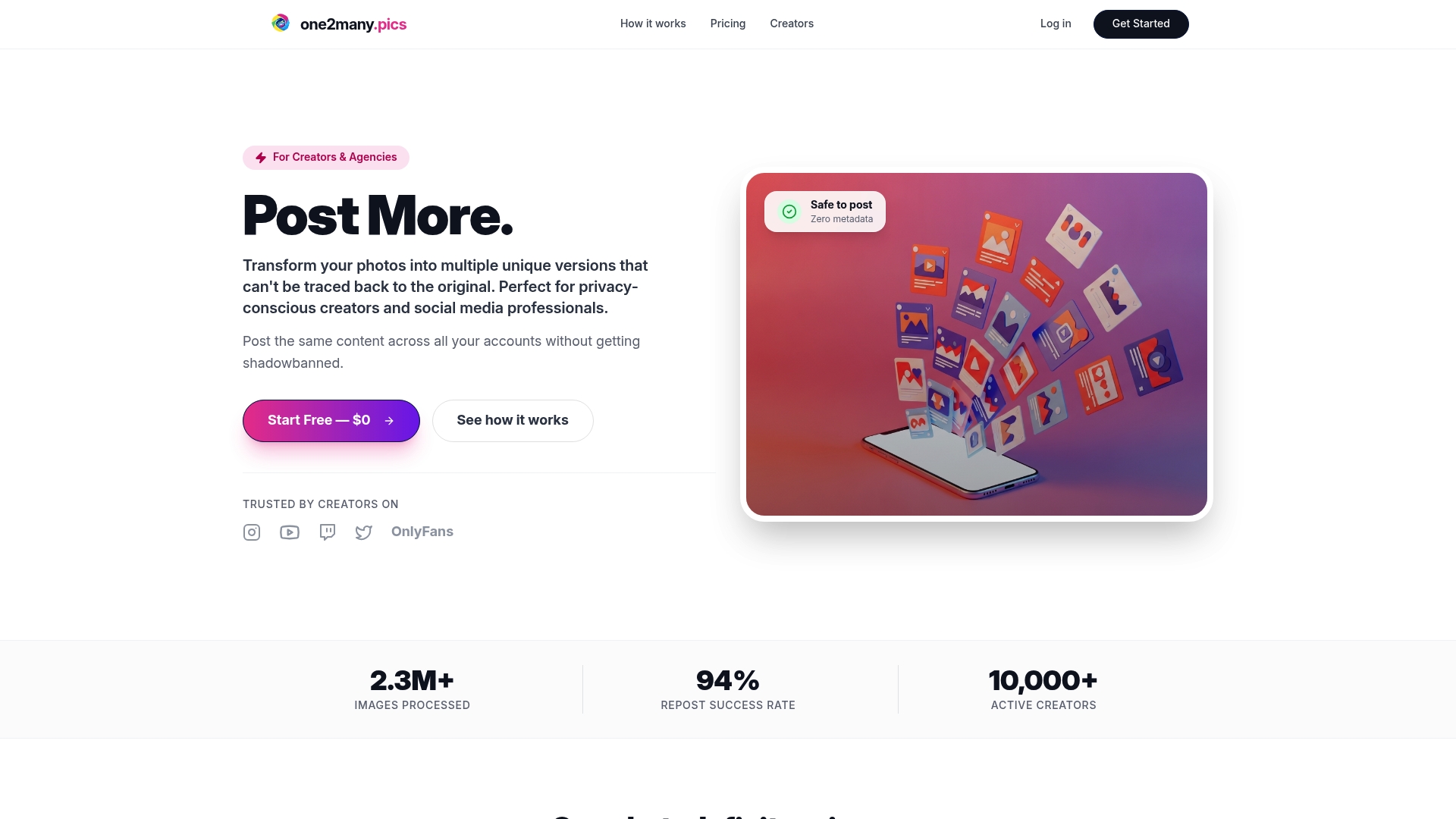
One2many removes embedded metadata from your images and generates unique visual variations so every version you post is distinct at the file level. This protects your personal information, prevents duplicate content detection, and keeps your distribution reach intact. Whether you manage one account or twenty, One2many fits into your existing workflow without adding friction. Explore the full platform and subscription options at one2many.pics and see how it supports the privacy infrastructure your content strategy depends on.
FAQ
What is influencer privacy?
Influencer privacy covers how creators protect their personal data, account credentials, content metadata, and audience information from unauthorized access, platform penalties, and regulatory violations.
Why do influencers need privacy strategies?
Without formal privacy strategies, influencers face account takeovers, FTC penalties up to $50,120 per violation, audience data breaches, and content suppression from platforms detecting duplicate or metadata-flagged posts.
What does FTC disclosure compliance require?
The FTC requires clear, conspicuous disclosure of any material connection with a brand, placed early in the content, using explicit language. Platform tags alone do not satisfy this requirement.
How should influencers handle GDPR data requests?
Influencers must respond to data subject access requests within one month under GDPR. This requires a documented intake process, identity verification, and a written response, regardless of follower count.
How does image metadata affect influencer privacy?
Image metadata including GPS coordinates, device model, and timestamps is embedded in every photo by default. Posting unstripped images reveals your location history and enables platforms to fingerprint your content, which can suppress distribution.