

Platform content policies are the explicit rules social media platforms set to regulate what creators can post, promote, and monetize. Understanding platform content policies is no longer optional for creators, marketers, and agencies. Violate the wrong rule and you lose monetization, reach, or your account entirely. This guide covers the core policy categories, how enforcement actually works, what recent regulations like the EU Digital Services Act mean for you, and how to build a compliance practice that protects your content long term.
What are common examples of platform content policies and violations?
Platform content policies fall into several consistent categories across major social media networks. Knowing these categories is the first step toward building an effective content strategy that survives enforcement.
The most common policy categories include:
- Content authenticity: Platforms prohibit coordinated inauthentic behavior, fake engagement, and undisclosed AI-generated content. X now requires AI disclosure on armed conflict videos, with a 90-day suspension from revenue programs for first-time violations and permanent removal for repeat offenses.
- Misleading promotions and medical claims: TikTok Shop enforces 8 recurring violation types including Misleading Promotions and Medical Claims, each tied directly to creator account sanctions.
- Copyright and intellectual property: Posting unlicensed music, images, or video clips triggers automated takedowns and, in some cases, account strikes.
- Hate speech and harassment: Content targeting individuals or groups based on protected characteristics violates policies across every major platform.
- Adult content: Explicit material outside designated creator programs results in immediate removal and potential permanent bans.
- Ad transparency: Sponsored content must be clearly labeled. Undisclosed paid partnerships violate both platform rules and, in many markets, consumer protection law.
Common influencer platform violations follow predictable patterns. Creators get flagged for direct deposit call-to-action language in ads, unverified health claims in product reviews, posting identical content across multiple accounts without variation, and failing to disclose affiliate relationships. These are not edge cases. They are the most frequent reasons accounts lose monetization access.
Pro Tip: Review the specific violation categories your platform lists publicly, not just the general community guidelines. TikTok Shop, for example, publishes a detailed breakdown of its 8 violation types. Knowing the exact language the platform uses helps you spot risk in your own content before it gets flagged.
How do platforms enforce content policies?
Enforcement is where most creators get surprised. Platforms do not enforce policies the way most creators expect.

Modern platforms combine automated machine learning systems with human review teams. The automated layer catches high-volume, pattern-based violations like duplicate content, keyword triggers, and metadata signals. Human reviewers handle appeals and edge cases. The problem is that translating policy into consistent enforcement using both AI and human teams is one of the leading causes of flawed moderation outcomes. A policy that reads clearly in a document can produce wildly inconsistent results when run through an ML classifier at scale.
Strike systems and account health ratings
Most platforms use tiered enforcement. Minor violations accumulate silently as strikes or account health deductions. TikTok Shop removes e-commerce permissions immediately after 6 violations within 90 days. That threshold sounds generous until you realize violations compound across content types, not just one category. TikTok Shop's Account Health Rating also affects platform-wide features like promotions and bidding access, meaning a degraded rating costs you reach even before a formal suspension.
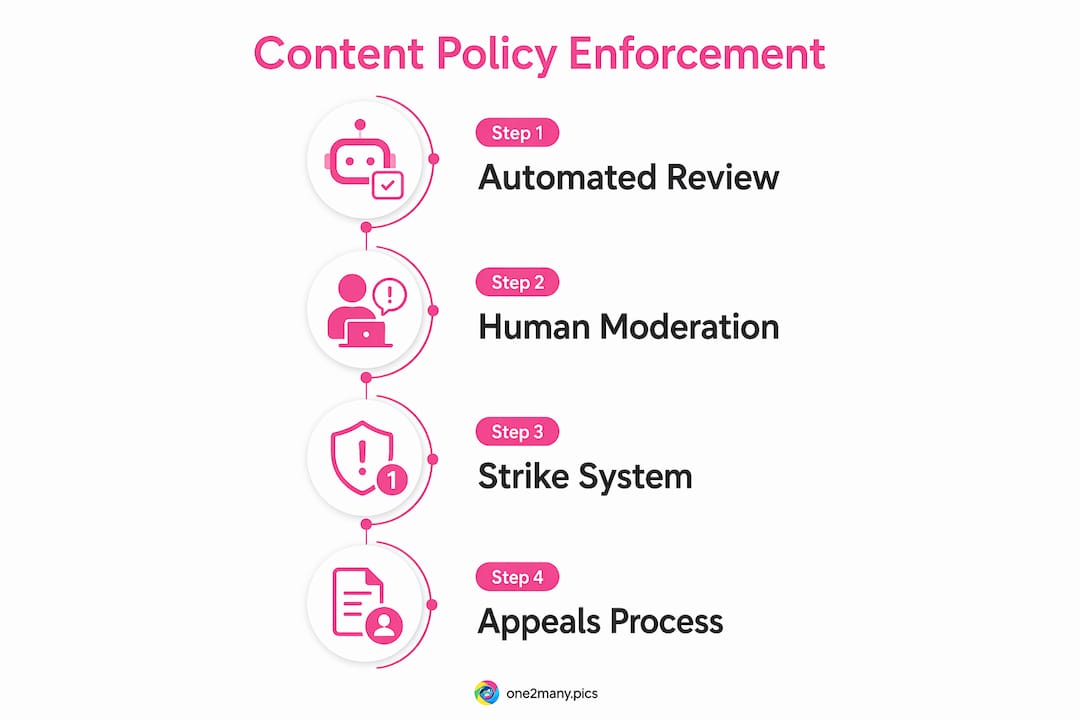
One severe violation can bypass the strike system entirely and trigger immediate enforcement. That distinction matters. A single piece of content with undisclosed AI in a sensitive context can end your revenue program participation without any prior warning.
Vague platform policies cause more harm than strict but clearly defined ones. When enforcement tiers are well-defined, warnings versus suspensions versus permanent bans, creators can manage risk. When policies are ambiguous, enforcement feels arbitrary, and creators cannot predict consequences until they are already penalized.
Pro Tip: Keep a compliance log. Document every piece of content you publish, the platform it went to, the date, and any disclosures included. If you receive a violation notice, that log is your first line of defense in an appeal.
What recent regulations affect platform content policies?
External regulation is reshaping how platforms write and enforce their content rules. The EU Digital Services Act (DSA) is the most significant development in platform governance in years.
The DSA mandates transparency in content removals and requires platforms with large EU user bases to publish meaningful reasons for every removal decision. It also creates out-of-court appeal pathways, giving creators formal routes to contest enforcement decisions that previously had no structured resolution process. That is a meaningful shift. Before the DSA, most appeals were handled by automated systems that simply re-ran the same AI evaluation and returned the same result.
| Regulatory area | DSA requirement | Creator impact |
|---|---|---|
| Content removal transparency | Platforms must state specific reasons for removal | Creators can identify exact policy violations |
| Appeals mechanism | Out-of-court dispute resolution available | Formal path to contest automated decisions |
| Minor protections | Restrictions on targeting users under 18 | Ad targeting parameters must be reviewed |
| Ad transparency | Advertisers and targeting criteria must be disclosed | Sponsored content labeling requirements increase |
The DSA has shifted power toward users with better transparency and appeal mechanisms. For creators operating on global platforms, this means enforcement decisions made in the EU must meet a higher standard of explainability. That standard is gradually influencing how platforms document and communicate enforcement worldwide, not just in Europe.
Creators who operate across multiple regions should treat DSA-level transparency as the floor, not the ceiling. If a platform cannot explain why your content was removed in plain language, that is a signal the enforcement was automated and potentially contestable.
How can creators build a compliance strategy that actually works?
Compliance is not a one-time checklist. It is an ongoing practice that covers your content, your linked assets, and your account behavior across every platform you use.
- Audit your full content ecosystem. Inconsistent landing page disclosures can trigger violations even when your ads appear compliant on their own. Every URL you link from an ad or post must meet the same disclosure standards as the creative itself.
- Build platform-specific compliance checklists. TikTok Shop's qualification process covers 16 product categories, each with its own content rules. A checklist built for Instagram Reels will not catch TikTok Shop violations. Tailor your review process to each platform's specific framework.
- Label AI-generated content proactively. Do not wait for a platform to flag it. X's policy on armed conflict content is the current leading example, but AI disclosure requirements are expanding across platforms. Label AI content in every context where the platform's policy is unclear, not just where it is explicitly required.
- Use geo-targeting carefully. Content that is compliant in one market may violate regulations in another. This applies especially to health claims, financial promotions, and alcohol or gambling content.
- Prepare your appeals before you need them. Maintaining archives of original content and metadata is the most effective way to contest inauthentic behavior claims. Automated appeals often fail because the AI re-evaluates using the same criteria. A human-led appeal backed by documented evidence has a significantly better outcome rate.
- Monitor your account health rating regularly. Do not wait for a suspension notice. Check your account health dashboard weekly and address minor violations before they accumulate to a threshold that triggers enforcement.
For creators managing TikTok brand strategy, adapting content to platform policy changes is now a core part of the creative process, not an afterthought. The creators who maintain reach long term are the ones who treat compliance as a creative constraint, not an obstacle.
Pro Tip: Cross-check your ad creative against your landing page before every campaign launch. The ad may pass review while the landing page triggers a violation. Both assets are evaluated as a single unit by most platform enforcement systems.
Key Takeaways
Platform content policies define the rules of every monetization and reach decision a creator makes, and understanding them at an operational level is the difference between sustainable growth and sudden account loss.
| Point | Details |
|---|---|
| Policy categories are consistent | Most platforms enforce the same core categories: authenticity, copyright, misleading claims, hate speech, and AI disclosure. |
| Enforcement is tiered and cumulative | Minor violations accumulate silently; 6 violations in 90 days removes TikTok Shop e-commerce permissions entirely. |
| Vague policies hurt creators most | Well-defined enforcement tiers give creators predictable risk management; ambiguous rules produce arbitrary outcomes. |
| The DSA raises the transparency floor | EU regulations now require platforms to explain removals and provide formal appeal pathways for creators. |
| Full ecosystem audits prevent violations | Landing pages, ad copy, and linked assets must all meet disclosure standards, not just the primary content. |
What working with platform policies has taught me
The part of platform policy that most creators underestimate is the gap between what a policy says and how it gets enforced. I have seen accounts lose monetization over violations that were technically compliant with the written rule but triggered an automated flag based on pattern matching. That gap is not a bug. It is a structural feature of enforcement at scale.
AI moderation systems are trained on historical violation data. They catch what they have seen before. Novel content formats, new disclosure language, and emerging ad categories often fall into gray zones where the automated system flags first and asks questions later. The appeal process exists precisely because the first enforcement decision is frequently wrong.
What actually protects creators is documentation. Original content archives, metadata records, and compliance logs are not bureaucratic overhead. They are the evidence base for every successful appeal I have seen. Platforms that provide clear enforcement tiers make this process manageable. Platforms that do not require creators to become their own compliance officers.
The creators who thrive long term are not the ones who avoid risk entirely. They are the ones who understand the rules well enough to work within them, document their process, and know exactly what to do when enforcement gets it wrong.
— one2many.pics
How One2many supports your content compliance practice
Staying compliant across multiple platforms while scaling your content output is one of the hardest operational challenges creators face in 2026. One2many is built for exactly that problem.
One2many gives creators and agencies the tools to manage content privacy and variation at scale, removing metadata that can trigger duplicate detection flags and generating unique image versions that protect your digital footprint across accounts. For creators managing high-volume posting schedules, that kind of systematic content management is what keeps accounts healthy and reach intact. Visit one2many.pics to see how the platform fits your compliance and content workflow.
FAQ
What are platform content policies?
Platform content policies are the official rules social media platforms publish to govern what users can post, promote, and monetize. Violating these rules can result in content removal, account strikes, or permanent bans.
What are the most common examples of platform policy violations?
The most common violations include undisclosed AI-generated content, misleading product promotions, unverified medical claims, unlicensed copyrighted material, and failure to label sponsored content. TikTok Shop enforces 8 specific recurring violation types tied directly to account sanctions.
How does the strike system work on platforms like TikTok Shop?
TikTok Shop removes e-commerce permissions after 6 violations within 90 days. Minor violations accumulate silently against your Account Health Rating, while a single severe violation can trigger immediate enforcement without prior warning.
What does the EU Digital Services Act mean for creators?
The DSA requires platforms to provide specific reasons for content removals and offer formal out-of-court appeal pathways. Creators in the EU now have structured legal routes to contest enforcement decisions that were previously handled only by automated systems.
How do I appeal a platform enforcement decision successfully?
Automated appeals frequently fail because the AI re-evaluates using the same criteria. Successful appeals require human-led review backed by original content archives, metadata records, and documented compliance evidence.