

Privacy best practices 2026 define a layered system combining data minimization, behavioral controls, encryption standards, and compliance with GDPR, CCPA/CPRA, and emerging global regulations to protect your digital content and audience. Creators and marketers face a sharper threat environment than ever. Phishing, ransomware, and platform penalties target accounts that expose metadata, skip consent mechanisms, or ignore regulatory obligations. This guide covers the tools, workflows, and compliance steps you need to protect your online presence and stay ahead of enforcement in 2026.
What are the essential privacy tools every digital creator needs in 2026?
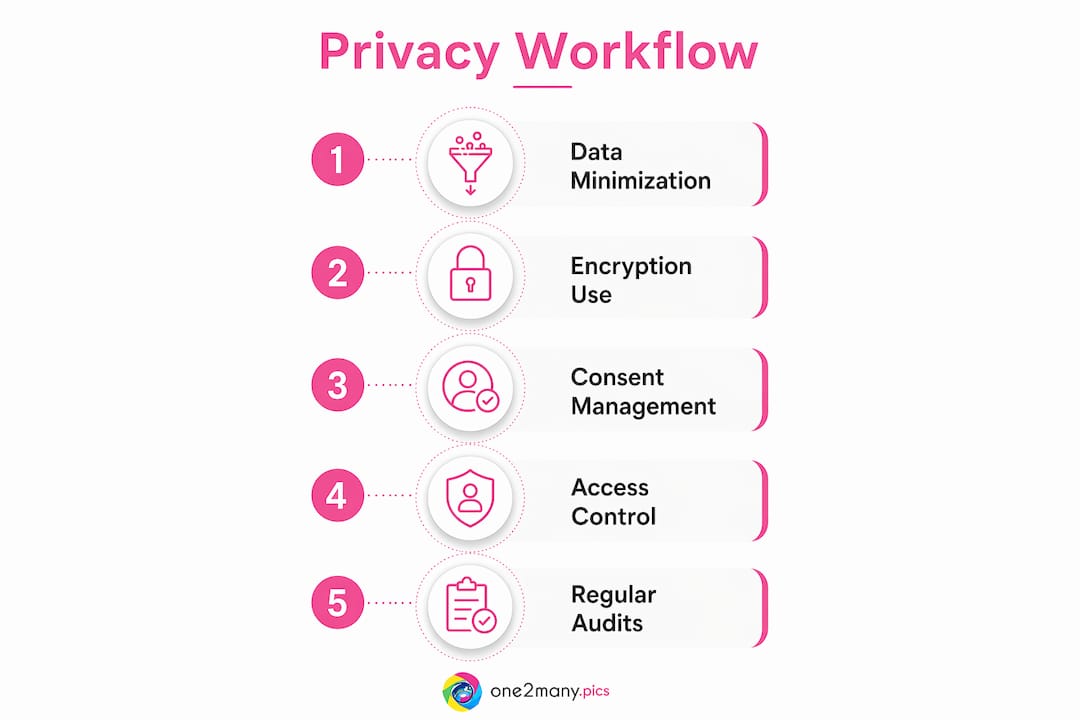
Data minimization is the single most effective technical control available to creators. Collecting less data means less exposure when a breach occurs. Every field you do not collect is a field attackers cannot steal.
Encryption protects data at every stage. AES-256 encryption covers data at rest. TLS 1.3 covers data in transit. Confidential computing addresses data in use. Applying all three closes the gaps that single-layer encryption leaves open.

Zero Trust architecture removes the assumption that anyone inside your network is safe. Role-based access control (RBAC) limits who can touch sensitive files. Multi-factor authentication (MFA) blocks credential-stuffing attacks, which remain one of the most common entry points for account takeovers targeting creators.
Consent Mode v2, developed by Google, is now a baseline requirement for any creator running analytics or ad tracking in Europe. Pair it with a cookie banner that meets WCAG 2.2 accessibility standards and includes an explicit "Reject All" option that blocks tracking scripts before consent is given. Generic banners without these controls are among the top enforcement triggers regulators target.
| Tool or Method | Primary Use Case | Key Benefit |
|---|---|---|
| AES-256 Encryption | Protecting stored files and databases | Prevents unauthorized data access at rest |
| Consent Mode v2 | Analytics and ad tracking compliance | Maintains data flow within GDPR boundaries |
| MFA (Authenticator Apps) | Account access control | Blocks credential-based intrusions |
| RBAC | Team and platform access management | Limits breach surface to authorized users only |
| Metadata Removal Tools | Image and file publishing | Strips location, device, and timestamp data |
Pro Tip: Use a password manager like Bitwarden or 1Password alongside MFA. Password reuse across platforms is the fastest path to a multi-account compromise.
How can creators build privacy-conscious workflows in 2026?
Behavioral privacy controls outperform single-tool reliance. No software fully compensates for habits that expose data by default. The most effective data protection strategies 2026 demands are behavioral first, technical second.
Separating digital identities is the foundational habit. Maintain distinct accounts and devices for professional work, personal use, and any anonymous research or posting activity. Mixing these identities creates cross-platform tracking opportunities that advertisers and bad actors both exploit.
Limit app permissions aggressively. Most social media apps request access to your camera, microphone, location, and contacts by default. Grant only what the app needs to function. Revoke permissions quarterly and audit which platforms have access to your email or calendar through OAuth connections.
Avoid over-aggregating audience data. Collecting email addresses, phone numbers, behavioral data, and purchase history in a single unencrypted database creates a high-value target. Segment data storage and apply retention limits so old records are deleted automatically.
A privacy-focused posting workflow removes metadata from every image before publishing. Image files carry EXIF data including GPS coordinates, device model, and shooting timestamp. Stripping that data before upload is a non-negotiable step for any creator who values location privacy. For a detailed workflow, the privacy-focused posting guide from One2many covers this process step by step.
Common behavioral missteps to avoid:
- Reusing the same profile photo across personal and professional accounts
- Logging into creator tools with your primary Google or Facebook account
- Posting location-tagged content that reveals your home or studio address
- Granting third-party scheduling tools full account access instead of limited API access
- Ignoring platform privacy setting updates after major app version releases
Pro Tip: Set a monthly calendar reminder to audit connected apps across Instagram, TikTok, YouTube, and LinkedIn. Remove any app you have not actively used in 30 days.
What regulatory compliance requirements must creators know for 2026?
GDPR enforcement fines exceeded €5.5 billion by the end of 2025. Non-compliance costs 5–10 times more than compliance for mid-sized firms. Those numbers apply directly to creators who collect audience data, run newsletters, or sell digital products to European users.
GDPR's Article 30 requires a Record of Processing Activities (ROPA). Many creators assume they qualify for the small-business exemption. They are wrong. Most small creators who process data regularly or handle special categories like health or political data must maintain a ROPA regardless of company size. Skipping it complicates every future compliance audit.
CCPA/CPRA applies if you have California-based audience members and meet revenue or data volume thresholds. Key obligations include honoring opt-out requests within 15 business days, providing a "Do Not Sell or Share My Personal Information" link, and responding to data subject access requests within 45 days.
Vendor management is a compliance gap most creators overlook. Every email platform, analytics tool, and scheduling app you use processes your audience's data. Each one requires a Data Processing Agreement (DPA). Without a signed DPA, you bear full liability for that vendor's data handling.
Compliance checklist for creators in 2026:
- Maintain a ROPA documenting every data category you collect and its purpose
- Publish a privacy policy that covers GDPR and CCPA/CPRA obligations
- Implement Consent Mode v2 and a compliant cookie banner with explicit opt-out
- Sign Data Processing Agreements with every third-party vendor
- Conduct a Data Protection Impact Assessment (DPIA) before launching new data-heavy features
- Establish a process to respond to data subject rights requests within legal deadlines
- Audit vendor compliance annually and update contracts when tools change their data practices
Recent multimillion-euro fines against Meta and TikTok confirm that regulators pursue high-profile cases aggressively. Creators with large audiences are not invisible to enforcement.
How can creators defend against cybersecurity threats in 2026?
83% of organizations reported increased cyberattacks in the past year, with phishing, ransomware, and denial-of-service attacks leading the list. Only 24% have fully integrated AI into their cybersecurity defenses. That gap is where attackers operate.
Median dwell time for cyber threats rose to 14 days in early 2026. Attackers spend nearly two weeks inside a system before detection. That window is long enough to exfiltrate audience databases, steal credentials, and plant persistent backdoors.
"Early remediation of low-impact malware alerts is critical. Attackers use them as staging for rapid escalation to serious compromises." — M-Trends 2026, Google Cloud
Do not dismiss small alerts. A low-priority malware notification on a secondary device is often the first step in a larger attack chain. Treat every alert as a potential precursor to a hands-on intrusion.
Practical defense steps for creators:
- Enable login alerts on every platform and review them weekly
- Use phishing-resistant MFA methods such as hardware keys (YubiKey) or passkeys instead of SMS codes
- Subscribe to a threat intelligence feed relevant to your platforms, such as Google's Threat Analysis Group updates
- Apply AI governance as continuous monitoring rather than a one-time setup, especially if you use AI tools in your content production workflow
- Back up all audience data and content assets to an encrypted, offline location weekly
Exploit-based infection vectors account for 32% of intrusions. Keeping software, plugins, and browser extensions updated closes the majority of those entry points without any additional cost.
What are the most common privacy pitfalls creators make in 2026?
The biggest pitfall is assuming GDPR does not apply to small creators. This misunderstanding leads to missing ROPA documentation, absent DPAs, and cookie banners that fail basic compliance tests. Regulators do not grade on audience size.
Generic cookie banners are a direct enforcement risk. A banner that loads tracking scripts before the user clicks "Accept" violates GDPR regardless of how it looks. Dark patterns in consent flows are a primary enforcement trigger. The fix is straightforward: block all non-essential scripts until explicit consent is recorded.
Low consent rates are a signal, not just a metric. If fewer than 40% of visitors accept your cookie banner, the design is likely using confusing language or burying the "Reject All" option. Simplify the language, make both options equally visible, and test across mobile and desktop.
Vendor compliance gaps compound over time. A tool you signed up for two years ago may have updated its data practices without notifying you. Annual vendor audits catch these changes before they become your liability.
Common pitfalls and fixes:
- Pitfall: Assuming the GDPR ROPA exemption applies to your creator business. Fix: Document all processing activities regardless of size if you handle regular or high-risk data.
- Pitfall: Using a cookie banner template without blocking scripts pre-consent. Fix: Implement a consent management platform that gates all tracking until the user responds.
- Pitfall: Skipping DPAs with email marketing or analytics vendors. Fix: Request and sign DPAs before connecting any new tool to audience data.
- Pitfall: Ignoring low-impact security alerts on secondary accounts. Fix: Treat every alert as a potential escalation path and investigate within 24 hours.
Pro Tip: Run a quarterly privacy audit using a simple checklist: consent mechanism, vendor DPAs, ROPA currency, and access control review. Ninety minutes every three months prevents the majority of compliance failures.
Key Takeaways
Effective privacy in 2026 requires layered controls across behavior, technology, and compliance, with no single tool or policy sufficient on its own.
| Point | Details |
|---|---|
| Layer your defenses | Combine encryption, MFA, RBAC, and behavioral controls rather than relying on one tool. |
| Strip metadata before posting | Remove EXIF data from every image to protect location, device, and timestamp information. |
| Comply with GDPR and CCPA/CPRA | Maintain a ROPA, sign vendor DPAs, and implement a compliant consent mechanism with explicit opt-out. |
| Respond to threats early | Median dwell time is 14 days; investigate every alert before attackers escalate to full intrusion. |
| Audit continuously | Review vendor contracts, consent rates, and access permissions every quarter to stay ahead of enforcement. |
Privacy is a system, not a setting
The creators I see struggle most with privacy treat it as a one-time setup. They install a cookie banner, check a compliance box, and move on. That approach fails within months as platforms update their data practices, regulations tighten, and threat actors adapt.
Privacy in 2026 is a program, not a product. The TrustArc 2026 Privacy Playbook frames it well: map privacy risks to measurable outcomes and review them on a regular cycle. That discipline separates creators who stay compliant from those who face enforcement actions.
What I find most underestimated is the behavioral layer. You can deploy every technical control available and still expose your audience through a single habit: logging into your creator tools with a personal account, posting unstripped images, or granting a scheduling app more access than it needs. The social media privacy guide from One2many addresses exactly these workflow-level risks.
AI tools add a new compliance dimension that most creators have not fully addressed. Using an AI writing or image tool means your inputs may be processed, stored, or used for model training. Review the data practices of every AI tool in your workflow. Treat AI governance as an ongoing review, not a one-time terms-of-service check.
The creators who build durable privacy programs share one trait: they treat privacy as a professional standard, not a legal burden. That mindset shift is the most important change you can make in 2026.
— one2many.pics
How One2many helps creators master privacy in 2026
Protecting your digital footprint starts with the content you publish. One2many is built specifically for creators who need to manage image privacy at scale, removing metadata like GPS coordinates, device info, and timestamps before content goes live. The platform generates unique visual variations of your images, reducing duplicate detection risks and protecting your posting workflow across multiple accounts and platforms.
Whether you manage a single account or run campaigns across dozens of profiles, One2many's tools fit directly into a privacy-focused content workflow. Subscription plans range from single-image processing to bulk automation with workflow integrations. Visit one2many.pics to see how the platform supports your digital security best practices in 2026.
FAQ
What are the core privacy best practices for creators in 2026?
The core practices are data minimization, metadata removal, MFA, compliant consent mechanisms, and signed vendor DPAs. Behavioral controls like identity separation and permission audits are equally critical.
Does GDPR apply to small content creators?
GDPR applies to any creator who collects data from European users. Most small creators who process data regularly or handle sensitive categories must maintain a ROPA and comply with data subject rights obligations.
How does metadata in images create a privacy risk?
Image EXIF data contains GPS coordinates, device model, and timestamps. Publishing unstripped images exposes your location and equipment details to anyone who downloads or analyzes the file.
What is the biggest cybersecurity threat to creators in 2026?
Phishing, ransomware, and credential-stuffing attacks are the top threats. 83% of organizations reported increased attacks in the past year, with phishing remaining the most common entry point.
How often should creators audit their privacy practices?
A quarterly audit covering consent mechanisms, vendor DPAs, access controls, and ROPA currency catches the majority of compliance gaps before they become enforcement risks.