

Posting automation is defined as software that automatically schedules and publishes social media content across platforms without manual input, using APIs, rule engines, and AI to manage distribution at scale. For digital marketers and social media managers, this means replacing repetitive daily posting tasks with programmatic workflows that run in the background while you focus on strategy, creative, and audience engagement. Tools like Hootsuite, Sprinklr, and Buffer have made automating social media posts accessible to teams of every size. The shift from manual posting to automated pipelines is no longer optional for brands managing more than two or three active accounts.
What is posting automation and how does it actually work?
Posting automation connects three core layers: a content source, a rule engine, and a distribution layer. The content source holds your approved posts, images, captions, and hashtags. The rule engine defines when each piece of content publishes, to which account, on which platform, and under what conditions. The distribution layer handles the actual API calls that push content live.
Here is how a typical automated posting pipeline runs in practice:
- Content ingestion. A social media manager uploads a batch of posts into a scheduling tool like Buffer or Sprinklr. Each post is tagged with metadata including platform, account, target date, and content type.
- Rule application. The rule engine evaluates each post against pre-set conditions. A rule might say: "Publish this Instagram post at 9 a.m. on Tuesday only if the approval status is confirmed."
- API handoff. The tool calls the platform's official API, passing the content, credentials, and timestamp. Scheduling APIs handle token refresh, error retries, and platform-specific formatting automatically.
- Delivery confirmation. The system logs the result. If a post fails due to a rate limit or API error, the pipeline retries or flags the issue for review.
- Content variation. For multi-account campaigns, the pipeline generates caption variants and swaps hashtag sets to avoid duplicate detection across accounts.
Pro Tip: Set up failure alerts in your automation pipeline so any API error or rejected post triggers an immediate notification. Silent failures are the most damaging because you assume content went live when it did not.
The technical complexity scales fast when you add multiple platforms. Instagram, LinkedIn, TikTok, and X each have different character limits, media specs, and API rate limits. Unified scheduling APIs abstract these differences, letting one content input publish correctly across all channels without manual reformatting.

What features define modern social media automation beyond basic scheduling?
Basic scheduling is just the entry point. Full automation workflows require integrated publishing, engagement, listening, alerts, and analytics to deliver real efficiency gains. Here is what a mature automation system actually covers:
- Batch scheduling and approval workflows. Teams upload content in bulk, route it through a review process, and set it to publish only after sign-off. This prevents unauthorized or off-brand posts from going live automatically.
- AI-powered engagement routing. Incoming comments and messages are categorized by sentiment and intent, then routed to the right team member or answered by an auto-response template. Sprinklr's AI engine, for example, classifies messages and suggests replies in real time.
- Social listening and alerting. The system monitors brand mentions, competitor activity, and trending keywords. When a threshold is crossed, such as a spike in negative sentiment, an alert fires so your team can respond before a situation escalates.
- Rule-based conditional triggers. A trigger might say: "If a post receives more than 500 engagements in the first hour, boost it automatically with a paid promotion." These conditional actions extend automation beyond publishing into campaign optimization.
- Analytics dashboards and automated reporting. Performance data from every platform feeds into a unified dashboard. Scheduled reports go out to stakeholders weekly without anyone pulling data manually.
"Automation systems that only handle posting but omit approvals, engagement routing, and analytics fail to achieve optimal efficiency or consistent messaging." — Sprinklr
The distinction between a scheduling tool and a full automation platform matters enormously for teams managing more than five accounts. A scheduling tool publishes posts. A full platform manages the entire content lifecycle from creation to performance review.
How does posting automation benefit digital marketers?
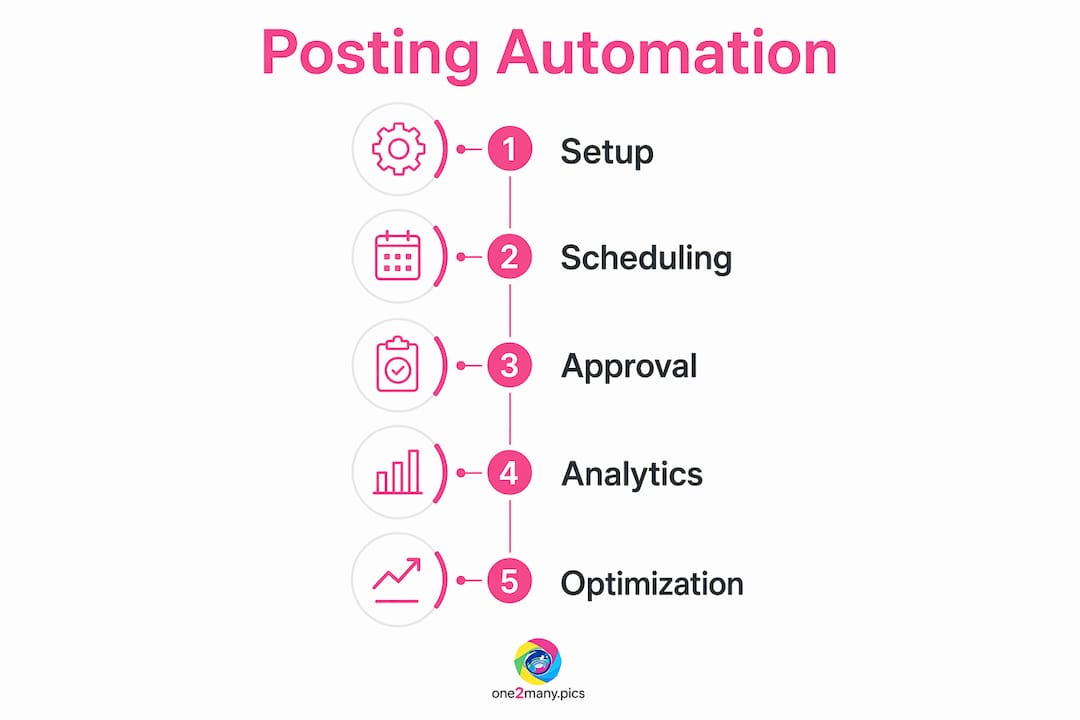
The primary benefit of automating social media posts is time recovery. Automation delegates repetitive scheduling and publishing tasks, freeing marketers to focus on strategy, creativity, and genuine audience interaction. For a social media manager running eight brand accounts across four platforms, that time difference is measured in hours per week, not minutes.
The practical advantages go further than time savings:
- Consistent posting frequency. Algorithms on Instagram, LinkedIn, and TikTok reward accounts that post regularly. Automation holds that cadence even when your team is short-staffed, traveling, or focused on a product launch.
- Optimized timing. AI-driven tools analyze historical engagement data and recommend or automatically select the best posting windows per platform and audience segment. Consistent brand visibility improves when software manages scheduling around peak engagement periods.
- Scalable multi-account management. A single manager can oversee dozens of accounts without a proportional increase in workload. This is especially relevant for agencies running campaigns across multiple client brands.
- Reduced human error. Manual posting introduces risks: wrong account, wrong time zone, missing caption, or duplicate content. Rule-based automation removes most of those failure points.
- Cross-platform reach without extra effort. One approved post can be adapted and distributed to Instagram, Facebook, LinkedIn, and X simultaneously, with platform-specific formatting handled by the tool.
Pro Tip: Use your automation platform's analytics to identify your top three performing post formats per platform, then build content templates around those formats. Automation amplifies what already works, so start with data, not assumptions.
For a deeper look at why this matters in 2026, the case for content automation covers platform-specific strategies and time-saving frameworks worth reviewing.
What are best practices for authentic and compliant posting automation?
Automation without governance creates problems faster than it solves them. Human oversight remains critical to prevent spammy behavior, off-brand messaging, and platform policy violations. Follow these practices to keep your automation pipeline both effective and trustworthy:
- Build approval workflows into every pipeline. No post should publish automatically without at least one human review step, especially for regulated industries or multi-market campaigns. Governance workflows including compliance checks prevent inappropriate content from going live at scale.
- Vary content per platform and account. Posting identical captions and images across multiple accounts triggers duplicate detection on most platforms. Use caption variants, different hashtag sets, and platform-specific creative to keep each post unique. Tools that support content diversification strategies reduce this risk significantly.
- Set conditional posting logic. Use rule engines to pause or redirect posts based on real-world conditions. If a breaking news event makes a scheduled post tone-deaf, a monitoring trigger should flag it for review before it publishes.
- Implement content firewalls for autonomous pipelines. Advanced automation systems use content validation, deduplication checks, and safety rules to reject repetitive or inappropriate content before it reaches the distribution layer. This is non-negotiable for AI-driven posting loops.
- Respect platform rate limits and terms of service. Exceeding API rate limits or automating fake engagement violates platform policies and risks account suspension. Use only official API integrations and stay within published usage thresholds.
The biggest mistake teams make is treating automation as a set-and-forget system. Platform algorithms change, audience preferences shift, and what worked in Q1 may underperform by Q3. Schedule quarterly audits of your automation rules, content templates, and performance benchmarks.
Which posting automation tools should marketers consider in 2026?
The market for posting automation tools has matured considerably. The right choice depends on your team size, platform mix, and how much of the workflow you want to automate beyond basic scheduling.
| Tool | Best for | Key strengths | Limitations |
|---|---|---|---|
| Hootsuite | Mid-size teams | Multi-platform scheduling, analytics, listening | Can feel heavy for small teams |
| Sprinklr | Enterprise | Full automation suite, AI engagement, compliance | High cost, steep learning curve |
| Buffer | Small teams and creators | Simple scheduling, clean UI, affordable | Limited engagement automation |
| Quuu | Content curation | Auto-curated content suggestions, scheduling | Less control over original content |
| PostEverywhere | Developer-focused | API-first scheduling, multi-account support | Requires technical setup |
Hootsuite covers the widest range of use cases for mid-size marketing teams, with native support for Instagram, Facebook, LinkedIn, TikTok, Pinterest, and X. Sprinklr is the choice for enterprise teams that need AI-driven engagement routing, compliance workflows, and unified analytics across global campaigns. Buffer remains the most accessible entry point for creators and small agencies who need reliable scheduling without the overhead of a full platform.
When evaluating any tool, prioritize three things: official API integrations with every platform you use, approval workflow support, and the ability to generate content variants for multi-account posting. For teams managing visual content across multiple accounts, pairing your scheduling tool with a platform that handles cross-platform content distribution adds another layer of reach and efficiency.
Key takeaways
Posting automation delivers its full value only when it covers the entire content lifecycle, from scheduling and approval to engagement, listening, and analytics, not just the act of publishing.
| Point | Details |
|---|---|
| Core definition | Posting automation uses APIs, rule engines, and AI to publish content without manual input. |
| Beyond scheduling | Full automation includes approval workflows, engagement routing, listening, and analytics. |
| Primary benefit | Teams recover hours per week by delegating repetitive publishing tasks to software. |
| Governance is non-negotiable | Approval workflows and content firewalls prevent spammy or off-brand posts at scale. |
| Tool selection criteria | Prioritize official API integrations, approval support, and content variation capabilities. |
The part most marketers skip until something goes wrong
After working with social media managers and content teams across dozens of accounts, one pattern stands out: most teams adopt automation for the time savings and then underinvest in governance until a post goes out at the wrong moment, on the wrong account, or with the wrong message. The automation worked exactly as configured. The configuration was the problem.
The uncomfortable truth about posting automation is that its ceiling is set by your content quality and your rule logic, not by the tool you choose. Hootsuite and Sprinklr are genuinely powerful, but a poorly structured approval workflow in either platform will still let bad content through. I have seen enterprise teams spend significant budget on automation platforms while still manually reviewing every post because they never built the rule logic that would make the approval workflow actually function.
The other thing worth saying directly: automation and authenticity are not opposites. The brands that use automation most effectively are the ones that use it to protect time for genuine interaction, not to replace it. They automate the distribution of planned content and then show up in real time for comments, conversations, and trend responses. That combination is what actually builds audience trust. If you are repurposing content across platforms, understanding how to repurpose content effectively without losing brand voice is worth the time investment before you scale.
Evaluate your automation stack every quarter. Platform APIs change, algorithm priorities shift, and the rules you set in January may be working against you by July.
— one2many.pics
How One2many helps you scale posting without the privacy risks
Posting automation creates a specific problem that most scheduling tools do not solve: when you distribute the same or similar visual content across multiple accounts, platforms detect duplicate metadata and flag or suppress your posts.
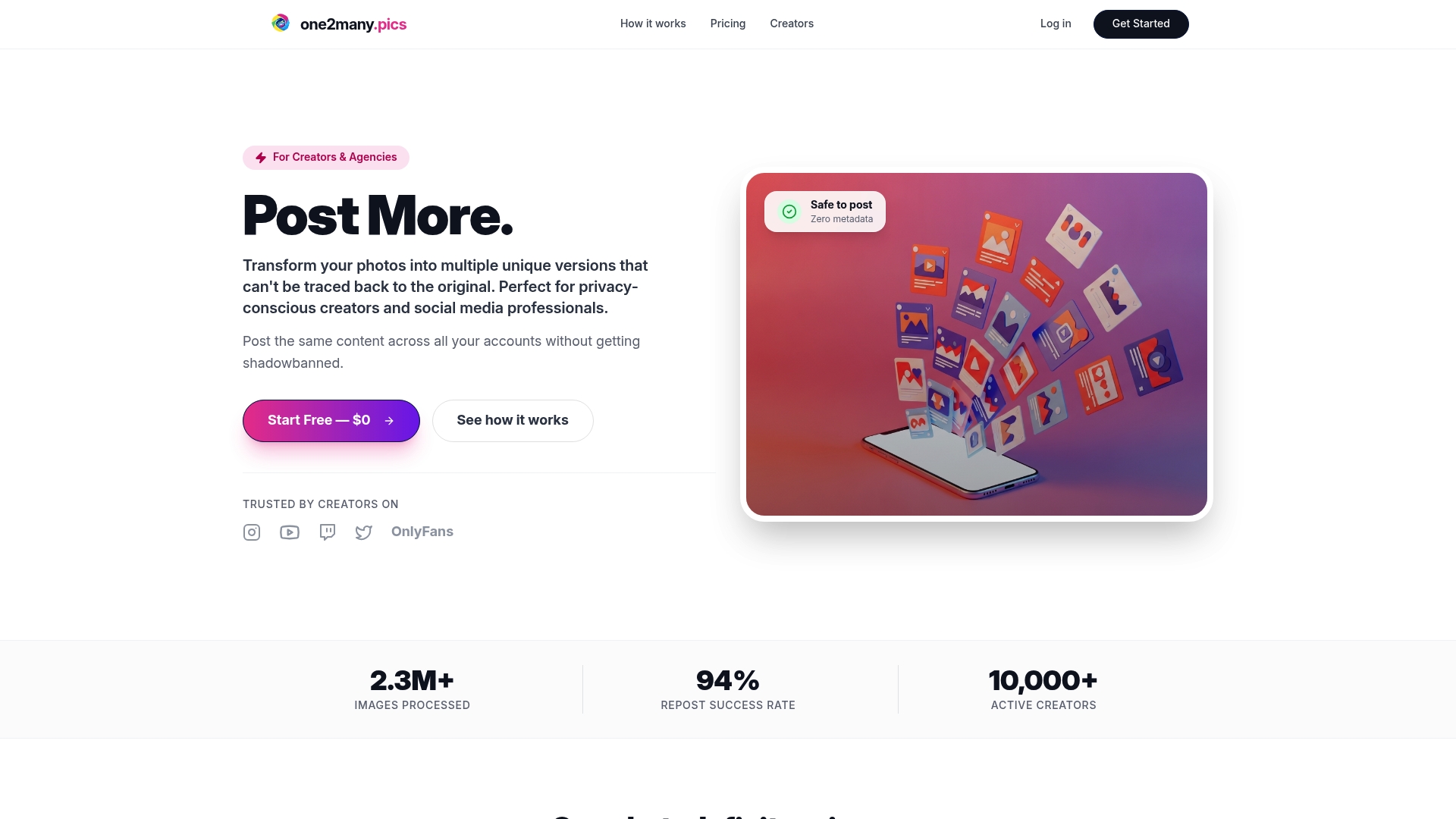
One2many is built to close that gap. The platform transforms original images into unique visual variants by stripping metadata including location, device info, and timestamps, then generating spoofed versions that pass platform duplicate detection. For social media managers running multi-account campaigns, this means your automated pipeline delivers content that looks original on every account, every time. One2many integrates with existing workflows and supports bulk processing for teams that need to scale visual content without triggering shadowbans or suppression. If your automation strategy includes visual content across more than two accounts, this is the layer your current stack is missing.
FAQ
What is the difference between posting automation and basic scheduling?
Basic scheduling lets you set a future publish time for a single post manually. Posting automation uses rule engines, APIs, and conditional logic to manage entire content pipelines across multiple accounts and platforms without per-post manual input.
How does posting automation handle multiple platforms at once?
Unified scheduling APIs abstract platform differences in formatting, character limits, and credentials, allowing one content input to publish correctly across Instagram, LinkedIn, TikTok, and X simultaneously.
Does automation hurt engagement or brand authenticity?
Automation does not hurt authenticity when governed correctly. Human oversight and approval workflows preserve brand voice, while automation handles distribution. The risk comes from removing human review entirely, not from automation itself.
What is the biggest challenge in posting automation?
The most significant challenge is governance: building approval workflows, compliance checks, and conditional routing rules that prevent inappropriate or duplicate content from publishing automatically at scale.
Can small teams benefit from posting automation tools?
Yes. Tools like Buffer offer affordable scheduling and multi-platform support that recover meaningful time even for solo managers or two-person teams handling three or more active accounts.