

Automation can drive over 1,200% ROI for small businesses and agencies, yet the majority of content creators and social media managers still operate with a patchwork of manual tasks, missed posting windows, and genuine confusion about what automation actually does to their privacy and account standing. The promise is real. So are the risks. This guide cuts through both, giving you concrete strategies to scale your output, protect your digital footprint, and avoid the platform penalties that kill reach before it ever has a chance to grow.
Table of Contents
- What is social media automation?
- Core benefits and risks of automation
- Key protocols for safe automation
- Applying automation to maximize impact and privacy
- Why automation power is misunderstood and how it is best harnessed
- Enhance privacy and scale with one2many.pics
- Frequently asked questions
Key Takeaways
| Point | Details |
|---|---|
| Automation drives efficiency | Systematic automation can cut content posting time by 70% and scales reach and leads for teams and agencies. |
| Hybrid workflows beat pure AI | Mixing automation with manual engagement keeps content authentic and minimizes platform penalties. |
| Safe scaling requires protocols | Warm up new accounts, pace posting, and human-edit automated content to avoid detection and bans. |
| Privacy must remain a priority | Choose tools and methods that protect your account and keep posts untraceable as you scale. |
What is social media automation?
Building on the introductory data, let's clarify what automation really means for social media workflows, because this is where most creators get it wrong from the start.
Social media automation refers to using software to handle repeatable, time-consuming tasks that do not require human creativity or real-time judgment. Think scheduling posts, distributing content across platforms, pulling analytics reports, and queuing up images or captions for review. What automation does not cover, and should not cover, is engagement. Replying to comments, responding to DMs, and building community connections are human jobs. Platforms are very good at detecting the difference, and audiences are even better.
The distinction matters because many creators conflate automation with abandonment. They picture a set-it-and-forget-it machine that posts on their behalf while they do nothing. That model fails, and it fails fast. The creators and agencies seeing the biggest wins are the ones using automation to handle logistics so their human energy goes entirely into strategy, creativity, and relationships.
Here is what well-implemented automation actually looks like in practice:
- Scheduling and queuing: Posts go live at optimal times without anyone manually hitting publish
- Content distribution: The same asset gets reformatted and posted across Instagram, TikTok, LinkedIn, and Facebook from a single workflow
- Reporting and analytics: Weekly performance data is compiled automatically so you spend time acting on insights, not collecting them
- Asset management: Images, captions, and tags are organized, tagged, and ready to deploy without hunting through folders
The measurable impact of getting this right is significant. Agencies and creators using structured automation report 70% time savings, cutting weekly social media work from 8.5 hours down to 2.4 hours, while simultaneously seeing a 350 to 425% increase in posting volume, 76 to 110% reach growth, and a 156 to 163% increase in leads generated. These are not projections. These are benchmarks from real implementations.
"Automation is not a replacement for creativity. It is the infrastructure that gives creativity room to breathe."
Learning the privacy and engagement best practices that sit underneath a solid automation strategy is the next logical step once you understand what the tools are actually doing.
Core benefits and risks of automation
With the basics defined, it is crucial to map out both the gains and the real-world risks of automating your workflow, because going in without both sides of the picture is how accounts get flagged and reach gets throttled.
The benefits
The efficiency gains for agencies are particularly striking. Firms that implement structured automation frameworks report 60 to 72% workflow automation, meaning the majority of their social media operations run without manual intervention. That compounds into a client capacity increase of 167% and ROI that can reach 1,268% on the right campaigns. For individual creators, the math is simpler: fewer hours wasted on logistics equals more time for content quality, audience interaction, and brand partnerships.

The risks you cannot ignore
The risks break down into two distinct categories: privacy risks and platform detection risks. They are related but require different solutions.
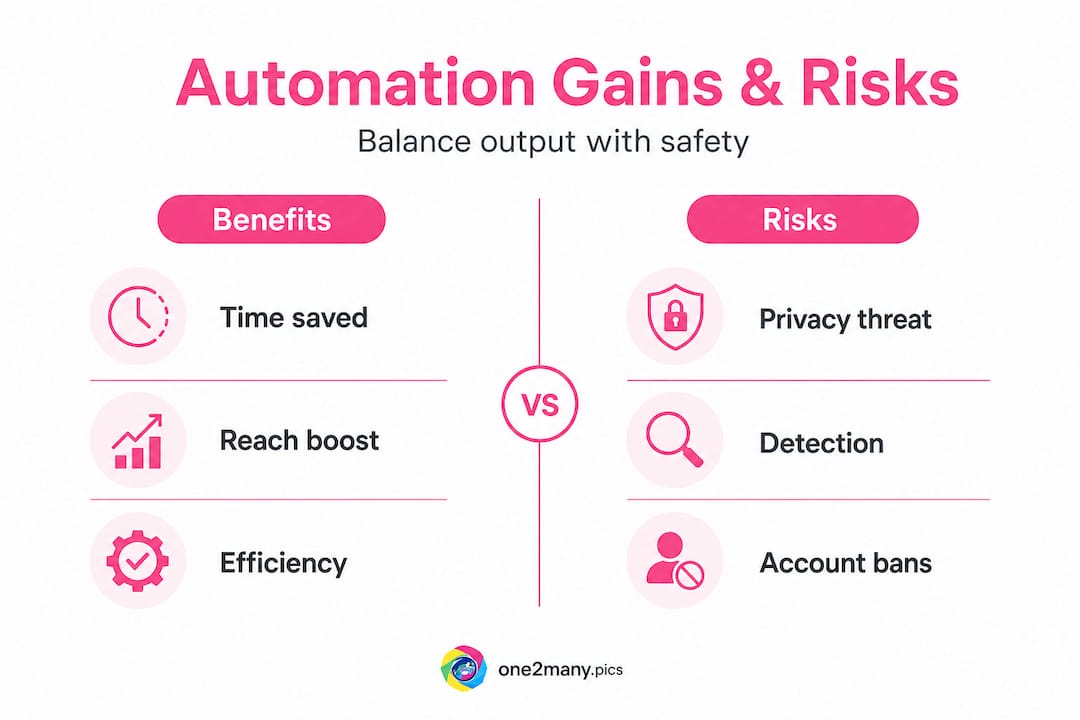
Privacy risks include traceable metadata embedded in images (location tags, device identifiers, timestamps), consistent posting patterns that reveal account relationships, and digital footprints that can connect multiple accounts to a single operator. If you manage multiple accounts for a client or run your own creator portfolio, these traces can expose your workflow and trigger platform reviews.
Platform detection risks are more technical. Research shows that bot-generated content is detectable through linguistic patterns, sentence structure, and posting cadence, particularly once automated content crosses the 20% volume threshold. AI-generated captions and images that do not go through human quality review consistently underperform and can trigger suppression signals that platforms use to limit distribution.
| Factor | Benefit | Risk |
|---|---|---|
| Posting volume | 350-425% increase in output | High-volume posting can trigger platform flags |
| Time savings | 70% reduction in weekly hours | Less oversight can mean lower content quality |
| Reach growth | 76-110% increase in reach | Detectable patterns can reverse reach gains |
| Client capacity | +167% for agencies | More accounts means more privacy exposure |
| AI content | Faster content production | Unreviewed AI posts risk engagement penalties |
Pro Tip: Never let AI-generated captions or images go live without at least one human review pass. Platforms penalize low-engagement content, and unreviewed AI copy is the fastest way to trigger that penalty at scale.
The compliance guide for creators covers the specific platform rules worth knowing before you scale. The privacy guide for creators is essential reading if you manage multiple accounts. And if you have already hit some friction, the guide on avoiding platform penalties walks through recovery strategies.
Key protocols for safe automation
Armed with knowledge of both benefits and hazards, let's walk through proven protocols to automate safely and effectively. These are the guardrails that separate creators who scale without consequence from those who lose reach trying.
Step-by-step safe automation framework
-
Warm up new accounts manually. Research shows that new accounts need 2 to 3 weeks of consistent manual activity before any automation is introduced. This establishes a behavioral baseline that platforms use to assess account legitimacy. Skip this step and your automation will look suspicious from day one.
-
Set posting pace deliberately. Do not go from zero to five posts per day overnight. Increase volume gradually over two to three weeks. Platforms track acceleration patterns, and a sudden spike in output is one of the clearest signals that software has taken over an account.
-
Rotate content assets, not just captions. Posting the same image to multiple accounts, even with different captions, creates a detectable fingerprint. Strip metadata from images and create visual variations before distributing across accounts or platforms. This protects your privacy and prevents duplicate content detection.
-
Apply the Human-in-the-Loop model. This means AI drafts, a human edits and approves, then automation publishes. Hybrid AI-draft workflows yield 80% faster responses and turnaround times compared to fully manual workflows, without the detection risk of full AI autonomy.
-
Separate automation by function. Use automation for scheduling, reporting, and distribution. Use humans for engagement, community management, and creative decisions. Never blur this line.
| Protocol | Threshold | Risk if ignored |
|---|---|---|
| Account warmup | 2-3 weeks manual before automation | Immediate account flag or suppression |
| Posting pace | Gradual increase, not spike | Platform detects bot behavior |
| Image variation | Unique asset per account/platform | Duplicate detection, reduced reach |
| Human review | Every AI-generated piece of content | Low engagement penalty |
| Bot volume limit | Keep automated content below 20% of total | Detectable linguistic patterns |
Pro Tip: Use a content calendar with a dedicated column for "automation type" so every piece of content has a clear label: fully human, AI-assisted, or fully automated. This forces intentionality and prevents defaults that lead to over-automation.
The security tips for accounts give you a technical baseline to protect your infrastructure. For deeper understanding of how different content types interact with privacy settings, the content privacy tips article is highly practical. And if visual content is central to your workflow, the guide on safe visual posting scaling is worth bookmarking.
Applying automation to maximize impact and privacy
Having explored guidelines for safe automation, here is how to put them into practice for maximum benefit and minimum risk. This is where strategy meets execution.
The first decision is tool selection. Not all automation platforms treat privacy the same way. Some store your uploaded images on shared servers, some embed tracking pixels in scheduled posts, and some log account credentials in ways that create exposure. Before committing to any tool, check their data retention policy, image handling protocols, and whether they strip or preserve metadata from uploaded assets.
Structuring your workflow around the Human-in-the-Loop model is not just a safety measure. It is a quality standard. AI content that passes human quality gates consistently outperforms fully automated content on both engagement metrics and reach. The human review step catches tone mismatches, factual errors, and creative gaps that AI tools still get wrong regularly.
Here is a practical workflow structure that balances speed and safety:
- Monday: AI generates the week's content drafts, including captions and image suggestions
- Tuesday: Human editor reviews, revises, and approves each piece, flagging anything that sounds generic or off-brand
- Wednesday: Approved assets are processed for privacy (metadata stripped, visual variations created) and loaded into the scheduler
- Thursday/Friday/Weekend: Automation publishes according to the pre-set calendar, while a human monitors comments and engagement in real time
This approach keeps the smart visual content decisions in human hands while letting automation handle the operational weight. For agencies managing multiple clients across platforms, the cross-platform posting examples resource shows how to adapt this framework for different brand voices and platform requirements without multiplying your workload.
Pro Tip: Build a "privacy checklist" into your content approval process. Before any image goes live, confirm that metadata has been removed, the visual has been varied from any previously posted version, and no identifiable posting patterns link it to your other accounts.
Why automation power is misunderstood and how it is best harnessed
Having examined practical strategies, let's step back and share what most automation guides miss, and why the right balance matters for your growth.
The automation conversation in creator and agency circles tends to swing between two extremes. On one end, full skeptics refuse to schedule even a single post, insisting that "authentic" means manual. On the other end, full enthusiasts want AI running everything, including engagement, believing volume is the path to growth. Both positions are wrong, and both cost creators real money and reach.
Here is the uncomfortable truth: full AI autonomy risks bans, suppression, and long-term account damage that can take months to reverse. But the hybrid model, where AI drafts content and humans edit and approve before automation publishes, yields 80% faster workflows with dramatically lower detection risk. The math makes the case for hybrid clearly, yet most creators either do not know about it or find the discipline of implementing it consistently too demanding.
What we see repeatedly is that creators over-automate content production and under-automate logistics. They let AI write and post captions without review, then manually compile analytics every week. That is exactly backwards. The cognitive work, creative decisions, and quality checks should stay human. The mechanical, repetitive, time-sensitive tasks should be automated.
There is also a privacy dimension that most automation guides skip entirely. Every image you post carries metadata. Every account you manage follows patterns. Every tool you use leaves logs. The creators who scale successfully without triggering shadowbans or duplicate detection are the ones treating privacy as a workflow component, not an afterthought. The privacy-focused platform impact is measurable and significant for anyone managing multiple accounts or posting across platforms at volume.
The creators and agencies winning right now are not the ones with the most automation. They are the ones with the most deliberate automation. Every tool they use was chosen for a reason. Every automated task has a human checkpoint. Every image goes live clean, without a traceable fingerprint attached.
Enhance privacy and scale with one2many.pics
Ready to safely automate your workflow? Here's where smart tools can take your reach and safety to the next level.
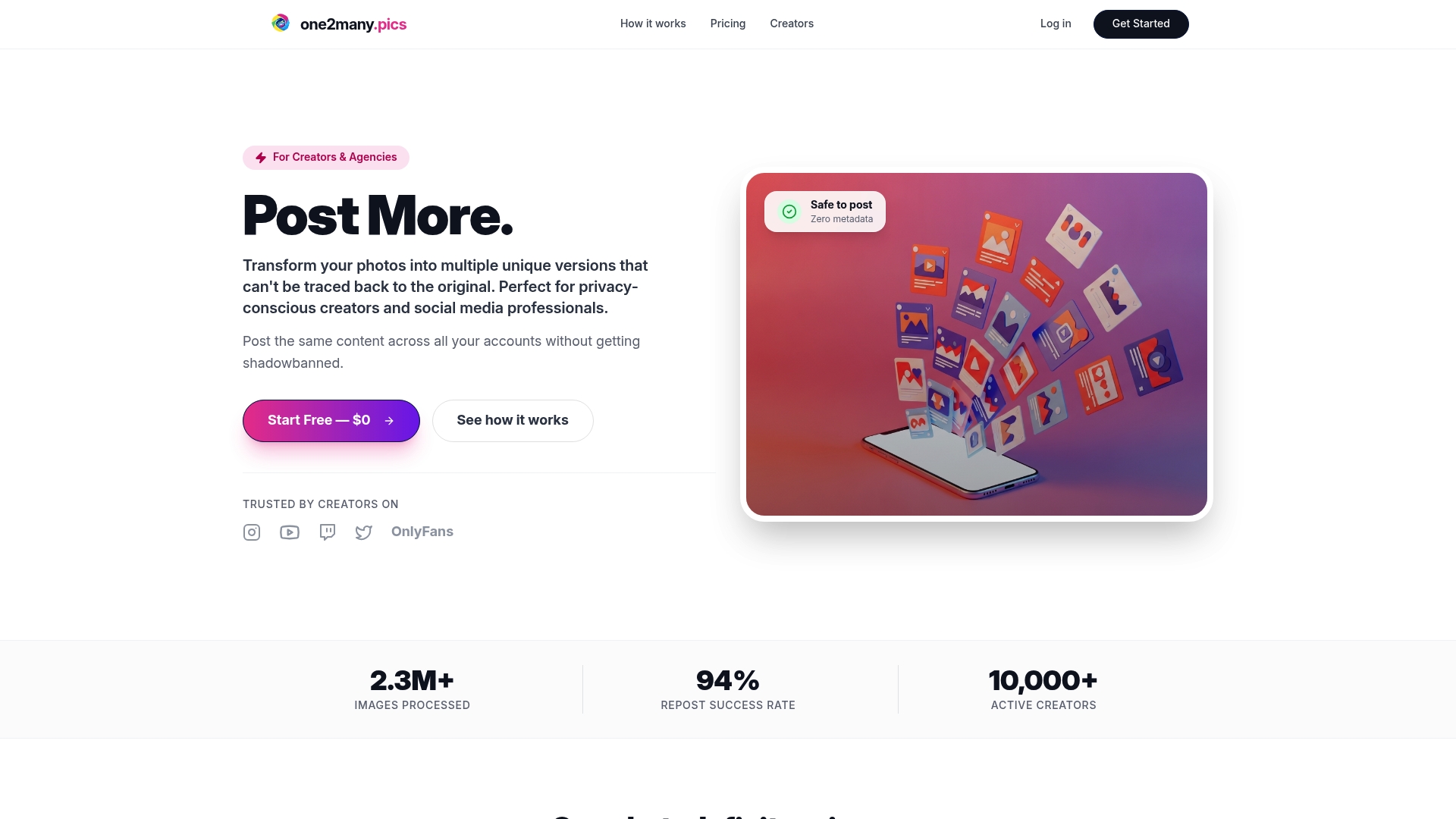
One2Many.pics is built specifically for creators and agencies who take privacy seriously while scaling their output. The platform strips metadata from images including location data, device identifiers, and timestamps, then generates unique visual variations so you can distribute content across multiple accounts and platforms without triggering duplicate detection or leaving a traceable footprint. Whether you are managing a single creator account or a full agency portfolio, the tools are designed to fit directly into the kind of Human-in-the-Loop workflow this guide recommends. You can create untraceable social media images at scale, protect your digital identity, and post with confidence. If you want to add a revenue stream while you scale, the affiliate program offers a straightforward way to earn by introducing other creators to privacy-first content management.
Frequently asked questions
How long does it take to safely scale a new social media account with automation?
Most platforms require 2 to 3 weeks of manual activity before scaling up automation, to establish a legitimate behavioral baseline and avoid account flags.
What's the main risk of full AI-led content automation?
Full AI automation risks bans if bot-like content crosses the 20% posting threshold; hybrid approaches with human review layers minimize both detection and engagement penalties.
How much time can I save by automating social media workflows?
Empirical benchmarks show 70% time savings, cutting the average social media workload from 8.5 hours per week down to just 2.4 hours.
What should I automate and what should remain manual?
Scheduling, reporting, and content distribution should be automated, while engagement, community management, and content quality review require human oversight to maintain authenticity and avoid platform suppression.