

Anonymous posting is the practice of sharing content online without revealing your real identity, and its advantages extend far beyond simple privacy. Research shows that removing identity requirements from feedback forms increases submission volume by 1.5x to 2.5x. That number reflects a broader truth: when people feel safe from judgment, they speak more freely, participate more often, and share more honestly. For social media users and digital creators navigating shadowbanning, harassment, and platform scrutiny, understanding why anonymous posting matters is not optional. It is a practical skill.
1. What are the core advantages of anonymous posting?
Anonymous posting gives creators control over their digital identity. You decide what the public knows about you, and that control shapes every interaction you have online. The benefits of anonymous comments and content go beyond hiding your name. They include protection from retaliation, freedom from social hierarchy, and the ability to test ideas without risking your reputation.
The three most documented advantages are privacy protection, higher participation rates, and more honest communication. Each one builds on the others. When you feel protected, you participate more. When you participate more, you communicate more honestly. That cycle produces richer online communities and better content.

2. How does anonymous posting protect your privacy and safety?
Anonymous posting shields creators from doxing, harassment, and professional retaliation. A creator who shares a controversial opinion under their real name risks losing clients, followers, or even employment. Posting without a linked identity removes that risk entirely.
The anonymous posting privacy benefits are especially significant for marginalized groups. LGBTQ+ communities and political minorities use anonymous channels to participate in public discourse without exposing themselves to discrimination or government surveillance. Anonymity is not a niche tool for edge cases. It is a historical tradition of political resistance and community support.
A Cato Institute survey found that 62% of Americans fear sharing political views publicly, rising to 77% among conservatives. That figure shows how widespread self-censorship already is. Anonymous posting directly counters that chilling effect.
One critical limitation: pseudonyms alone do not guarantee privacy. Metadata and digital fingerprints can reveal your identity even when your name is hidden. Location data, device information, and posting timestamps all create a traceable trail.
Pro Tip: Strip metadata from every image before posting. One2many removes location, device info, and timestamps from your files automatically, so your content does not carry hidden identity signals.
3. Why does anonymous posting increase engagement and honest feedback?
Anonymous environments produce more participation and more candid responses. The data is consistent: submission rates rise 150–250% when anonymity is the default setting. That is not a marginal improvement. It represents a fundamental shift in how willing people are to contribute.
The psychological mechanism is straightforward. Anonymity creates psychological safety. When you are not worried about being judged, you stop filtering your thoughts. Studies in LGBTQ+ and mental health forums confirm that anonymous environments produce more authentic conversations than named ones. Creators who want genuine audience feedback get more of it when they remove the identity requirement.
Anonymous environments also neutralize social hierarchy. A junior creator's idea carries the same weight as a senior influencer's when neither name is attached. That levels the playing field and surfaces ideas that would otherwise stay buried under impression management.
The tradeoff is real, though. Anonymous bug reports and feedback submissions cost roughly 10x more to follow up because they lack context. More volume does not always mean more useful signal.
| Scenario | Named posting | Anonymous posting |
|---|---|---|
| Participation volume | Baseline | 1.5x to 2.5x higher |
| Honesty level | Filtered by social risk | Significantly less self-censored |
| Hierarchy effect | Status influences reception | Ideas evaluated on merit |
| Follow-up cost | Lower, identity available | Higher, context often missing |
4. What are the ethical considerations of posting anonymously?
Anonymity protects truth-tellers and enables abuse in equal measure. That tension is the central ethical challenge of anonymous posting. Ethics experts draw a clear line: anonymity is justified when it protects speakers from power, and far less defensible when it is used to avoid accountability for harmful acts.
"Anonymity is justified when protecting speakers against power but less defensible when used to avoid accountability. The ethical weight shifts depending on who is being protected and from what." — Ethics Centre
The same feature that lets a whistleblower report corruption safely also lets a troll harass someone without consequence. Platforms that allow anonymous posting face genuine moderation challenges. Reduced accountability correlates with reduced empathy, and that combination produces cruelty that named environments tend to suppress.
The solution is not to eliminate anonymity. It is to build moderation systems that protect vulnerable voices while removing cover for bad actors. Creators who use anonymous channels have a responsibility to model the behavior they want to see, even when no one knows who they are.
5. How do creators use anonymous posting effectively today?
The most effective approach is a hybrid model. Use anonymous posting for ideation, sensitive topics, and audience research. Use your named account for announcements, collaborations, and anything that requires trust and follow-up. Hybrid anonymity workflows increase volume during the discovery phase while preserving accountability where it matters.
Here is a practical framework for creators:
- Separate your accounts by purpose. Keep an anonymous account for testing ideas and a named account for your public brand. Never cross-post content that links the two.
- Use a VPN when posting anonymously. Your IP address is a direct identifier. A VPN masks it and prevents platforms from connecting your anonymous activity to your named account.
- Strip metadata from every image. Exif data embedded in photos includes GPS coordinates, device model, and timestamps. Tools like One2many remove this data before your image reaches a platform.
- Avoid reusing usernames or profile photos. Consistent handles across platforms create a digital fingerprint even without a real name attached.
- Review your privacy settings on every platform. Default settings on most social networks favor data collection. Adjust them manually for each account.
- Use a separate email address for anonymous accounts. Your primary email connects to your identity through account recovery systems and advertising profiles.
- Post at varied times. Consistent posting schedules can be matched across accounts by anyone analyzing behavior patterns.
Pro Tip: Before you post anonymously, read the platform's terms of service. Some platforms prohibit multiple accounts entirely. Knowing the rules lets you make an informed decision rather than an accidental one.
True anonymity requires layered protection, not a single step. A pseudonym without a VPN, metadata-free images, and separate infrastructure is not real anonymity. It is a thin mask that determined observers can remove. Creators who take privacy-focused posting seriously treat it as a system, not a setting.
The risks of assuming you are anonymous when you are not are significant. Platforms use device fingerprinting, behavioral analysis, and IP tracking to link accounts. A single slip, like logging into both accounts on the same device without a VPN, can collapse your separation entirely.
Podcast creators face similar concerns. Privacy in audio content involves metadata, hosting data, and listener tracking that most creators never consider. The same layered approach that protects social media anonymity applies to audio publishing.
6. Why anonymity matters for content creators specifically
Anonymous posting is not just a privacy tool. It is a content strategy. Creators who use anonymous channels can test controversial ideas, gather unfiltered audience reactions, and participate in communities where their public persona would create bias. That research informs better named-account content without exposing the creator to blowback during the experimental phase.
Anonymity also protects creators from the specific risks of image-based digital footprints. Every photo you post carries embedded data that platforms read and store. Removing that data before posting is not paranoia. It is standard practice for anyone managing multiple accounts or posting sensitive content.
The pros of posting anonymously compound over time. Creators who build anonymous channels for honest community engagement develop a clearer picture of what their audience actually thinks, separate from what followers say to their face.
Key Takeaways
Anonymous posting increases participation, protects vulnerable creators, and produces more honest feedback, but it requires layered technical protection to work as intended.
| Point | Details |
|---|---|
| Participation jumps with anonymity | Removing identity requirements raises submission rates by 1.5x to 2.5x consistently. |
| Metadata defeats pseudonyms | A fake name alone does not protect you. Strip image metadata and use a VPN every time. |
| Hybrid models work best | Use anonymous posting for ideation and named accounts for trust-dependent communication. |
| Ethical use requires self-regulation | Anonymity protects truth-tellers but also enables abuse. Model the behavior you want to see. |
| Platform rules vary | Some platforms ban multiple accounts. Know the terms before building an anonymous workflow. |
What I have learned from watching creators use anonymity
Anonymity gets a bad reputation because the loudest anonymous voices are often the worst ones. That framing misses the majority of people who use it quietly and responsibly. The creator who tests a new content angle anonymously before committing to it publicly is not being deceptive. They are being careful.
The part that most guides skip is the emotional dimension. Posting under your real name carries weight that accumulates over time. Every opinion becomes part of your permanent record. Anonymity gives creators a space to think out loud without that pressure, and that space produces better ideas.
The accountability concern is real but overstated as a reason to avoid anonymity entirely. Accountability exists in named environments too, and it does not always produce honesty. People say what they think will be received well, not what they actually believe. Anonymous environments flip that dynamic.
The practical advice I would give any creator is this: treat anonymity as a tool with a specific job, not a permanent identity. Use it where it serves you, protect it technically so it actually works, and stay ethical in how you engage. Anonymity is not a license to behave badly. It is a license to speak freely. Those are very different things.
— one2many.pics
How One2many supports privacy-focused creators
Creators who take anonymous posting seriously need more than a fake username. They need tools that remove the technical traces that platforms use to link accounts and suppress content.
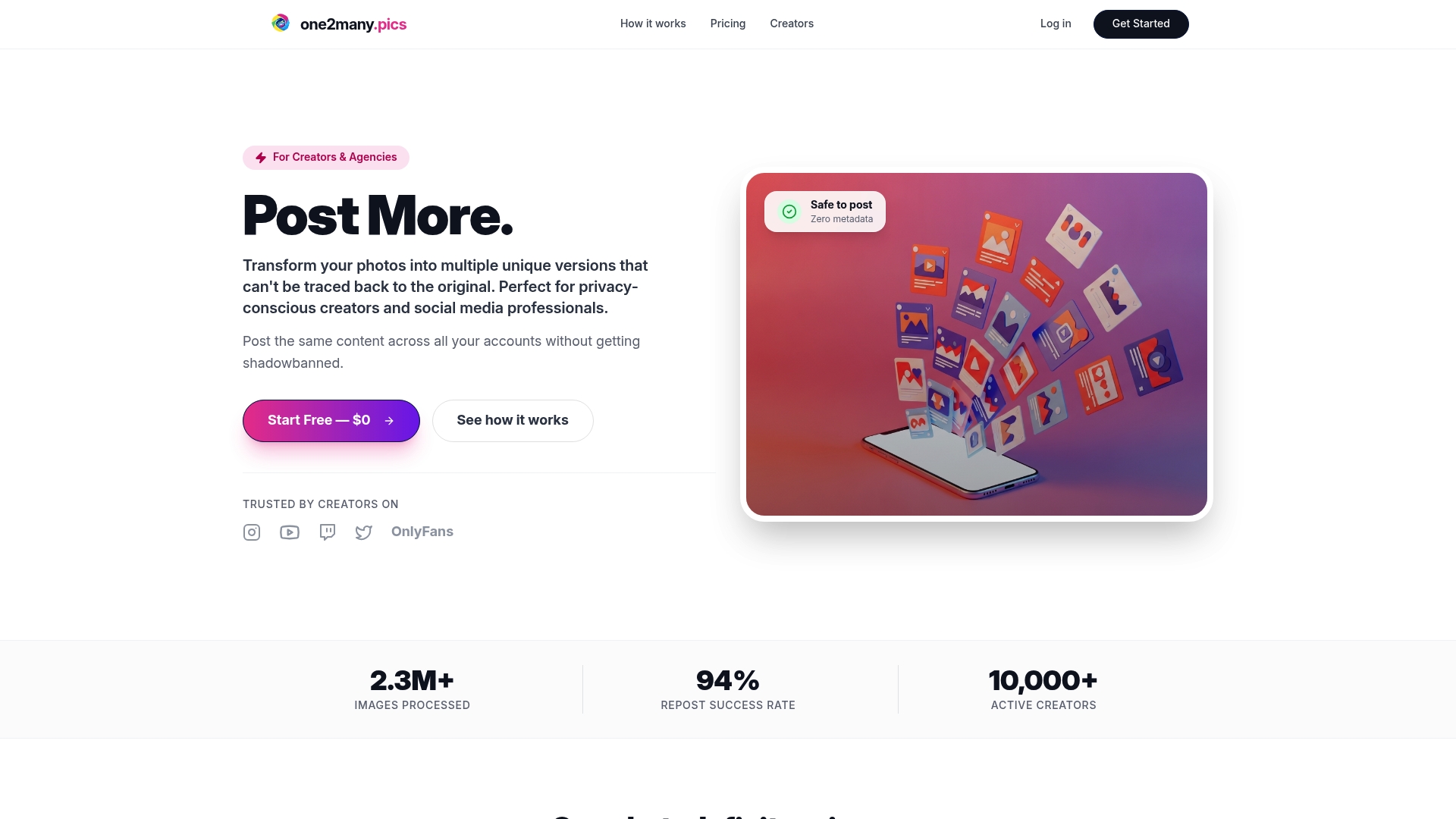
One2many is built for exactly that. The platform strips metadata from images before you post, including location data, device information, and timestamps. It also generates unique visual variations of your content so that duplicate detection systems cannot flag the same image posted across multiple accounts. For creators managing secure content workflows at scale, One2many handles the technical layer so you can focus on the content itself. Plans range from single-image processing to bulk automation with workflow integrations. Visit one2many.pics to see which plan fits your posting volume.
FAQ
What is anonymous posting?
Anonymous posting is sharing content online without disclosing your real identity. It can involve pseudonyms, separate accounts, or technical tools that remove identifying metadata from your content.
Does anonymous posting actually increase participation?
Removing identity requirements raises submission rates by 1.5x to 2.5x. The increase is consistent across feedback platforms, forums, and social media environments.
Is a pseudonym enough to stay anonymous?
A pseudonym alone is not sufficient. Metadata and digital fingerprints including IP addresses, device data, and image Exif information can identify you even when your name is hidden.
Who benefits most from anonymous posting?
Marginalized groups, political minorities, whistleblowers, and creators testing new ideas benefit most. Anonymous communication lowers barriers for people who face real social or professional risks from speaking publicly.
What is the biggest risk of posting anonymously?
The biggest risk is assuming you are protected when you are not. Without a VPN, metadata removal, and separate account infrastructure, anonymous accounts can be linked to your real identity through behavioral analysis and platform tracking.