

Content anonymity is defined as the practice of publishing, sharing, or monetizing digital content without revealing your real identity. The benefits of content anonymity go well beyond simple privacy. Creators who operate anonymously report stronger creative freedom, lower personal risk, and in many cases, higher earnings potential. Anonymous creators earn between $3,000 and $30,000 monthly without ever showing their face. That range proves anonymity is not a hobbyist workaround. It is a legitimate business model. One2many supports this shift by giving creators the tools to strip metadata and generate unique image variations, so your digital footprint stays invisible while your content keeps working.
What are the primary benefits of content anonymity for creators?
Content anonymity gives creators a structural advantage that personal branding cannot. When your real identity is not attached to your content, you control the risk profile of everything you publish.
The core advantages break down clearly:
- Identity protection. Your name, location, and device data stay off the record. This matters most for creators covering sensitive topics, political commentary, or niche communities where personal exposure carries real consequences.
- Freedom to experiment. Anonymity enables experimentation with controversial or niche content without risking your professional or social reputation. You can test formats, opinions, and audiences without those experiments following you permanently.
- Reduced harassment. Creators with public identities absorb personal attacks, doxxing attempts, and coordinated pile-ons. Anonymous creators redirect that energy back into content.
- Scalable brand assets. An anonymous brand is not tied to one person's face or voice. That makes it easier to hire writers, editors, or co-creators without disrupting the brand's identity.
- Free expression protection. Anonymity protects dissenters challenging powerful figures from retaliation. That principle applies directly to creators covering topics that attract institutional or community pushback.
Pro Tip: Build your anonymous brand around a clear niche and consistent voice from day one. Audiences follow quality and consistency. They do not need a face to build loyalty.
The advantages of anonymous content are not theoretical. They show up in audience behavior, content output, and business structure. Creators who separate identity from content often publish more frequently and more boldly than their public-facing peers.
How does anonymity impact a creator's income and business model?
Anonymous content creation is a proven income path, not a compromise. The monthly earnings range of $3,000 to $30,000 reflects creators running newsletters, podcasts, digital product shops, and faceless YouTube channels. That spread is wide because the ceiling depends on niche, volume, and monetization mix, not on whether your face appears on camera.
The most common monetization structures for anonymous creators include:
| Revenue Stream | How it works without identity |
|---|---|
| Newsletters | Subscribers pay for insight, not personality |
| Digital products | Templates, courses, and guides sell on value |
| Affiliate content | Niche review sites earn commissions anonymously |
| Faceless video channels | Voiceover or text-based content drives ad revenue |
| Licensing and syndication | Content assets sell or license independently of creator |
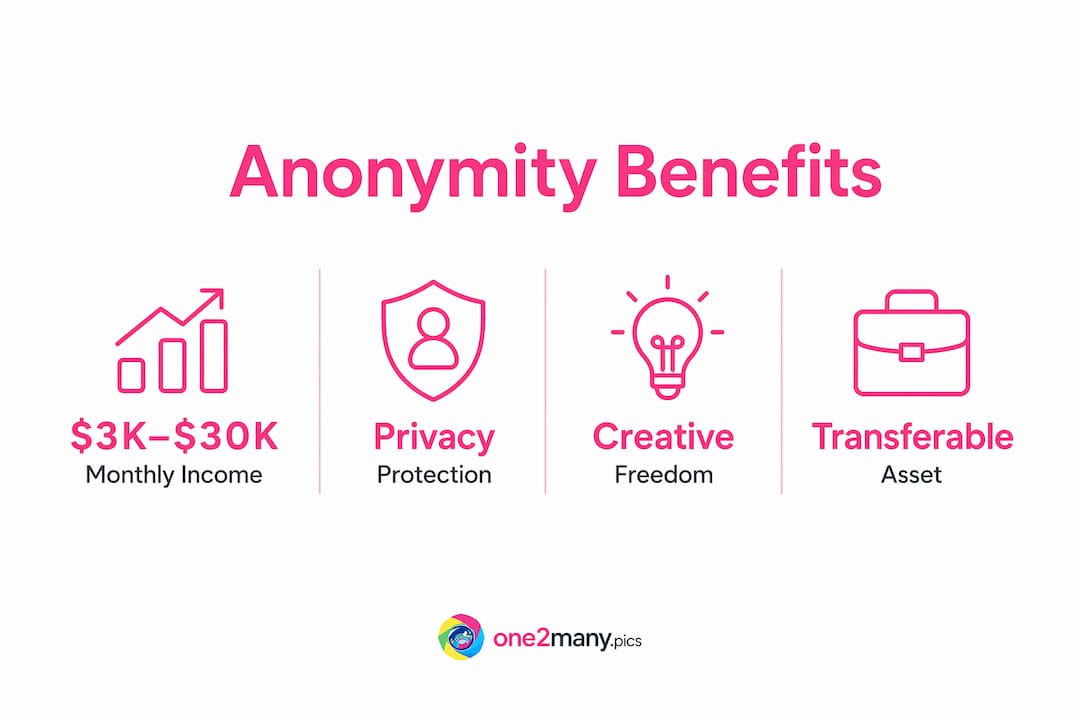
The business model advantage goes deeper than income. Anonymous brands facilitate the sale or delegation of a media property because the asset is not locked to one person's identity. A newsletter with 50,000 subscribers built under a pseudonym can be sold, staffed, or handed off without losing its audience. A personal brand built around your face cannot be transferred the same way.
This separation also makes delegation practical. You can bring in guest writers, editors, or social media managers without exposing the brand's core identity or your own. That is how anonymous content operations scale into media businesses rather than staying solo projects.
Pro Tip: Structure your anonymous brand as a business from the start. Register it as a separate entity, use a dedicated payment processor, and keep all brand communications under the pseudonym. This makes future delegation or sale far cleaner.
For creators exploring how to build this kind of operation, reviewing anonymous posting advantages gives a practical starting point for structuring your approach.
What are the psychological and creative advantages of anonymous content creation?
Anonymity removes a tax that most creators do not realize they are paying. Visibility costs creators time and mental health. Managing a public persona means monitoring comments, curating your image, and absorbing public judgment as part of the job. Anonymous creators skip that overhead entirely.
The psychological benefits are specific and measurable in behavior:
- Lower burnout rate. Without the pressure to maintain a personal brand image, creators focus on the work itself rather than the performance of being a creator.
- Freedom from narrative capture. Public creators get locked into audience expectations. Once you are known for one thing, pivoting feels like a betrayal. Anonymous creators change direction without friction.
- Bolder creative choices. Anonymity removes social desirability bias, producing more honest and higher-quality content. Creators say what they actually think rather than what their audience wants to hear.
- Focus on quality over personality. When your face is not the product, your ideas have to carry the content. That constraint forces better writing, tighter editing, and stronger concepts.
Platforms supporting pseudonymous interactions see higher psychological safety and more open discourse on sensitive topics. That finding applies directly to creators. When you are not personally exposed, you engage more honestly with your subject matter. Your audience gets better content as a result.
The creative freedom that comes with pseudonymous content creation is not just about avoiding criticism. It is about removing the self-censorship that public identity creates. Creators who know every post reflects on their real name write defensively. Anonymous creators write freely.
What challenges and trade-offs come with anonymous content creation?
Anonymous content creation carries real trade-offs. Understanding them upfront prevents costly mistakes later.
- Slower audience trust. Personal connection accelerates loyalty. Without a face or name, you build trust through consistency and quality alone. That takes longer, especially in the early months.
- Limited premium pricing for personal services. Coaching, consulting, and speaking engagements depend on personal credibility. Anonymous creators cannot charge the same premium for services that require a verifiable identity.
- Partnership and sponsorship friction. Brands often require creator identity verification before signing deals. Anonymous creators face more scrutiny and sometimes outright rejection from partnership programs.
- Metadata and re-identification risks. True anonymity is technically difficult. Metadata embedded in images, linguistic patterns in writing, and behavioral data across platforms can re-identify creators over time. Most creators achieve pseudonymity rather than complete invisibility.
- Platform policy conflicts. Some platforms require real identity verification for monetization features. Anonymous creators must navigate these requirements carefully or accept limited access to certain revenue tools.
- Isolation. Operating without a public identity can feel isolating. Creator communities, collaborations, and networking events all favor visible participants.
Strategic digital privacy management is not optional for anonymous creators. It is the operational foundation of the entire model. Creators who treat anonymity as passive quickly find their identity leaking through the details they overlooked.
How can creators effectively maintain anonymity while maximizing audience engagement?
Maintaining anonymity while growing an audience requires deliberate systems, not just caution. The goal is not to hide. The goal is to control exactly what information you share and what you do not.
Practical strategies that work:
- Use a pseudonym openly. Audiences accept pen names and brand personas when they are presented with confidence. Transparency about the fact that you use a pseudonym actually builds trust rather than undermining it.
- Strip metadata from every file you publish. Images carry location data, device information, and timestamps by default. Tools like One2many remove this metadata automatically and generate unique image variations that prevent duplicate detection across platforms.
- Build on owned channels. Email lists and owned websites give you audience access that does not depend on platform algorithms or identity verification requirements.
- Manage linguistic patterns. Writing style can re-identify creators. Vary your sentence structure, avoid signature phrases, and consider using an editor to smooth out identifiable patterns.
- Use privacy-respecting publishing infrastructure. An enterprise content publishing platform built for media professionals gives you distribution without the identity exposure that consumer-facing tools create.
Pro Tip: Never use your personal device or home network to manage anonymous accounts. Use a dedicated device, a VPN, and separate email addresses for every anonymous property you run. One metadata slip can undo months of careful work.
The common digital footprint mistakes that expose creators are almost always operational, not strategic. The strategy is sound. The execution is where anonymity breaks down. Building checklists and repeatable workflows for every publishing step is the most reliable protection.

Content privacy best practices for 2026 emphasize that anonymity needs balance with digital realities. Creators must adopt a systematic approach rather than relying on instinct.
Key Takeaways
Content anonymity gives creators privacy, creative freedom, and a transferable business asset, but it requires deliberate operational systems to maintain effectively.
| Point | Details |
|---|---|
| Anonymity enables real income | Anonymous creators earn $3,000–$30,000 monthly through newsletters, digital products, and faceless video channels. |
| Brands become transferable assets | Anonymous media properties can be sold or delegated because they are not tied to one person's identity. |
| Psychological benefits are concrete | Removing public identity reduces burnout, eliminates social desirability bias, and produces bolder content. |
| Metadata is the biggest risk | Images, writing patterns, and behavioral data can re-identify creators; stripping metadata is non-negotiable. |
| Pseudonymity is the practical standard | Complete anonymity is rare; most creators manage exposure through pseudonyms and privacy tools rather than full invisibility. |
Why anonymity is the most underrated creator strategy
Most creators treat anonymity as a last resort or a niche workaround. That framing is wrong. Anonymity is a structural advantage that the most visible creators in the world cannot access. They are locked into their public persona. You are not.
What I have seen working with creators at One2many is that the ones who build anonymous brands from the start make faster decisions. They publish more. They pivot without drama. They do not spend hours managing comments that attack them personally rather than their ideas. That mental bandwidth goes directly back into content quality.
The counterintuitive truth is that anonymity often produces better audience relationships, not worse ones. When your audience follows your ideas rather than your personality, they are more loyal to the work. They are not there because you are likable. They are there because you are useful or interesting. That is a more durable foundation.
The trade-offs are real. Slower trust-building, limited personal service pricing, and the operational discipline required to maintain a clean digital footprint are genuine costs. But for creators who want to build a media business rather than a personal brand, those costs are worth paying.
The future of the creator economy will include a significant anonymous tier. Creators who build that infrastructure now will have a head start when the tools and norms fully mature.
— one2many.pics
Privacy tools for anonymous content creators
Anonymous content creation requires more than a pseudonym. Every image you publish carries metadata that can expose your location, device, and posting patterns.
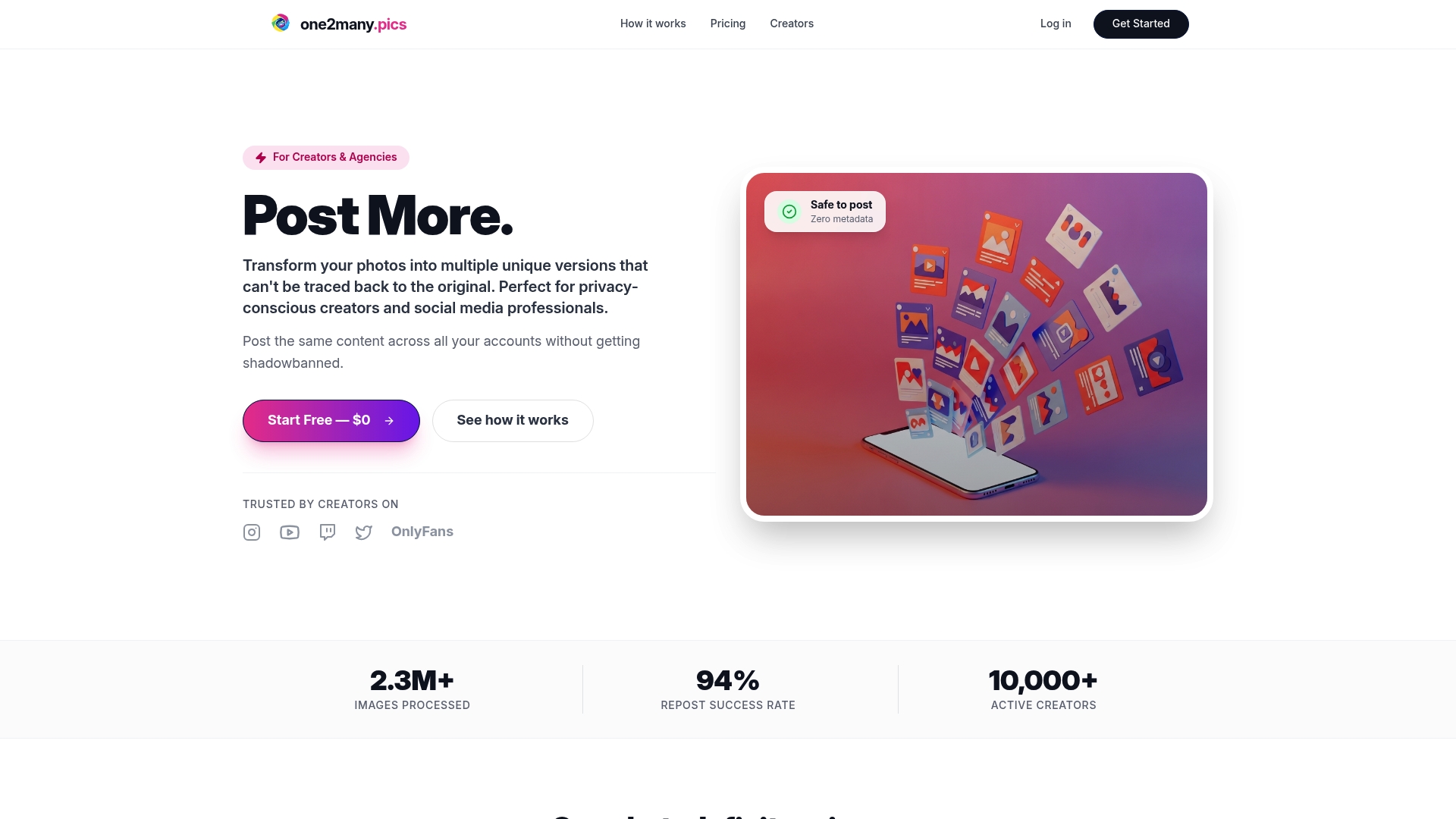
One2many gives creators a direct solution. The platform strips metadata from images automatically, generates unique visual variations to prevent duplicate detection, and supports bulk processing for creators managing multiple accounts or platforms. Whether you run one anonymous channel or ten, One2many keeps your digital footprint clean at every step of your publishing workflow. Individual creators, agencies, and social media managers all use it to post at scale without leaving a traceable trail.
FAQ
What is pseudonymous content creation?
Pseudonymous content creation means publishing under a consistent pen name or brand persona rather than your real identity. It is the practical standard for most anonymous creators, since complete invisibility is technically difficult to maintain.
Can anonymous creators make real money?
Anonymous creators earn between $3,000 and $30,000 monthly through newsletters, digital products, affiliate content, and faceless video channels. Income depends on niche, volume, and monetization mix, not on identity visibility.
What are the biggest risks of anonymous content creation?
Metadata leaks, linguistic re-identification, and platform verification requirements are the primary risks. Creators must strip metadata from files, vary writing patterns, and use dedicated devices and networks to maintain effective anonymity.
How does anonymity affect audience trust?
Anonymity slows initial trust-building because personal connection is absent. Creators compensate by publishing consistently high-quality content and being transparent about using a pseudonym, which audiences accept when presented with confidence.
Is content anonymity legal?
Publishing under a pseudonym is legal in most jurisdictions and has a long history in journalism and literature. Creators should verify platform-specific identity requirements for monetization features, as some programs require identity verification regardless of publishing name.