

Content suppression risk is defined as any mechanism, policy, or automated process that reduces the discoverability or reach of your content without necessarily deleting it. For creators, marketers, and digital influencers, understanding the types of content suppression risks is not optional. Platforms are enforcing rules through legal demands, community guidelines, and invisible algorithmic tactics, and each category hits your visibility differently. The Digital Millennium Copyright Act (DMCA), platform community guidelines, and algorithmic de-prioritization represent three distinct threat categories that every creator needs to map before they can defend against them.
1. What are the primary types of content suppression risks?
Content takedowns and restrictions fall into six main categories: legal and government demands, copyright, trademark, network shutdowns, platform community guideline violations, and company-specific standards enforcement. That taxonomy matters because each category requires a different response. A DMCA takedown demands a legal counter-notice. A community guideline strike demands a policy review. An algorithmic demotion demands a content audit. Treating all suppression the same way guarantees you fix nothing.
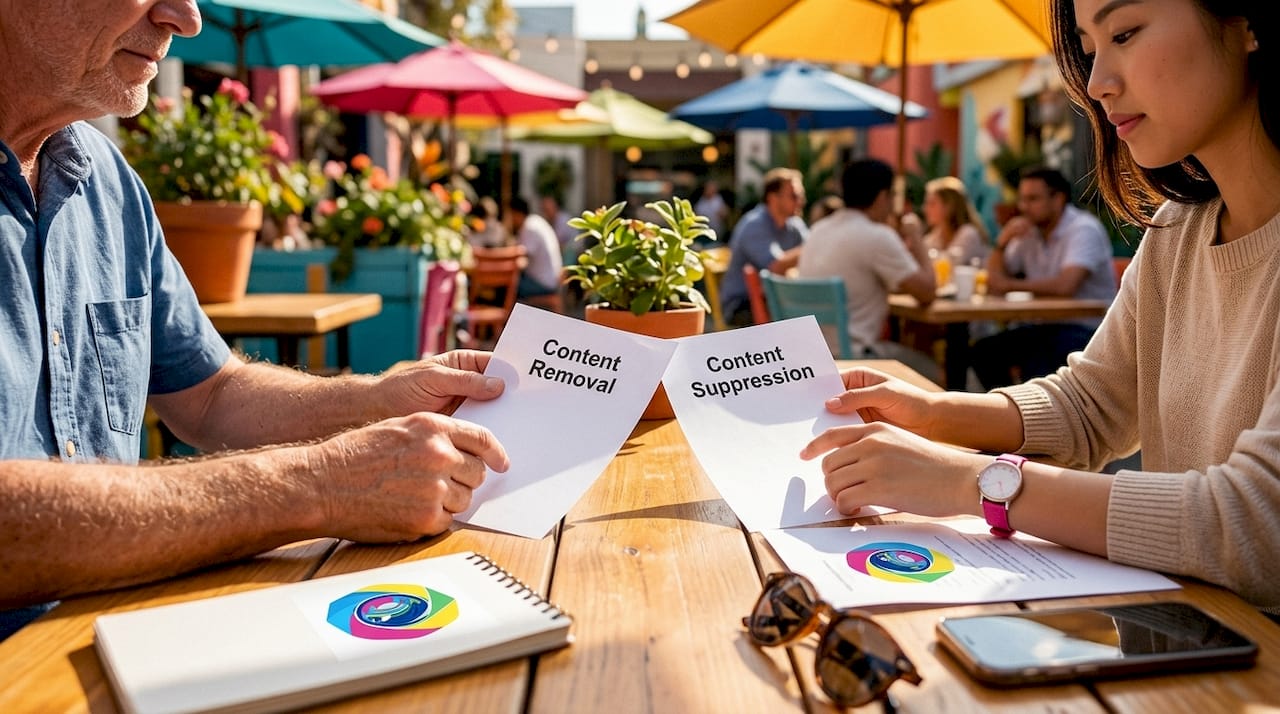
The distinction between suppression and removal is equally critical. Removal deletes content entirely. Suppression reduces its discoverability while leaving it technically live. Platforms prefer suppression when content is lawful and accurate but still considered undesirable, because demotion and de-amplification are the least restrictive and most proportionate responses to harmful content. That legal philosophy shapes how platforms build their moderation systems, and it shapes how you need to defend your reach.
2. Legal and government-driven suppression risks
Government and legal demands represent the most formal category of content suppression. These include court orders, regulatory directives, and statutory frameworks like the DMCA that compel platforms to act on specific content.
The most common legal suppression triggers for creators include:
- DMCA copyright takedown notices: A rights holder files a notice, and the platform removes or restricts your content within hours. You have the right to file a counter-notice, but the process takes time and your reach suffers in the interim.
- Trademark violation requests: Brand owners can demand removal of content that uses their marks in ways that imply endorsement or cause confusion.
- Right to be Forgotten requests: In jurisdictions that recognize this right, individuals can request that search engines de-index specific URLs, effectively suppressing your content from search results.
- Network shutdowns: Government-ordered internet disruptions or platform blocks in specific regions cut off your audience entirely, regardless of content quality.
Pro Tip: Run a quarterly legal compliance check on your content catalog. Flag any third-party music, logos, or branded visuals before a rights holder does it for you.
3. How platform community standards suppress content
Community guideline enforcement is what legal scholars call private law enforcement. Platforms set their own rules, adjudicate violations, and apply penalties without the checks and balances of a public legal system. That asymmetry puts creators at a structural disadvantage.
Enforcement mechanisms include automated moderation, user flagging, and manual review. Each can trigger:
- Content removal or age-restriction: Posts that violate policies on misinformation, hate speech, or spam get removed or locked behind age gates.
- Account suspension or demotion: Repeat violations can suppress all content from an account, not just the offending post.
- Reduced distribution: A single policy flag can quietly reduce how often your content appears in feeds or recommendations, without any formal notification.
The unpredictability of automated moderation is the real risk here. Algorithms trained on policy categories can misclassify compliant content. A fitness creator discussing injury recovery can get flagged under health misinformation policies. A political commentator can get flagged under election integrity rules. Understanding platform moderation methods in detail is the first step to avoiding accidental violations.
Pro Tip: Read the community guidelines for every platform you post on at least once per quarter. Policies update frequently, and what was compliant in january may not be compliant in july.
4. Invisible suppression tactics that limit your reach
Invisible suppression is the most damaging category for creators because you cannot appeal what you cannot see. Platforms apply at least six invisible suppression tactics without formal notification: search de-indexing, feed de-prioritization, recommendation exclusion, reply hiding, hashtag suppression, and engagement throttling.
These tactics can reduce content reach by 50% or more. A single flagged keyword can trigger automated risk scoring that cuts your distribution in half, even when your content does not technically violate any rule. That is the core danger of algorithmic suppression. You are penalized for proximity to a risk category, not for an actual violation.
Here is how each tactic shows up in practice:
| Tactic | What it does | How you notice it |
|---|---|---|
| Search de-indexing | Removes content from platform search results | Your posts stop appearing in hashtag or keyword searches |
| Feed de-prioritization | Reduces how often content appears in follower feeds | Reach drops sharply without a drop in posting frequency |
| Recommendation exclusion | Blocks content from "For You" or discovery feeds | New follower growth stalls despite consistent posting |
| Reply hiding | Collapses your replies under other users' posts | Engagement on comments drops to near zero |
| Hashtag suppression | Prevents your posts from appearing under specific hashtags | Hashtag-driven traffic disappears overnight |
| Engagement throttling | Limits likes, shares, or saves on specific posts | Engagement rate falls well below your account average |
Shadowbanning, the informal term for these combined tactics, is real and well-documented. Creators who rely on brand safety practices, such as those discussed in podcast content moderation contexts, recognize that invisible suppression affects audio and video creators just as much as image-based ones.
Pro Tip: Check your analytics weekly for sudden drops in reach, hashtag traffic, or profile visits. A drop of 30% or more in a single week with no change in posting behavior is a strong signal of algorithmic suppression.
5. Content suppression vs. content removal: what is the difference?
Suppression and removal are not the same thing, and confusing them leads creators to pursue the wrong fix. Removal deletes content from a platform entirely. Suppression reduces its discoverability while leaving it technically accessible.
Suppression is preferred when content is accurate and lawful but still considered problematic by a platform or third party. Legal rights to publish content often prevent removal even when the content is damaging to someone's reputation or brand. In those cases, suppression becomes the practical tool. Platforms use it to manage harm without triggering free speech objections. Reputation managers use it to push negative but accurate content lower in search results by building stronger, more authoritative content above it.
| Feature | Removal | Suppression |
|---|---|---|
| Content availability | Deleted entirely | Still accessible via direct link |
| Discoverability | Zero | Reduced but not eliminated |
| Best used when | Content violates law or policy | Content is lawful but undesirable |
| Platform preference | High-severity violations | Borderline or sensitive content |
| Creator control | Limited once removed | Can be countered with authority building |
Understanding this distinction helps you choose the right response. If your content was removed, you need a counter-notice or an appeal. If your content is suppressed, you need a content audit and an authority-building strategy.
6. Practical steps to protect your reach and recover from suppression
Recovery from content suppression requires fixing multiple negative signals simultaneously. Partial fixes rarely restore full visibility. Addressing only metadata, or only content quality, or only engagement signals in isolation will not lift a suppression penalty. You need a coordinated approach.
Here is a systematic recovery framework:
- Audit your content for risk signals. Review your recent posts for flagged keywords, policy-adjacent topics, and metadata issues. Platforms focus suppression on negative signals, so removing unhelpful signals yields better results than trying to boost vague quality scores.
- Clean your metadata. Location data, device identifiers, and timestamps embedded in image files can trigger duplicate detection or privacy flags. Tools like One2many strip this metadata and generate unique image variations, reducing the risk of suppression from duplicate content detection across accounts.
- Build topical authority. Suppression recovery is not about flooding your feed with positive content. Effective suppression recovery requires building high-trust, topically relevant assets that search and recommendation algorithms favor.
- Diversify your platform presence. Single-platform dependency means a single suppression event can wipe out your entire reach. Distribute content across multiple channels to reduce that risk.
- Monitor analytics for early detection. Set baseline benchmarks for reach, engagement rate, and hashtag traffic. Review them weekly. Early detection of suppression gives you time to respond before the penalty compounds.
- Engage your community directly. Direct messages, email lists, and community groups sit outside algorithmic reach controls. Building these channels gives you a suppression-proof line to your audience.
Pro Tip: When auditing for suppression recovery, address metadata, content quality, and E-E-A-T signals at the same time. Fixing one factor while ignoring the others rarely restores full reach.
Creators who want a deeper look at preventing social media penalties will find that proactive compliance and metadata hygiene are far less costly than reactive recovery.
Key Takeaways
The most effective defense against content suppression is a simultaneous fix of legal compliance, metadata hygiene, platform policy alignment, and authority-building, because partial fixes consistently fail to restore full reach.
| Point | Details |
|---|---|
| Six suppression categories exist | Legal, copyright, trademark, network, community guidelines, and company standards each require a different response. |
| Invisible tactics are the biggest threat | Shadow banning tactics like feed de-prioritization and hashtag suppression can cut reach by 50% or more without any formal notice. |
| Suppression differs from removal | Suppression reduces discoverability; removal deletes content. Each demands a different fix. |
| Partial fixes fail | Recovery requires correcting metadata, content quality, and authority signals at the same time. |
| Diversification protects reach | Spreading content across multiple platforms and channels limits the damage from any single suppression event. |
The suppression threat most creators underestimate
Creators tend to worry about the visible threats: a DMCA notice, a community guidelines strike, an account suspension. Those are serious, but they are also legible. You know when they happen, and you know what triggered them.
The suppression risk I see consistently underestimated is the invisible kind. Algorithmic de-prioritization operates silently. Your content stays up. Your follower count does not drop. But your reach quietly collapses over weeks, and most creators attribute it to "the algorithm changing" rather than recognizing it as a targeted suppression response to a risk signal in their content.
The other underestimated risk is metadata. Creators who post the same or similar images across multiple accounts without stripping metadata are handing platforms a fingerprint. Duplicate detection systems use that fingerprint to flag content as coordinated or inauthentic, which triggers suppression even when the content itself is fully compliant. One2many was built specifically to address this. Stripping location data, device identifiers, and timestamps, and generating unique visual variations, removes the fingerprint before it becomes a liability.
My honest view is that content risk management in 2026 is a technical discipline, not just a creative one. Creators who treat it that way will protect their reach. Those who do not will keep wondering why their numbers are falling.
— one2many.pics
How One2many helps creators manage suppression risks
Content suppression risks are technical problems that need technical solutions. One2many gives creators, social media managers, and marketing teams the tools to address the metadata and duplicate detection risks that trigger invisible suppression.
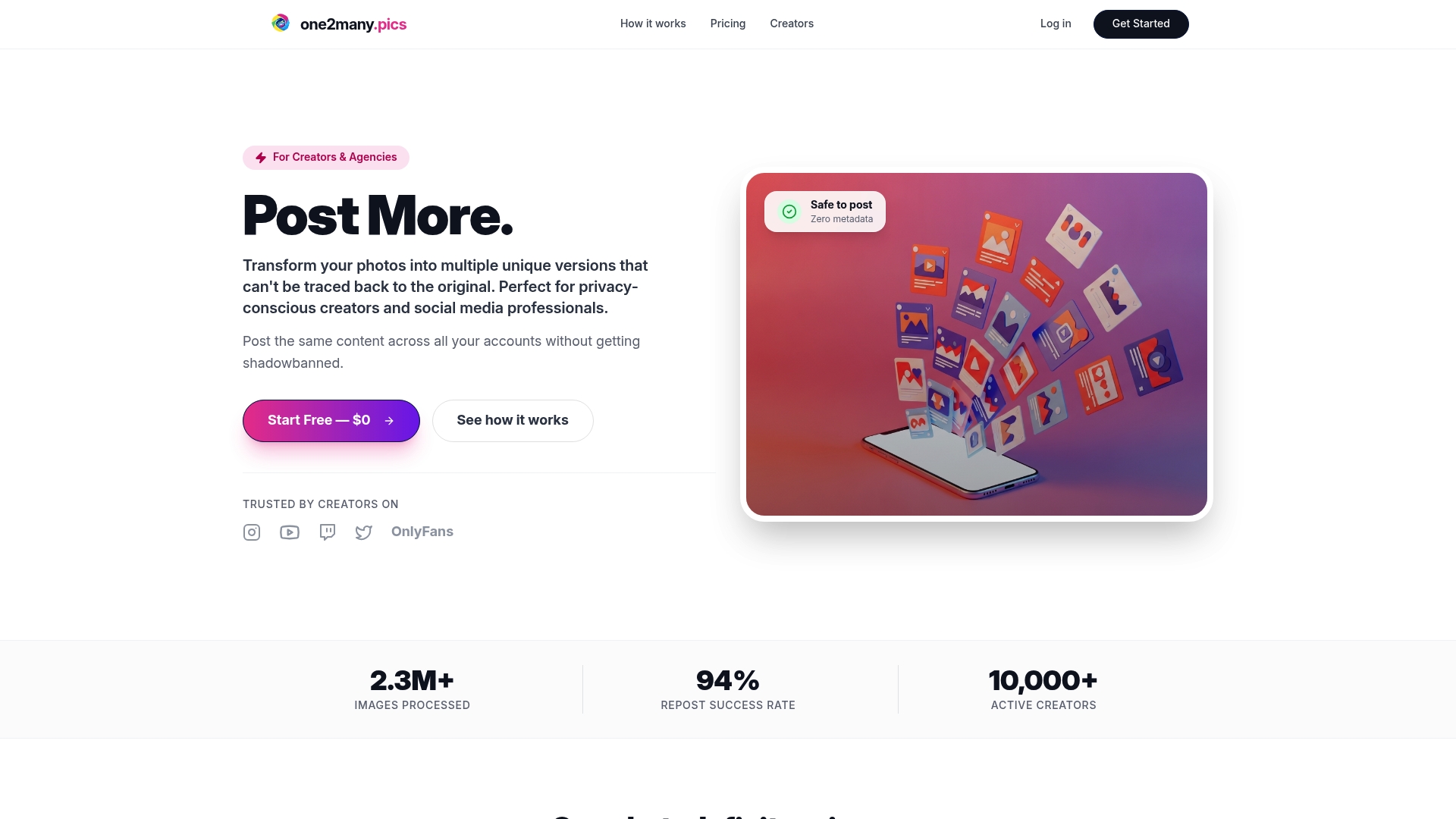
The platform strips identifying metadata from images, including location, device info, and timestamps, and generates unique visual variations that pass duplicate detection checks across platforms and accounts. That means you can scale your content posting without leaving a fingerprint that flags your account for suppression. Whether you manage one account or dozens, One2many's privacy tools give you a direct line of defense against one of the most common and least visible suppression triggers in 2026. Explore the platform to see how metadata hygiene fits into your broader content privacy practices.
FAQ
What is content suppression?
Content suppression is the reduction of a piece of content's discoverability or reach without deleting it. Platforms use suppression when content is lawful but considered undesirable, applying tactics like feed de-prioritization, hashtag suppression, and recommendation exclusion.
What are the main types of content suppression risks?
The six main categories are legal and government demands, copyright violations, trademark claims, network shutdowns, platform community guideline violations, and company-specific standards enforcement. Each category triggers different suppression mechanisms and requires a different response.
What is shadowbanning and how does it work?
Shadowbanning is the informal term for invisible suppression tactics that reduce content reach without notifying the creator. Platforms apply at least six methods including search de-indexing, feed de-prioritization, and engagement throttling, often triggered by automated risk scoring of flagged keywords or content categories.
How does content suppression differ from content removal?
Removal deletes content entirely and makes it inaccessible. Suppression leaves content technically live but reduces how often it appears in searches, feeds, and recommendations. Suppression is the preferred platform response for borderline or sensitive content that does not clearly violate policy.
How can creators recover from content suppression?
Recovery requires fixing multiple negative signals at the same time, including metadata issues, content quality gaps, and authority signals. Addressing only one factor rarely restores full reach. Diversifying across platforms and building direct community channels also reduces the impact of future suppression events.