

Content moderation is defined as the systematic review and management of user-generated content to enforce platform policies and maintain safe, trustworthy online communities. Platforms like Facebook and YouTube process billions of posts daily, making moderation one of the most operationally complex challenges in digital media. Modern systems combine AI classifiers with human reviewers to handle both volume and nuance. Understanding how this process works matters for any organization managing a social media presence, building a community platform, or navigating compliance requirements in 2026.
What is content moderation and why does it matter?
Content moderation is the process platforms use to decide which user content stays online, which gets removed, and how enforcement aligns with community standards and legal requirements. It covers text, images, video, audio, and links across every major social network and user-generated content platform.
The importance of content moderation goes beyond removing offensive posts. Moderation shapes public perception and directly influences whether users trust a platform enough to stay and engage. A community that tolerates harassment drives users away. One that over-censors legitimate speech frustrates creators and suppresses organic conversation.

Proactive AI moderation identifies over 95% of hate speech removals on platforms like Facebook. That figure shows how central automated systems have become to modern enforcement at scale. Without AI, no human team could review content fast enough to keep communities safe.
Content moderation has also evolved into a board-level priority at major platforms. That shift reflects growing regulatory pressure, advertiser expectations, and the reputational cost of high-profile moderation failures.
What are the main types of content moderation?
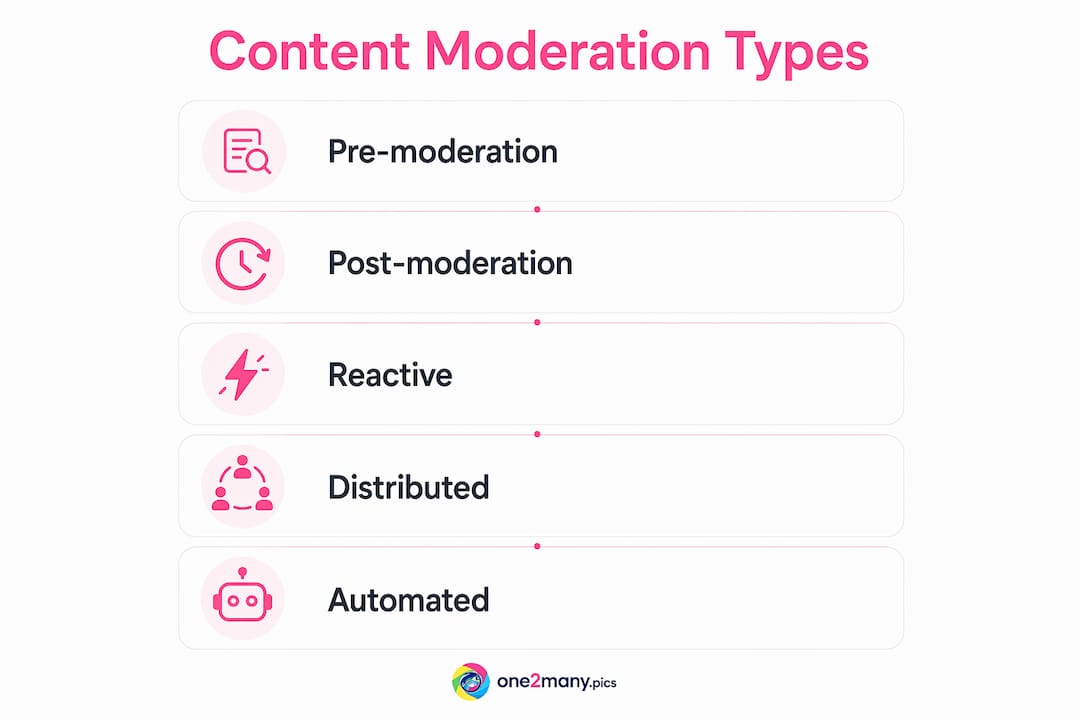
Five primary moderation types each carry distinct operational trade-offs. Choosing the wrong model for your platform's risk profile causes real failures.
| Moderation type | How it works | Best use case |
|---|---|---|
| Pre-moderation | Content is reviewed before it goes live | High-risk platforms: children's apps, regulated industries |
| Post-moderation | Content publishes first, reviewed after | News comment sections, general social platforms |
| Reactive moderation | Community flags content for review | Large open communities with active user bases |
| Distributed moderation | Trusted users vote on content quality | Forums like Reddit with established community norms |
| Automated moderation | AI filters content in real time | High-volume platforms needing instant enforcement |
Pre-moderation offers the highest safety level but creates latency. Users wait for approval before their content appears, which slows engagement. Post-moderation supports faster engagement but requires a fast review queue to limit exposure to harmful content.
Reactive moderation works well when your community is large and engaged enough to flag problems quickly. Distributed moderation suits platforms with strong community identity, like specialized forums. Automated moderation handles volume but needs human backup for edge cases.
Pro Tip: Match your moderation model to your platform's risk profile first, then staff accordingly. A children's education platform needs pre-moderation regardless of the latency cost. A general news site can use post-moderation with a rapid response team.
How do hybrid human and AI moderation systems work?
Most modern systems use hybrid moderation: AI handles bulk filtering and humans manage nuanced reviews and AI training. This combination solves the core tension between speed and accuracy that no single approach resolves alone.
AI tools in content moderation perform several distinct functions:
- Hash matching: Compares uploaded content against databases of known harmful material, such as the PhotoDNA system used to detect child sexual abuse material (CSAM)
- Text classifiers: Scan posts for hate speech, threats, and spam using natural language processing models
- Image recognition: Flags nudity, graphic violence, and brand-unsafe visuals before human review
- Behavioral signals: Detect coordinated inauthentic behavior by analyzing posting patterns, account age, and network connections
- Confidence scoring: Routes borderline content to human reviewers when AI certainty falls below a set threshold
Human reviewers handle what AI cannot. Sarcasm, cultural context, satire, and novel content types all require human judgment. Reviewers also process appeals, catch false positives, and generate labeled examples for AI retraining.
Effective AI moderation depends on a curated "golden dataset" for training to reduce bias and handle nuances like sarcasm. Maintaining this dataset is resource-intensive. It requires ongoing human oversight to keep pace with evolving language, slang, and community standards.
An AI content optimization audit can help organizations assess whether their current content workflows align with how AI moderation systems evaluate and classify material. Understanding how classifiers read your content is a practical first step for any compliance-focused team.
What challenges and ethical considerations affect content moderation?
Content moderation acts like an immune system for online communities, cultivating engagement while balancing freedom of expression and user safety. Get the balance wrong in either direction and the community suffers.
Over-moderation silences legitimate voices. Under-moderation drives away users who feel unsafe. Both outcomes damage platform reputation and reduce long-term engagement. Overly strict policies stifle conversation; lenient ones drive community abandonment. Neither extreme is sustainable.
AI bias is a concrete operational risk. A classifier trained on English-language data performs poorly on multilingual content. A model trained on one cultural context misreads humor, protest language, or religious expression from another. Addressing bias requires diverse training data and regular audits of enforcement outcomes across different user groups.
A transparent appeals process improves user trust and AI moderation quality by flagging false positives and negatives for retraining. Without an appeals pathway, users have no recourse and AI models never receive the feedback they need to improve. Lack of appeals frustrates users and degrades AI accuracy over time.
Human moderators face significant psychological strain. Reviewing graphic, violent, or disturbing content at volume causes documented harm. Platforms that ignore moderator wellbeing face high turnover, which degrades institutional knowledge and moderation consistency.
Pro Tip: Write community guidelines in plain language with specific examples of prohibited behavior. Vague rules like "no harmful content" create inconsistent enforcement. Specific rules like "no threats of physical violence directed at named individuals" give moderators and users a clear standard.
What are content moderation best practices for organizations?
Treating moderation methods as interchangeable leads to failure incidents that damage brand reputation. Effective moderation requires deliberate strategy, not default settings.
The following practices define effective moderation programs:
- Publish specific community guidelines: Clear policies help align enforcement with platform values and give users a basis for understanding decisions. Vague guidelines produce inconsistent enforcement and user confusion.
- Layer detection methods: Combine automated filters with human review queues. AI handles volume; humans handle context. Neither works as well alone.
- Build escalation pathways: Severe content categories like CSAM, terrorism, and credible threats need immediate escalation protocols that bypass standard review queues.
- Design for growth: Moderation infrastructure that works at 10,000 users breaks at 1,000,000. Build review capacity and AI training pipelines before you need them.
- Audit enforcement outcomes regularly: Review removal rates by content type, language, and user segment to catch bias and inconsistency before they become public issues.
- Integrate with compliance workflows: Social media compliance requirements vary by jurisdiction. Moderation policy must account for legal obligations in every market where the platform operates.
Understanding why platforms suppress posts helps organizations design content strategies that work within moderation systems rather than against them. Creators who understand enforcement logic make better decisions about format, language, and posting behavior.
Proactive AI moderation reduces long-term legal and reputational risk despite upfront integration costs. Reactive moderation carries higher risk because harmful content remains visible until someone reports it. The cost of a moderation failure, measured in advertiser pullouts, regulatory fines, and user churn, almost always exceeds the cost of proactive investment.
Key Takeaways
Effective content moderation requires a layered strategy combining clear policies, hybrid AI-human review, transparent appeals, and regular audits to maintain platform safety and user trust.
| Point | Details |
|---|---|
| Define your moderation model | Match pre-, post-, reactive, distributed, or automated moderation to your platform's risk level and staffing. |
| Use hybrid AI-human systems | AI handles volume and speed; human reviewers manage nuance, appeals, and AI training data. |
| Publish specific guidelines | Clear, public community rules reduce inconsistent enforcement and build user trust. |
| Build a transparent appeals process | Appeals improve user satisfaction and provide feedback that makes AI models more accurate over time. |
| Audit for bias regularly | Review enforcement outcomes across languages and user groups to catch and correct AI bias before it scales. |
The moderation mistake most platforms make too late
The most common moderation failure is not a technology problem. It is a sequencing problem. Organizations build a community first and design moderation policy second. By the time harmful content patterns emerge, the platform already has a reputation problem and an undertrained AI model.
The platforms that get moderation right treat it as community cultivation from day one. They write guidelines before launch, not after the first controversy. They invest in human review capacity before traffic spikes make it impossible to hire fast enough. They treat the appeals process as a quality signal, not an administrative burden.
The shift to board-level priority for moderation reflects a hard lesson learned across the industry. Moderation failures are not just PR problems. They attract regulatory scrutiny, trigger advertiser flight, and accelerate user churn in ways that compound quickly. The organizations that understand this early build moderation infrastructure as a core product function, not an afterthought.
The future challenge is not choosing between AI and human review. It is maintaining the feedback loop between them. AI models that stop receiving quality training data from human reviewers drift toward the biases in their original dataset. That drift is invisible until it produces a high-profile enforcement error. The organizations that stay ahead of this problem treat their "golden dataset" as a living asset, not a one-time build.
— one2many.pics
How One2many supports smarter content management
Managing content across multiple platforms means navigating moderation rules, duplicate detection, and privacy requirements simultaneously. One2many is built for creators and teams who need to post at scale without triggering platform penalties.

One2many removes metadata like location data, device information, and timestamps from images before posting. It also generates unique visual variations of the same image, so duplicate detection systems do not flag repeated content across accounts. For teams managing social media penalties and suppression risks, One2many provides a practical layer of protection. Visit one2many.pics to see how the platform fits into your content workflow.
FAQ
What is content moderation in simple terms?
Content moderation is the process of reviewing and managing user-generated content to enforce platform rules and keep online communities safe. It covers text, images, video, and links across social media and community platforms.
What are the five types of content moderation?
The five types are pre-moderation, post-moderation, reactive moderation, distributed moderation, and automated moderation. Each differs in when content is reviewed and who performs the review.
How does AI content moderation work?
AI moderation uses classifiers, hash matching, image recognition, and behavioral signals to filter content in real time. Borderline content is routed to human reviewers when AI confidence falls below a set threshold.
Why is a content moderation appeals process important?
A transparent appeals process improves user trust and feeds false positive and negative data back into AI training. Without appeals, AI accuracy degrades over time and users lose confidence in enforcement fairness.
What are the biggest risks of poor content moderation?
Poor moderation exposes platforms to regulatory fines, advertiser withdrawal, and user churn. Overly strict enforcement silences legitimate speech; insufficient enforcement drives away users who feel unsafe.