

Social media data harvesting is the automated collection of user-generated content, profile data, and engagement signals from social platforms for use in marketing, research, and analytics. The two primary types of social media data harvesting are official API integration and web scraping, and most professional workflows combine both. Understanding how each method works, what data it captures, and where legal and ethical lines fall is now a baseline requirement for any marketer or researcher working with platform data.
1. What are the main types of social media data harvesting?
Social media data harvesting primarily uses two methods: official API integration and web scraping, each with distinct legal and technical characteristics. A third approach, the hybrid pipeline, combines both to maximize coverage.
Official API integration gives you structured, authorized access to platform data. Platforms like Meta, YouTube, and Reddit publish APIs that return clean JSON responses. The tradeoff is rate limits. YouTube, for example, offers a free quota of 10,000 units per day, and platforms change those limits with little notice. Any long-term project must account for sudden API failures and quota resets.

Web scraping extracts data directly from public web pages using automated bots. Tools like Puppeteer, Playwright, and Selenium control headless browsers to render JavaScript-heavy pages before pulling content. For simpler sites, a plain HTTP client with BeautifulSoup is faster and cheaper. Experienced scrapers often rely on simple HTTP request parsing instead of heavier browser automation, improving speed and reducing cost.
Hybrid approaches schedule API calls for core metrics and run scrapers for supplemental content that APIs do not expose. Most modern data workflows combine API data for core metrics and web scraping for additional unstructured content. This layered structure is the standard for professional social media analytics teams.
Pro Tip: Before writing a single line of scraping code, check whether the platform's API covers your data need. API data is cleaner, more stable, and legally safer than scraped data.
2. What types of data are typically harvested from social media?
Social media data collection covers four broad categories, each with different privacy implications and technical requirements.
- Profile data: Usernames, display names, bios, follower counts, and account creation dates. This data is publicly visible on most platforms and is the easiest to collect via API.
- Content data: Posts, images, videos, captions, and hashtags. Text content is straightforward to extract. Images and videos require additional storage and processing pipelines.
- Engagement metrics: Likes, shares, comments, saves, and view counts. These signals are the core of social media analytics techniques and inform content performance models.
- Network data: Follower and following lists, mentions, and tags. This data maps social graphs and carries the highest privacy risk. Collecting it at scale can expose relationships users consider private.
AI-assisted scraping uses language models to identify content semantically, making extraction more resilient to website layout changes compared to traditional rule-based scraping. This matters because platforms frequently redesign their interfaces, which breaks selector-based scrapers overnight. AI layers reduce that maintenance burden significantly.
The table below maps each data category to its primary use case and privacy risk level.
| Data category | Primary use case | Privacy risk |
|---|---|---|
| Profile data | Audience segmentation | Low |
| Content data | Trend analysis, content research | Medium |
| Engagement metrics | Performance benchmarking | Low |
| Network data | Influence mapping, social graph analysis | High |
For media professionals tracking audience engagement strategies, engagement metrics and content data are the most actionable categories. Network data requires explicit legal review before collection.
3. Which platforms have distinct harvesting characteristics?
Each major platform enforces its own rules around data access, and those rules change frequently. Knowing the platform-specific landscape prevents wasted engineering effort and legal exposure.
- Reddit: Reddit explicitly permits public scraping and provides JSON feeds by appending
.jsonto any public URL. This makes Reddit one of the most accessible platforms for researchers and marketers. - X (formerly Twitter): X prohibits scraping outside its official API. The API is now heavily restricted and expensive, making large-scale data collection on X a significant cost center.
- Instagram and TikTok: Both platforms render content client-side, requiring headless browsers for scraping, and both explicitly prohibit automated access in their terms of service.
- LinkedIn: LinkedIn is the most restrictive platform, enforcing aggressive IP blocking and legal action against scrapers. API access is limited to approved partners.
- YouTube: Offers a structured API with daily quotas, making it manageable for research but limiting for high-volume collection.
Anti-automation measures on platforms like LinkedIn enforce IP blocking and scraping detection. Professionals use proxy rotation and header spoofing to reduce blocks, though these techniques carry their own legal and ethical risks.
Pro Tip: For Instagram and TikTok, always check whether an official creator or business API endpoint covers your use case before building a scraper. Official endpoints are slower but legally defensible.
4. What are the ethical and legal considerations in data harvesting?
Ethical concerns in data harvesting are not abstract. They translate directly into legal liability, platform bans, and reputational damage for researchers and marketers alike.
The clearest boundaries are these:
- Never harvest data from minors. Platforms are legally required to protect users under 13 (and in many jurisdictions, under 16). Collecting their data exposes you to COPPA and GDPR violations.
- Never collect data from private accounts or direct messages. Data from private accounts and private messages is off-limits, regardless of technical access. This applies even when a scraper can technically reach the data.
- Establish a lawful basis under GDPR. If you process data from EU residents, ethical harvesting involves lawful basis under GDPR, documented data processing activities, and data minimization. Legitimate interest is the most common basis, but it requires a documented balancing test.
- Respect platform terms of service. Violating ToS is not automatically illegal, but it creates breach-of-contract risk and can result in permanent account or IP bans.
- Apply data minimization. Collect only what you need for a defined purpose. Storing excess data increases your liability surface under privacy regulations worldwide.
Harvesting public data does not make that data fair game. The legal risk of scraping varies by method, jurisdiction, and platform policy. A practice that is lawful in one country may violate data protection law in another. Document your legal basis before you collect, not after.
The social media compliance guide for creators covers platform-specific rules in detail and is worth reviewing before launching any collection project.
5. How do you build a reliable data collection pipeline?
A single scraper or API call is not a data pipeline. Reliable social media analytics techniques require scheduled extraction, validation, and entity resolution working together.
Layered data collection pipelines that schedule extraction, validate data, and resolve entities are key to reliable social media data analytics. Without validation, duplicate records and broken extractions corrupt your dataset silently. Entity resolution links the same account or post across multiple data sources, which is critical when combining API and scraped data.
Scheduling matters as much as the extraction logic. Platforms throttle traffic at peak hours, so running jobs during off-peak windows reduces rate-limit errors. Store raw data before transforming it. If your parsing logic breaks, you can reprocess from the raw archive without re-collecting.
Combining multiple data sources and cleaning harvested data enhances analytical reliability. A pipeline that pulls API data for engagement metrics and scrapes public pages for content gives you a fuller picture than either method alone. The social media posting best practices guide offers a useful framework for thinking about how collected data informs content decisions.
Key Takeaways
The most reliable social media data collection combines official API integration for structured metrics and web scraping for supplemental content, governed by GDPR-compliant documentation and platform-specific access rules.
| Point | Details |
|---|---|
| Two core harvesting methods | API integration and web scraping each serve different data needs and carry different legal risks. |
| Four data categories | Profile, content, engagement, and network data vary widely in privacy risk and collection complexity. |
| Platform rules differ sharply | Reddit permits public scraping; LinkedIn and Instagram prohibit it and enforce actively. |
| Legal compliance is non-negotiable | GDPR lawful basis, data minimization, and ToS compliance must be documented before collection begins. |
| Pipelines beat one-off scrapers | Scheduled extraction, validation, and entity resolution are what turn raw data into reliable analytics. |
My honest read on social media data harvesting in 2026
The conversation around data mining social networks has shifted. A few years ago, the debate was mostly technical: which tool is faster, which proxy service is more reliable. Now the legal and ethical layer dominates every serious project I see.
The practitioners who build durable data operations are not the ones with the cleverest scrapers. They are the ones who treat compliance as an engineering requirement, not an afterthought. They document their lawful basis before writing a line of code. They build validation into the pipeline from day one. They plan for API deprecation the same way they plan for server downtime.
The rise of AI-assisted extraction is real, and it does reduce maintenance costs. But it also makes it easier to collect data at a scale that creates legal exposure you may not notice until a regulator does. The big data paradox is not just about volume. It is about whether the patterns you extract are worth the privacy cost of collecting them.
My practical recommendation: start with the official API, document what it cannot give you, and only then evaluate whether scraping the gap is legally and ethically justified. That sequence keeps you out of trouble and produces cleaner data anyway.
— one2many.pics
How One2many supports your social media content and privacy needs
Managing social media data is only half the equation. What you do with that data, and how you protect your own content in the process, matters just as much.
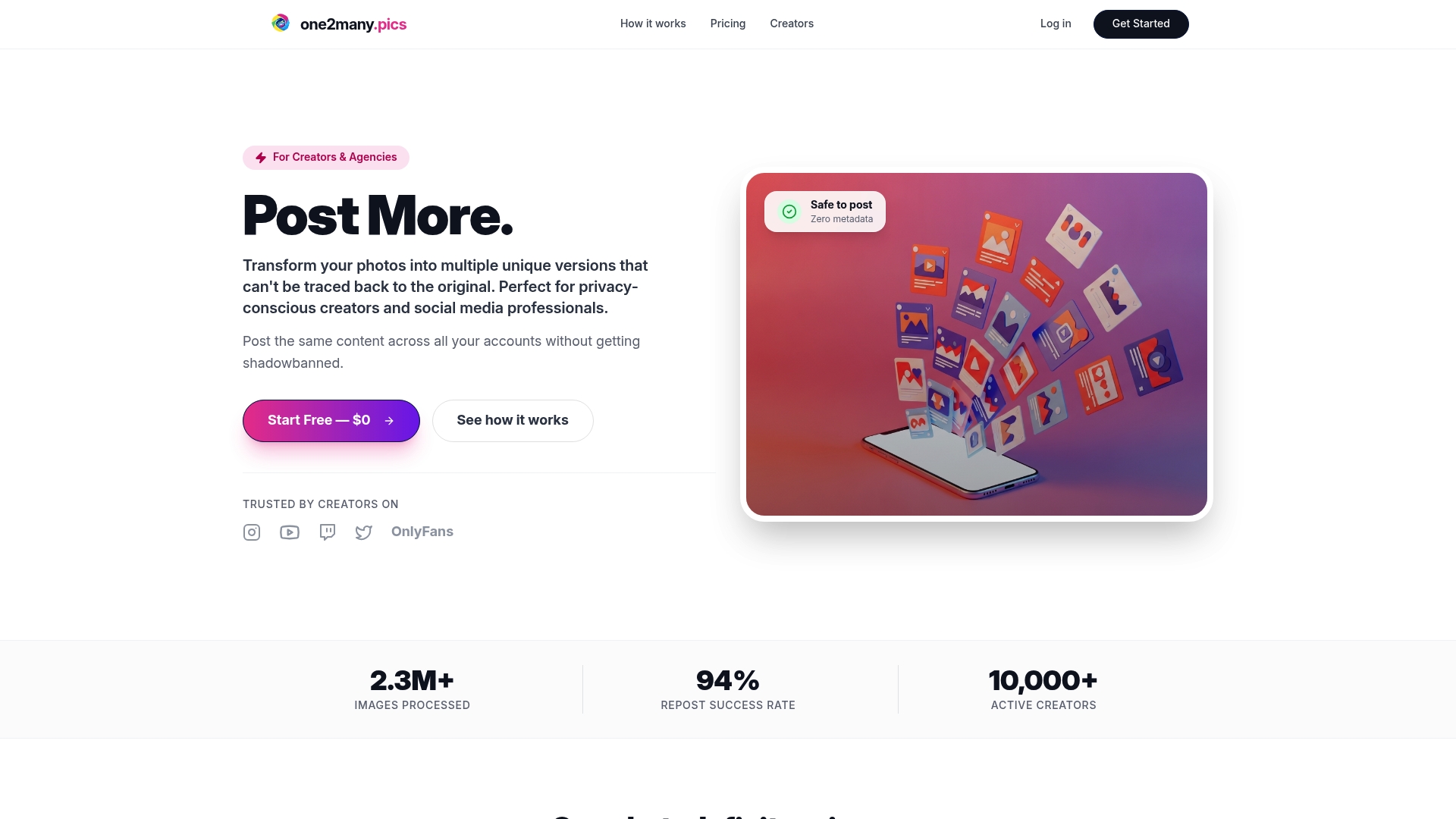
One2many is built for creators, marketers, and agencies who need to post at scale without leaving a traceable digital footprint. The platform removes metadata including location, device info, and timestamps from images, then generates unique visual variations so the same content can be distributed across multiple accounts without triggering duplicate detection. If your data collection work informs a content strategy that requires posting across multiple profiles, One2many's privacy-focused content tools handle the distribution side securely. Plans range from single-image processing to bulk workflows with automation integrations.
FAQ
What is social media data harvesting?
Social media data harvesting is the automated collection of user-generated content, profile data, and engagement signals from social platforms using APIs or web scraping tools.
Is web scraping social media legal?
Legality depends on the platform, the data collected, and the jurisdiction. Scraping public data may violate platform terms of service and, in some cases, data protection laws like GDPR, even when technically possible.
What data can you legally collect from social media?
Public profile data, public posts, and engagement metrics on public accounts are generally collectible via official APIs. Private account data, direct messages, and data from minors are off-limits under most legal frameworks.
Which social media platform is easiest to scrape?
Reddit is the most accessible platform for data collection. It explicitly permits public scraping and provides structured JSON feeds for public content without requiring authentication.
How do you avoid getting blocked when scraping social media?
Rotating user-agent headers and using residential proxy services are standard techniques. However, these methods do not eliminate legal risk and should only be used where scraping is permitted by the platform's terms of service.