

A content footprint audit is the systematic process of reviewing every piece of content you publish across platforms to measure its performance, accuracy, and compliance. Creators, marketers, and agencies that skip this process accumulate dead weight: outdated blog posts, duplicate social media assets, and off-brand messaging that quietly erodes authority. Tools like Ahrefs and Google Search Console surface the data, but the audit itself is the decision-making framework that tells you what to keep, fix, consolidate, or delete. Understanding why audit your content footprint matters is no longer optional. AI-driven search platforms now reward content authority over content volume, making regular audits a competitive necessity.
Why audit your content footprint in 2026?
A content footprint audit delivers measurable returns across SEO, brand consistency, compliance, and budget efficiency. The case for auditing is not theoretical. 96.55% of indexed pages receive zero organic search traffic. That means nearly every page you publish has a high probability of contributing nothing unless you actively manage and prune your catalog.
The benefits of auditing content break down into four categories:
- SEO and AI visibility: Removing or consolidating underperforming pages concentrates your site's authority on content that actually ranks. Generative Experience Optimization (GEO) requires audits to maintain relevance in AI-driven search results beyond traditional keyword rankings.
- ROI improvement: Content marketing generates three times the lead volume of outbound methods at 62% lower cost. Audits protect that investment by identifying which content drives leads and which drains production budget.
- Risk and compliance management: Outdated legal claims, expired promotions, and inaccurate product details create liability. Effective audits identify compliance gaps before they become fines or reputational damage, especially in regulated industries like finance and healthcare.
- Environmental efficiency: Hosting unnecessary content consumes server resources. Deleting redundant pages reduces your digital carbon footprint, a growing concern for agencies managing large client portfolios.
Pro Tip: Before your next audit, run a quick crawl with Screaming Frog or Ahrefs Site Audit to get a baseline page count. Creators who skip this step consistently underestimate how much content they have published across subdomains and microsites.
How to assess your content footprint effectively
The importance of content audits lies in their structure. A disorganized audit produces a spreadsheet nobody uses. A structured audit produces a prioritized action list that drives real decisions.
Step 1: Build a complete content inventory
Start by crawling your website with a tool like Screaming Frog, Sitebulb, or Ahrefs to export every URL. Include blog posts, landing pages, product pages, and resource documents. For social media, export your post history from each platform's analytics dashboard. This inventory is the foundation. Without it, you are making decisions based on memory rather than data.

Step 2: Layer in performance metrics
Attach four data points to each URL: organic traffic, backlinks, engagement rate, and last-updated date. Google Search Console provides traffic and click data. Ahrefs or Semrush supply backlink counts. Platform analytics cover social engagement. A content audit integrates quality signals, metadata, and performance data to enable fast, defensible decisions at scale. This is what separates an audit from a simple inventory.
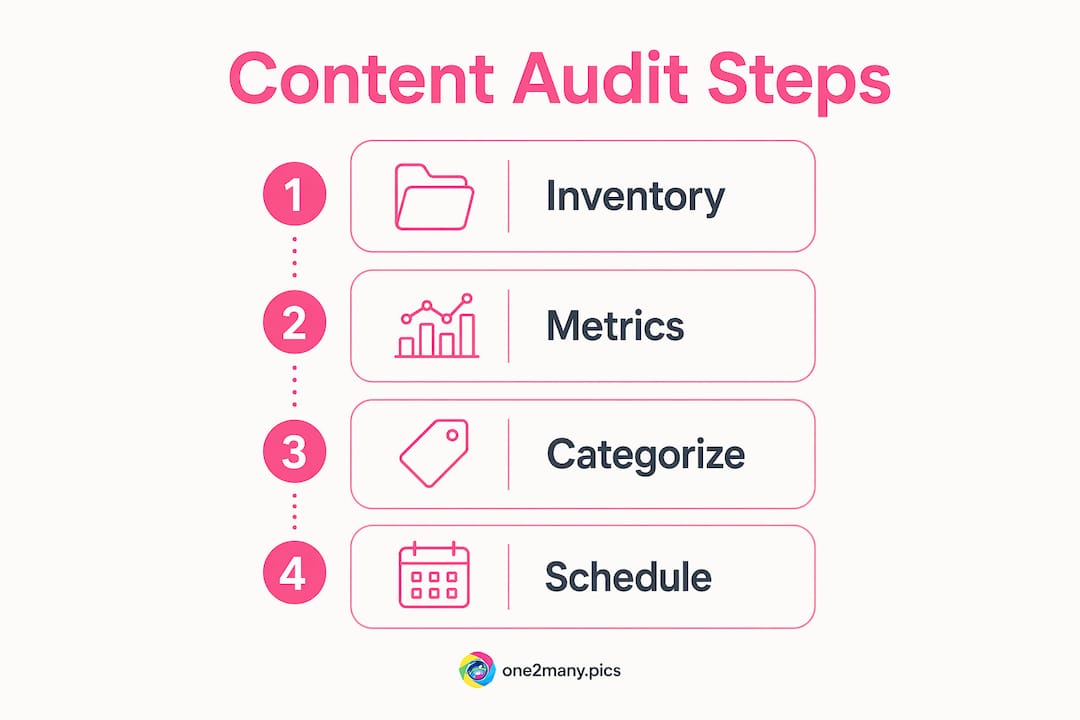
Step 3: Categorize and assign actions
Every URL gets one of four labels: Keep, Update, Consolidate, or Delete. Apply these labels based on traffic, accuracy, and strategic fit. Content that ranks but contains outdated statistics needs updating. Two posts covering the same topic with thin traffic should be consolidated into one authoritative piece. Pages with zero traffic and no backlinks are candidates for deletion.
| Action | Criteria | Expected outcome |
|---|---|---|
| Keep | High traffic, accurate, on-brand | Maintain and monitor quarterly |
| Update | Ranking but outdated or thin | Refresh with new data and examples |
| Consolidate | Overlapping topics, low traffic | Merge into one stronger page with 301 redirect |
| Delete | Zero traffic, no links, off-topic | Remove and redirect or return 404 |
Step 4: Set frequency and ownership
65% of successful content marketing teams conduct audits at least twice a year. High-performing teams audit quarterly to stay ahead of algorithm and AI search updates. Assign a specific owner to each action item. Audits without owners produce no results.
Pro Tip: Schedule a 30-minute audit review meeting each quarter. Teams that treat audits as a recurring calendar event complete 80% more action items than those who treat audits as one-time projects.
Content audit vs. content inventory: what is the difference?
Content creators and marketers often confuse a content inventory with a content audit. The distinction matters because each tool serves a different purpose.
A content inventory is a catalog. It lists every piece of content you own with basic metadata: URL, title, word count, publish date, and content type. It answers the question "What do we have?" A content inventory is the starting point for an audit, not a substitute for one.
A content audit is an evaluation. It takes the inventory and adds performance data, quality scores, and strategic alignment checks. It answers the question "What should we do with what we have?" The audit is where decisions happen.
Social media audits extend this framework beyond your website. They cover posts, ads, stories, and archived content across platforms like Instagram, TikTok, LinkedIn, and YouTube. Inactive ads and archived posts still impact platform algorithms and compliance risk, a detail most creators overlook. Including paused campaigns in your social audit prevents algorithm penalties and surfaces compliance issues before regulators do.
The table below summarizes the key distinctions:
| Method | Primary question | Key outputs |
|---|---|---|
| Content inventory | What do we have? | URL list, metadata, content types |
| Content audit | What should we do? | Action labels, owners, deadlines |
| Social media audit | How does social content perform? | Engagement data, compliance flags, algorithm impact |
Understanding content syndication practices also informs audit scope. Syndicated content creates duplicate detection risks across platforms, which audits must account for.
Common mistakes to avoid when auditing your content
The most common audit failure is producing a static spreadsheet with no follow-up. Successful audits assign clear actions per URL with specific owners and deadlines. Without that structure, the audit becomes a documentation exercise rather than a performance improvement tool.
Avoid these specific mistakes:
- Auditing only your website. Your content footprint includes social profiles, guest posts, press releases, and syndicated articles. A partial audit gives a partial picture.
- Trying to update everything at once. Prioritize by traffic and business impact. Fix your top 20 pages before touching anything else.
- Ignoring inactive social content. Paused and archived content affects platform review policies and algorithm rankings. Review it as part of your social media compliance process.
- Treating audits as one-time events. Content decays. Statistics go stale. Products change. Ongoing governance, not a single annual review, is what keeps your footprint accurate.
- Skipping AI visibility checks. Generative search platforms like Google's AI Overviews and Perplexity pull from authoritative, well-structured content. Auditing for AI discoverability means checking heading structure, entity clarity, and factual accuracy, not just keyword density.
Pro Tip: After each audit cycle, create a "content governance calendar" with specific review dates per content category. Blog posts need annual reviews. Pricing pages and legal content need quarterly checks. Treat each category differently based on how fast the underlying information changes.
Key Takeaways
A content footprint audit is the single most effective tool for protecting and growing your digital authority across platforms.
| Point | Details |
|---|---|
| Dead content kills authority | 96.55% of indexed pages get zero traffic; removing them concentrates ranking power on content that performs. |
| Audits are risk management tools | Outdated legal claims and expired promotions create compliance liability that audits catch before they escalate. |
| Frequency determines impact | Top-performing teams audit quarterly; at minimum, conduct a full audit twice per year. |
| Every URL needs an owner | Audits without assigned actions and deadlines produce no measurable improvement. |
| Social content counts | Inactive ads and archived posts still affect platform algorithms and must be included in every audit cycle. |
One2many's take on where content audits are heading
Auditing used to mean running an SEO crawl and deleting thin posts. That definition is outdated. The shift I see most clearly is that audits have become authority management tools. Platforms no longer reward creators who publish the most. They reward creators whose entire content catalog signals expertise, accuracy, and consistency.
The AI angle is real and accelerating. Generative search platforms do not just index your best page. They evaluate your entire footprint to decide whether to cite you at all. A single outdated statistic on a forgotten blog post can undermine the credibility of your strongest content. That is a new kind of risk that traditional SEO audits were never designed to catch.
What I have found works in practice is treating the audit as a content quality review, not a cleanup task. The teams that get the most from audits are the ones who use them to identify what they should be writing next, not just what they should delete. Gaps in your content catalog are as important as the underperformers already in it.
The next evolution in content auditing will involve real-time monitoring rather than periodic reviews. Tools that flag content decay as it happens, rather than six months after the fact, will define best practice by 2027. For now, the teams that audit quarterly and assign clear ownership are already ahead of most of the market.
— one2many.pics
How One2many supports your content footprint strategy
Managing a content footprint across multiple platforms creates real operational pressure. Creators and agencies need tools that handle the privacy and duplication risks that come with scaling visual content across accounts.

One2many is built for exactly that challenge. The platform removes metadata from images, including location data, device information, and timestamps, and generates unique visual variations so the same content can be distributed across platforms without triggering duplicate detection or shadowban filters. For agencies running multi-account workflows, One2many's bulk processing and automation integrations reduce manual effort significantly. Visit One2many to see how the platform fits into your content distribution and audit workflow.
FAQ
What is a content footprint audit?
A content footprint audit is a structured review of all content you publish across platforms, evaluating performance, accuracy, compliance, and strategic alignment. It produces a prioritized action list covering what to keep, update, consolidate, or delete.
How often should you audit your content?
Top-performing content teams audit quarterly. At minimum, conduct a full audit twice per year to stay current with algorithm changes and AI search updates.
Does a content audit include social media?
Yes. A complete audit covers your website, social profiles, ads, and archived posts. Inactive social content still affects platform algorithms and compliance risk, so it must be included.
What is the difference between a content audit and a content inventory?
A content inventory catalogs what you have. A content audit evaluates what you should do with it, adding performance data, quality scores, and action assignments to the inventory list.
Why do most content audits fail?
The most common failure is producing a static spreadsheet with no assigned actions, owners, or deadlines. Audits succeed when every URL has a clear next step and a person responsible for completing it.