

Image compliance in social media marketing is defined as the practice of ensuring every visual asset you publish meets legal rights requirements, platform content policies, and consumer privacy regulations. Getting this wrong costs real money. Global compliance failures have resulted in over $6 billion in fines over the past three years, with regulators including the FTC, CMA, and GDPR authorities accelerating enforcement. That figure signals a clear shift: regulators are no longer issuing warnings. They are issuing invoices. For social media marketers and content creators, understanding the three core pillars of image compliance, legal rights, clear disclosures, and privacy protection, is no longer optional.
What legal and platform rules govern image compliance in social media marketing?
Two distinct rule sets govern every image you post: external law and platform policy. Both carry real consequences, and neither excuses ignorance.
On the legal side, intellectual property law requires that you hold a valid license or own the rights to every image you publish commercially. Consumer protection law, enforced by the FTC in the United States and equivalent bodies in the EU and UK, requires that paid or incentivized content be clearly labeled. Privacy law, including GDPR in Europe and CCPA in California, restricts how you collect, store, and display personal data visible in images.

Platform policies add another layer. Instagram, Facebook, LinkedIn, TikTok, and X each publish content policies that govern what images can appear in ads and organic posts. Violating these policies triggers ad disapproval, account restrictions, or permanent bans. The key compliance pillars for 2026 are explicit written rights, clear disclosures for incentivized content, and privacy masking for sensitive data.
Reposting user-generated content does not protect you from liability. Marketers remain fully liable for any claims conveyed by an image, regardless of who originally created it. A reposted customer photo that implies a health benefit is an FTC violation whether you shot it or not.
- Intellectual property: Secure a written license before publishing any third-party image, including stock photos, influencer content, and user submissions.
- Disclosure rules: Label sponsored or incentivized posts with FTC-compliant language such as #ad or the platform's native "Paid Partnership" tag.
- Privacy law: Obtain explicit, informed consent before featuring identifiable individuals in marketing images. Consent must be freely given, specific, and unambiguous. Pre-checked boxes do not qualify.
- Platform policies: Review each platform's advertising and community guidelines annually, since they update without notice.
Pro Tip: Keep a dedicated compliance folder for each campaign. Store signed model releases, image licenses, and disclosure screenshots together so you can respond to any platform or regulatory inquiry within hours, not days.
What are the recommended image sizes for major social platforms?
Incorrect image dimensions are one of the most common and most avoidable compliance mistakes in social media marketing. Platforms crop, compress, or suppress images that fall outside their recommended specifications. That suppression directly reduces reach and click-through rates.
Platform-recommended image sizes for 2026 are specific and non-negotiable for optimal performance. Instagram portrait posts perform best at 1080x1350 pixels. Facebook feed images should be 1200x630 pixels. X (formerly Twitter) in-stream images are optimized at 1600x900 pixels. Using the wrong dimensions does not just look bad. It signals to the algorithm that your content is low quality, which reduces distribution.
| Platform | Recommended size | Aspect ratio | Best file type |
|---|---|---|---|
| Instagram (portrait) | 1080x1350 px | 4:5 | JPG or PNG |
| Facebook (feed) | 1200x630 px | 1.91:1 | JPG or PNG |
| X / Twitter (in-stream) | 1600x900 px | 16:9 | JPG or PNG |
| LinkedIn (post image) | 1200x627 px | 1.91:1 | JPG or PNG |
| TikTok (cover image) | 1080x1920 px | 9:16 | JPG or PNG |
File compression matters as much as resolution. Uploading an uncompressed 8MB image forces the platform to compress it automatically, often producing visible artifacts. Export images at the highest quality your file size budget allows, targeting under 1MB for feed posts and under 2MB for story or reel covers. Tools like Adobe Photoshop's "Export for Web" function or Squoosh give you direct control over compression without sacrificing visible quality.
How to secure and document image rights and usage permissions
Rights management is the foundation of legal image use in marketing. Without documented permissions, every image you publish is a potential liability.
There are four main categories of image rights you will encounter as a social media marketer.
- Stock images: Confirm whether your license covers commercial use, social media distribution, and the specific platforms where you plan to post. Many stock licenses restrict usage to a set number of impressions or exclude certain industries.
- Original content: Images you shoot or commission are safer, but you still need signed model releases for any identifiable person and property releases for recognizable private locations.
- Influencer content: Get a written agreement that specifies usage rights, duration, geographic scope, and whether you can repurpose the content in paid ads. Verbal agreements are not enforceable.
- User-generated content (UGC): A public tag or mention does not grant you permission to repost. Request explicit written consent via direct message or email before using any customer image in your marketing.
Automated rights libraries cross-referenced with final posts are the most reliable way to prevent license scope overreach. Build a digital asset management system, even a simple shared folder with a naming convention, that links every published image to its corresponding license or release document.
Common mistakes that lead to copyright infringement include assuming that a Creative Commons license covers commercial use (it often does not), using an image beyond its licensed time period, and failing to update rights documentation when repurposing content for a new campaign.
Pro Tip: Set calendar reminders for license expiration dates. A stock image that was compliant in january may become an infringement by june if your license lapses and you continue publishing.
What are effective ways to incorporate disclosures and protect privacy in social media images?
Clear disclosures are not a courtesy. They are a legal requirement enforced by the FTC in the United States and equivalent regulators globally. The FTC standard requires that disclosures be "clear and conspicuous," meaning a viewer must be able to see and understand them without searching. Placement and phrasing matter: burying "#ad" among ten other hashtags at the bottom of a caption does not meet the standard. The disclosure must appear before the "more" cutoff on any platform that truncates captions.
The EU AI Act and FTC scrutiny in 2026 now extend disclosure requirements to AI-generated or AI-assisted content. If you used an AI tool to create or significantly alter a marketing image, that use must be disclosed. This is a new primary enforcement target starting in august 2026, and regulators are actively monitoring for violations.
Privacy protection in images is equally non-negotiable. Screenshots of customer conversations, user-submitted photos, and behind-the-scenes content can all contain personally identifiable information (PII) such as names, phone numbers, email addresses, or location data embedded in metadata. Sharing that information without consent violates GDPR, CCPA, and the privacy policies of most major platforms.
- Disclosure placement: Put #ad, "Paid Partnership," or "Sponsored" at the start of the caption or directly on the image, not buried in hashtags.
- AI content labeling: Add a visible label to any image substantially created or altered by AI tools before publishing in a commercial context.
- Metadata stripping: Remove EXIF data including GPS coordinates, device identifiers, and timestamps from images before uploading. This protects both your privacy and the privacy of anyone identifiable in the image.
- UGC privacy check: Before reposting any customer image, blur or crop out phone numbers, email addresses, or other PII visible in the frame.
- Consent documentation: For influencer and creator content, confirm that the original creator obtained model releases from anyone appearing in the image.
Creators managing privacy risks in influencer content face particular exposure when cross-border campaigns involve audiences in multiple jurisdictions with different consent standards. A disclosure that satisfies the FTC may not satisfy the UK's ASA or Germany's Wettbewerbszentrale.
What are common compliance mistakes and how to build a pre-publishing QA workflow?
The most expensive compliance mistakes are not the obvious ones. They are the routine oversights that compound across hundreds of posts: an unlicensed background image in a product shot, a missing disclosure on a gifted product review, a screenshot with a customer's email address still visible. Each one is a separate violation.
A pre-publish QA checklist integrated into your content planning process is the most effective defense against these failures. Treating compliance as a creative production step, not an afterthought, is what separates teams that avoid violations from those that accumulate them.
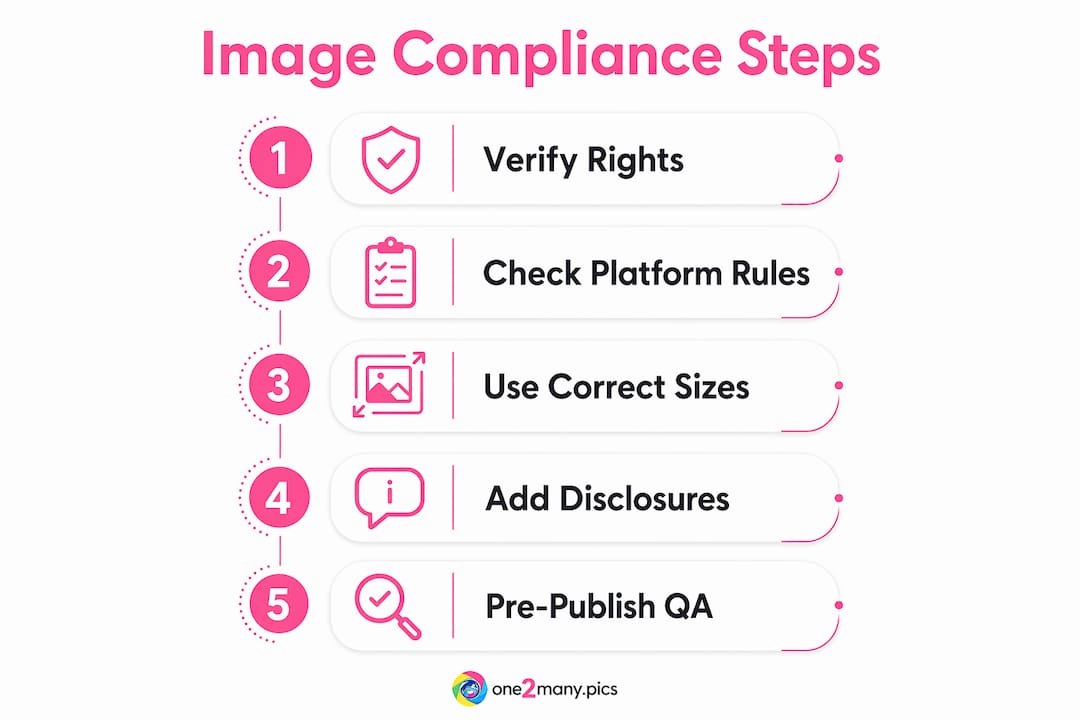
A reliable pre-publish checklist covers five areas in order:
- Rights verification: Confirm the image license is current, covers the intended platform and use type, and is stored in your rights library.
- Disclosure check: Verify that any paid, gifted, or AI-assisted content carries a visible, platform-compliant disclosure at the top of the caption or on the image itself.
- Privacy review: Strip metadata, blur any visible PII, and confirm that identifiable individuals have signed releases on file.
- Dimension and format check: Match the image to the platform's recommended size and file type before uploading.
- Claims review: Flag any health, earnings, or performance claims for substantiation. Link each claim to verifiable evidence in a compliance file before publishing.
Experienced teams use a traffic-light risk system to categorize content before it goes live. Green content clears the checklist automatically. Yellow content requires a second reviewer. Red content, typically posts with health claims, financial promises, or contested image rights, requires legal sign-off before publication.
| Step | Manual review | Automated workflow |
|---|---|---|
| Rights verification | Checked per post by creator | Rights library auto-flags expired licenses |
| Disclosure check | Reviewed by team lead | Template system prompts disclosure insertion |
| Privacy and PII review | Manual visual scan | Automated metadata stripping and PII detection |
| Dimension check | Creator checks against spec sheet | Upload tool rejects non-compliant file sizes |
| Claims substantiation | Legal review on request | Substantiation file linked to post in CMS |
Pro Tip: Build your checklist directly into your content calendar tool or project management system. A compliance gate that requires a checkbox before a post moves to "ready to publish" status removes the human tendency to skip the review when deadlines are tight.
The 2026 compliance guide for marketers recommends treating each checklist item as a mandatory production step, not a suggestion. Teams that embed compliance early in content creation avoid costly backtracking and publish faster with confidence.
Key Takeaways
Image compliance in social media marketing requires documented rights, visible disclosures, and active privacy protection at every stage of content production.
| Point | Details |
|---|---|
| Rights documentation | Secure written licenses and model releases for every image before publishing. |
| Platform-specific sizing | Use recommended dimensions per platform to avoid suppression and cropping. |
| Clear disclosures | Place #ad or "Paid Partnership" at the top of captions, not buried in hashtags. |
| Privacy and metadata | Strip EXIF data and blur PII from images before uploading to any platform. |
| Pre-publish QA workflow | Run a five-step compliance checklist on every post before it goes live. |
Why compliance is the competitive edge most creators overlook
Most creators treat compliance as a legal problem. After working with content teams across multiple industries, the pattern is clear: the creators who grow fastest are the ones who treat compliance as a production standard, not a legal department issue.
The brands that embed compliance early in content creation build stronger credibility and avoid costly backtracking. They publish faster because they are not stopping to fix problems after the fact. That speed compounds over months into a measurable competitive advantage.
The part that surprises most marketers is how much compliance protects creative freedom. When your rights library is current, your disclosures are templated, and your metadata is clean, you can post with confidence. You are not second-guessing every image or waiting for legal review on routine content.
The disclosure rules around AI-generated content are the area where I see the most exposure right now. Creators are using AI image tools without disclosing it, assuming the output looks "real enough" to skip the label. That assumption is exactly what regulators are targeting in 2026. Getting ahead of it now, before enforcement ramps up, is the lowest-cost compliance investment you can make.
The social media compliance guide for creators covers the regulatory trends shaping this space in detail. The short version: proactive compliance is not a burden. It is a brand asset.
— one2many.pics
How One2many supports compliant image creation at scale
Social media marketers who need to post frequently across multiple platforms face a specific problem: compliance checks slow down production. One2many is built to close that gap.
One2many's platform strips metadata including GPS coordinates, device identifiers, and timestamps from images automatically, removing one of the most common privacy oversights before it becomes a violation. For creators managing unique image creation safely across multiple accounts, One2many generates visual variations from a single source image, reducing duplicate detection risk while keeping your content library compliant and organized. The platform supports bulk processing with workflow integrations, making it practical for agencies and marketing teams managing high-volume content calendars. Visit one2many.pics to see how it fits into your compliance workflow.
FAQ
What is image compliance in social media marketing?
Image compliance in social media marketing means every visual you publish meets legal rights requirements, platform content policies, and consumer privacy regulations. The three core pillars are explicit written rights, clear disclosures, and privacy protection.
What disclosures are required for sponsored social media images?
The FTC requires that paid or incentivized content carry a "clear and conspicuous" disclosure such as #ad or a native "Paid Partnership" label placed before any caption cutoff. Burying the disclosure in hashtags does not meet the standard.
Do I need permission to repost user-generated content?
A public tag or mention does not grant permission to repost. Marketers are fully liable for any claims conveyed by reposted images, so explicit written consent from the original creator is required before commercial use.
What image sizes should I use for Instagram and Facebook?
Instagram portrait posts perform best at 1080x1350 pixels with a 4:5 aspect ratio. Facebook feed images should be 1200x630 pixels at a 1.91:1 ratio. Using incorrect dimensions triggers platform compression and reduces algorithmic reach.
Does AI-generated image content require disclosure in 2026?
The EU AI Act and FTC guidelines both require disclosure of AI-generated or AI-assisted marketing content. This became a primary enforcement target starting in august 2026, and applies to images substantially created or altered by AI tools.