

Staying ahead as a social media manager in 2026 means your visual content strategy tips need to do two things at once: drive real engagement and protect your accounts from platform penalties. That pressure is real. Algorithms punish duplicate images, suppress engagement bait, and throttle unlabeled AI content. The gap between those who figure it out and those who fall behind is stark. 65% of successful marketers have a documented visual content strategy, compared to just 14% of the least successful. This article gives you the frameworks, formats, and workflow tactics to close that gap.
Table of Contents
- Key criteria for an effective visual content strategy
- Top visual formats to boost engagement while protecting privacy
- Design specifications to optimize reach and avoid engagement penalties
- Streamlining workflows for scalable, high-impact visual content
- Navigating privacy and algorithm penalties in visual content
- Comparing visual content strategies: which tips deliver the best results?
- Why a privacy-first visual content strategy is the future
- Leverage one2many.pics to create private, optimized visual content
- Frequently asked questions
Key Takeaways
| Point | Details |
|---|---|
| Document your strategy | Written strategies improve team alignment and increase marketing success. |
| Choose format wisely | Use videos, carousels, or images according to message complexity and platform. |
| Optimize design specs | Correct sizing and text limits prevent engagement penalties and cropping. |
| Streamline workflows | Separate creative and production tasks to maintain brand consistency and privacy. |
| Prioritize privacy | Label AI content and avoid generic bait to maintain reach and build trust. |
Key criteria for an effective visual content strategy
Good visual storytelling strategies start with a plan, not a posting calendar. A documented strategy with clear goals and visual roles sets the foundation for every format, caption, and CTA decision you make. Without it, your team produces inconsistent content that confuses audiences and confuses algorithms.
Every effective visual content plan must meet these criteria:
- Documentation: Written goals, audience definitions, and platform-specific workflows that any team member can follow
- Defined visual narrative: How images and video reinforce your brand voice, values, and messaging arc across platforms
- Privacy compliance: Processes that strip or manage metadata before posting to prevent digital fingerprinting and account linking
- Quality CTAs: Platforms suppress engagement bait like "tag a friend" or "like if you agree," so every CTA must invite a genuine, specific response
- Platform-specific formatting: Each platform rewards different aspect ratios, lengths, and content styles, so one-size-fits-all planning fails by design
For deeper guidance on maximizing reach and privacy simultaneously, these documented criteria are your starting point.
Having set the criteria, let's explore the main visual content formats that meet these standards.
Top visual formats to boost engagement while protecting privacy
Format selection is where creating visual content plans gets tactical. Not every content type carries the same risk profile, and not every format performs equally across platforms.
Short vertical videos (15 to 60 seconds) are currently the primary reach drivers across Instagram Reels, TikTok, and YouTube Shorts. Short-form vertical video drives higher reach than any other content type right now, full stop. If you are not producing them, you are handing reach to competitors.
Carousels are the most underused format in most content teams' arsenals. Carousels outperform single images on saves and shares because they hold attention through multiple slides. Use them for step-by-step explanations, before-and-after comparisons, or educational sequences.
Single images still work for clear, emotionally direct messaging. They are faster to produce and easier to test. Just avoid cluttered compositions or stock photo aesthetics that feel generic.
One often-skipped element: alt text. It is not just an accessibility feature. Alt text improves reach on image-based posts without introducing any privacy risk, making it one of the cheapest wins in your toolkit.

On AI-generated images: use them, but integrate authentic human elements. Fully AI-generated visuals without labeling now carry real suppression risk. Make smart visual content choices by pairing AI efficiency with real-world context.
Key format tips:
- Match video length to platform norms: 15 seconds for TikTok discovery, 30 to 60 seconds for Instagram and Shorts
- Carousel slide 1 must hook immediately, or users swipe past without engaging further
- Use alt text on every image post, and keep it descriptive and natural, not keyword stuffed
- Label AI-generated content clearly in the post, not buried in captions
Pro Tip: Repurpose a single carousel into a short video slideshow with narration. You get two format types from one creative concept, cutting production time without duplicating content identically.
With formats selected, choose the right sizing and design specs for maximum effect.
Design specifications to optimize reach and avoid engagement penalties
This is where most content teams leave performance on the table. Getting visual content design tips right at the technical level prevents algorithmic penalties you may not even know you are receiving.
1080 pixels wide with 4:5 or 9:16 vertical ratios consistently outperforms square or horizontal formats on mobile-first feeds. Portrait orientation takes up more screen real estate, which means more attention time before a scroll.
| Spec | Recommended value | Risk if ignored |
|---|---|---|
| Image width | 1080px | Blurry or upscaled output |
| Feed post ratio | 4:5 (portrait) | Cropped key elements |
| Stories/Reels ratio | 9:16 | Black bars, reduced engagement |
| Text overlay | Under 20% of image | Meta algorithm suppression |
| Safe zone margin | 14% from edges | Key text cropped on mobile |
Text overlays above 20% of the image area trigger Meta algorithm suppression. Keep your headlines short and your visuals doing most of the storytelling. If you need to explain your image with a wall of text on top of it, the image is not working hard enough.
Improper resizing can reduce engagement by up to 50% due to cropping penalties. This is not a minor issue. A beautiful creative that gets cropped loses its impact entirely on mobile, where most of your audience is watching.
Pro Tip: Build your designs with a visible safe zone guide in your design tool. Anything critical, such as your logo, CTA, or face, stays within the inner 72% of the frame to survive every platform's crop behavior.
For a full breakdown of best practices for privacy and engagement, technical specs are just the start.
Next, let's compare workflow approaches that ensure consistent delivery across platforms.
Streamlining workflows for scalable, high-impact visual content
Scaling visual content without workflows is how teams burn out and accounts get flagged. Best practices for visual content production require separating two distinct tasks that most teams wrongly combine.
Step 1: Strategy first. Define the message, audience segment, CTA, and platform before anything is designed. Separating strategy from production prevents off-brand output and reduces the risk of posts being flagged as spam because they feel disconnected or templated.
Step 2: Production with brand guardrails. Build and maintain a brand kit with exact hex codes, approved fonts, and logo variations. Every designer or tool using the kit produces on-brand output without manual review of every file.
Step 3: Test before you scale. A crawl, walk, run approach validates milestones before you commit full resources. Post a small batch, measure engagement and reach, refine the format or spec, then scale what performs.
Step 4: Version control and scheduling discipline. Name files consistently (platform, format, date, version). Schedule posts in advance to avoid rushed uploads that skip metadata removal or caption checks.
Step 5: Accessibility and privacy in every file. Alt text, descriptive file names, and stripped metadata are not afterthoughts. Build them into your production checklist so they happen automatically.
Additional workflow essentials:
- Assign separate roles for content creation and compliance review
- Use platform-native scheduling where possible to reduce third-party footprint
- Archive all published versions to prevent accidental duplicate posting
For detailed guidance on scaling visual posting efficiently and streamlining content workflows for privacy, the process matters as much as the content itself.
After refining workflows, understand the unique privacy challenges and algorithm risks you need to navigate.
Navigating privacy and algorithm penalties in visual content
This section covers the risks most strategy guides skip. How to enhance visual strategy is not just about aesthetics. It is about not losing the reach you already built.
AI-generated content labeling: Unlabeled AI visuals trigger immediate throttling on X and Meta. The platforms are not waiting for you to self-report. Their detection systems flag AI patterns automatically. Label clearly. It is not optional anymore.
Engagement bait suppression: Platforms suppress "like if you agree" and "tag a friend" prompts but actively reward specific, thoughtful questions. "Which of these two approaches fits your current setup?" works. "Double tap if you agree" does not.
Generic engagement bait is not just ineffective. It is actively harmful to reach. One flagged post can suppress the next three in your queue.
Privacy in alt text and captions: Avoid using personally identifiable location details or device-specific language in captions. This protects your audience and keeps your account from being profiled by data scrapers.
Monitor rule changes: Each major platform updates its content policies at least quarterly. Assign someone to track these changes or build a monthly policy audit into your calendar.
Key risks to monitor:
- Duplicate image hashes across multiple accounts (triggers duplicate detection)
- Embedded metadata revealing posting device or location
- Repeated posting patterns that flag automated behavior
- Caption templates reused verbatim across accounts
For more on privacy and engagement best practices, understanding these risks is where your strategy gets genuinely competitive.
With these risks understood, let's compare all key tactics in a summary to decide what fits best for you.
Comparing visual content strategies: which tips deliver the best results?
Visual content marketing significantly increases engagement and revenue when executed with intention. But not every tactic is equal for every team. Here is a direct comparison:
| Tactic | Engagement impact | Privacy risk | Production complexity | Best platform |
|---|---|---|---|---|
| Short vertical video | Very high | Low if labeled | Medium | TikTok, Reels, Shorts |
| Carousel posts | High | Low | Medium | Instagram, LinkedIn |
| Single images | Medium | Low | Low | All platforms |
| AI-generated visuals | Varies | High if unlabeled | Low | All (with labeling) |
| Alt text optimization | Low direct, high cumulative | None | Very low | All platforms |
| Metadata removal | Indirect (protects reach) | Eliminates | Low | All platforms |
Short-form video and carousels combined consistently produce the highest reach and saves across major platforms. If you have limited resources, these two formats give you the best return on production effort.
For budget-conscious teams, prioritize:
- Single images with strong alt text for low-cost, low-risk daily posting
- One carousel per week for depth and saves
- One short video per week for algorithmic reach
For teams ready to scale, cross-platform posting examples show how the same creative concept can be reformatted, not just reposted, across platforms without triggering duplicate detection.
Why a privacy-first visual content strategy is the future
Most strategy guides treat privacy as a compliance checkbox. They are wrong, and that mistake is costing creators real reach.
Privacy-first thinking is not about hiding. It is about owning your digital footprint intentionally. When you strip metadata, vary your image signatures, and label AI content clearly, you are not just avoiding penalties. You are building an operation that platforms cannot easily flag, suppress, or profile.
Consumers and regulators distrust opaque AI use. Transparency is not just ethical. It is a reach strategy. Accounts that clearly label and contextualize AI content are building audience trust at a time when most accounts are eroding it.
The deeper insight: authentic visuals that reflect real environments, real people, and real moments consistently outperform polished AI-generated compositions in emotional resonance. Emotional resonance drives saves, shares, and purchases. The ROI case for authenticity is stronger than most analytics dashboards show because saves and shares are underweighted in most reporting dashboards.
A long-term, documented, and iterative approach to unique images and privacy is not conservative strategy. It is the one that compounds. Every post that avoids a suppression event is a post that builds the next one's reach. Privacy is not the ceiling. It is the floor.
Leverage one2many.pics to create private, optimized visual content
Applying these visual content strategy tips at scale requires more than a good plan. You need tools that handle the technical privacy layer without slowing down production.
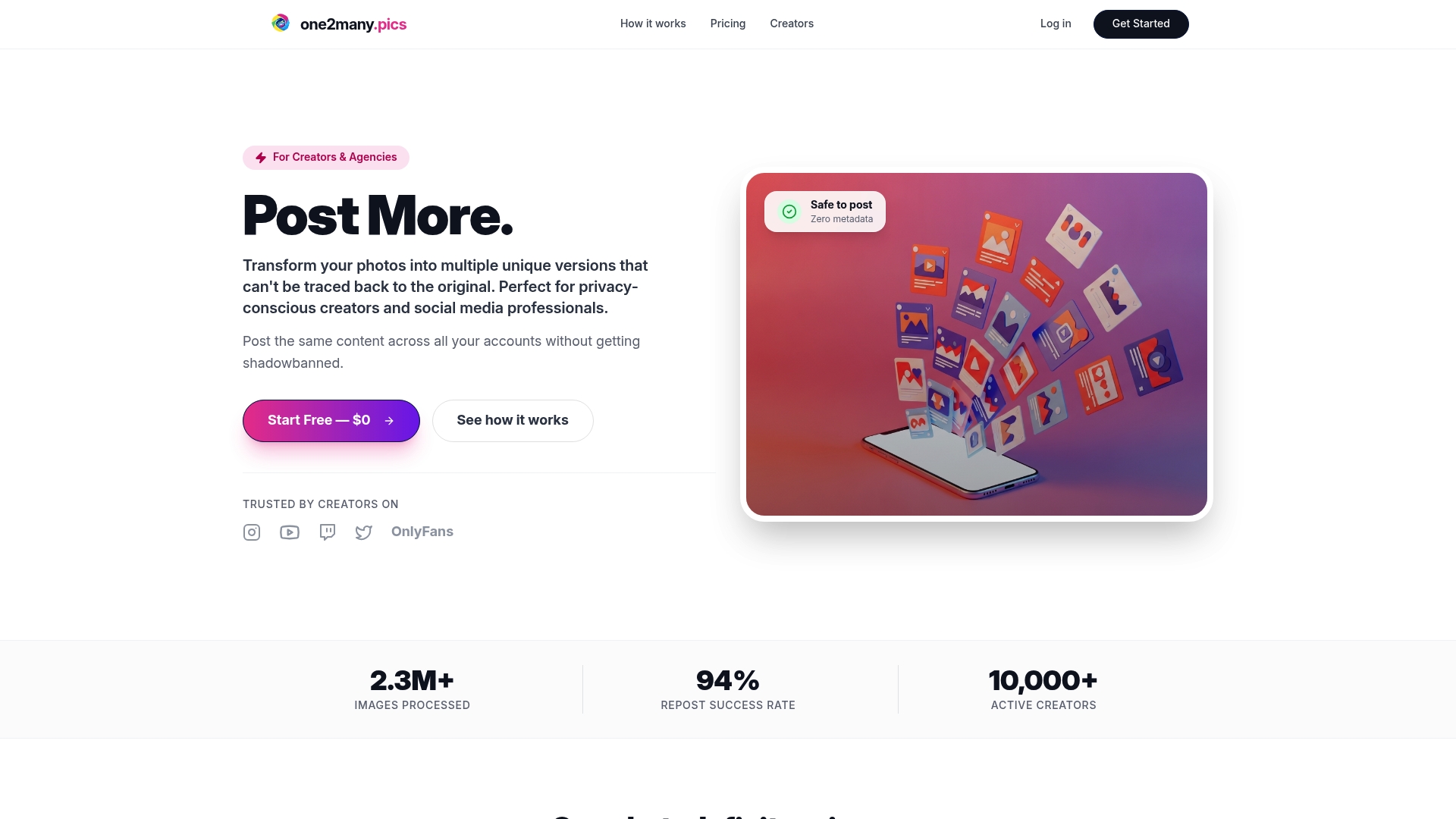
One2many.pics is built specifically for social media managers and content teams who post across multiple accounts and platforms. The platform strips identifying metadata from images, generates unique visual variations from a single source file, and supports bulk processing so you can produce platform-specific versions without manual duplication. Each image leaves no traceable footprint, which directly reduces the risk of duplicate detection and account suppression. For teams managing high-volume posting schedules, it integrates into existing workflows with secure download options and customizable variation settings. If reach protection and scalable visual production are priorities, this is where your workflow closes the gap.
Frequently asked questions
Why is documenting a visual content strategy important?
Documenting your visual content strategy clarifies goals and processes, boosting success rates and ensuring consistent team efforts across platforms. 65% of successful marketers have documented strategies, compared to just 14% of the least successful.
How can social media managers avoid engagement bait penalties?
Avoid generic prompts like "like if agree" and instead use specific questions that encourage meaningful comments to maintain reach and algorithm favor. Platforms suppress generic engagement bait but actively reward targeted, thoughtful questions.
What image sizes optimize engagement on major social platforms?
Images should be 1080px wide with vertical ratios of 4:5 or 9:16 to align with mobile-first feed layouts and avoid cropping penalties that can cut engagement by up to 50%.
How should AI-generated visuals be handled to prevent reach loss?
Clearly label "AI-generated" on all AI-produced visuals to maintain transparency and avoid algorithm throttling. Unlabeled AI visuals trigger instant throttling on X and Meta, with no grace period.
What is the best workflow approach for scaling visual content safely?
Use a "crawl, walk, run" approach, testing results at each milestone to ensure consistency and optimize metrics before committing full production resources. The crawl, walk, run model prevents wasted effort and catches quality issues before they scale.