

Secure content tools are defined as software systems that control who can access, share, and distribute your digital assets, protecting them from piracy, unauthorized use, and data exposure. For content creators, digital marketers, and social media managers, understanding why use secure content tools is no longer optional. Platforms like One2many show that privacy protection and content security directly affect brand reputation, audience trust, and long-term revenue. Regulations like GDPR and CCPA add legal weight to what was once just a best practice. The cost of getting this wrong is real, and it shows up fast.
Why use secure content tools to stop piracy and revenue loss
Unsecured content delivery exposes creators and marketers to piracy, server overload, and direct revenue loss from unauthorized distribution. When someone shares your paid content without permission, you lose the sale and the relationship. The damage compounds when pirated versions circulate under your brand name but deliver a degraded experience.
The mechanisms that prevent this are specific and proven:
- Expiring links make shared URLs useless after a set time window, cutting off unauthorized redistribution at the source.
- Password protection limits access to verified recipients only, keeping premium content out of public reach.
- Download limits cap how many times a file can be saved, reducing bulk copying for resale.
- Digital Rights Management (DRM) embeds usage rules directly into the file, so restrictions travel with the content regardless of where it ends up.
- Watermarking deters theft by making stolen content traceable back to the original leak source.
Each of these features addresses a specific attack vector. Using only one leaves the others open.
The brand reputation angle is equally serious. Pirated software users are 65 times more likely to encounter malware than legitimate customers. That means your audience, if they access your content through unofficial channels, associates your brand with a security threat you did not create but cannot escape.

Pro Tip: Set expiring links with a 48-hour window for digital product deliveries. This window is long enough for legitimate buyers to download their files but short enough to prevent link sharing across forums or group chats.
How privacy compliance protects your brand reputation
Privacy frameworks like GDPR and CCPA are not abstract legal concerns. They carry direct financial consequences. Data leaks can trigger multi-million dollar fines and cause brand damage that no marketing budget can fully repair. Enterprise platforms address this through certifications like SOC 2 Type II and ISO 27001, which verify that security controls are real and consistently applied.
The features that support compliance are not optional add-ons. They are the core of any serious content management setup:
- Encryption at rest and in transit protects data whether it is stored on a server or moving between systems.
- Role-based access controls limit who can view, edit, or export content based on verified identity and job function.
- Audit logs create a timestamped record of every action taken on a file, which is the primary evidence regulators request during an investigation.
- Privacy-by-design architecture builds data minimization and consent management into the workflow from the start, rather than bolting them on afterward.
Compliance is not a destination. It is a continuous operational state that requires active monitoring, regular audits, and tools that generate verifiable evidence on demand. A single unlogged access event can invalidate months of documented compliance work.
The reputational dimension matters just as much as the legal one. A data leak does not just expose files. It signals to your audience that you did not take their trust seriously. For social media managers and influencers whose entire business runs on audience confidence, that signal is often fatal to the brand relationship. Secure content management reasons go beyond avoiding fines. They include preserving the credibility that makes your content worth following in the first place.
How does AI change the risk profile for content security?
AI workflows introduce a category of risk that traditional security tools were not built to handle. The core problem is unstructured data. When AI systems ingest content to generate outputs, they often process files, images, captions, and metadata without the same access controls that govern structured databases. Traditional security tools fail to detect sensitive unstructured data fed to AI, making real-time monitoring and classification tools necessary for any team using AI in their content pipeline.
The practical risks for creators and marketers include:
- Accidental exposure of client data when AI tools process briefs, contracts, or campaign files that contain personally identifiable information.
- Metadata leakage from images and documents that reveal location, device, and timestamp data to AI systems that log inputs.
- Model training risks when AI platforms use uploaded content to improve their models without explicit consent from the creator.
- Prompt injection vulnerabilities that allow bad actors to extract sensitive content by manipulating AI inputs.
Specialized secure content tools address these gaps through contextual understanding and behavior-based risk assessment. They classify content by sensitivity level before it enters any AI workflow, flag anomalies in real time, and maintain logs that show exactly what data each AI system accessed. For creators working with privacy-focused posting workflows, this layer of control is what separates a professional operation from a liability.
Pro Tip: Before connecting any AI tool to your content library, audit what data the tool can access by default. Most platforms grant broad read permissions on first connection. Restrict access to only the folders and file types the AI actually needs.
What are the operational benefits of unified content security?
Fragmented security setups multiply your attack surface. Managing one secured perimeter is easier and more effective than maintaining multiple disconnected tools, each with its own update cycle, access policy, and audit log. For marketing teams running campaigns across several platforms simultaneously, fragmentation means compliance gaps appear wherever the tools fail to communicate.
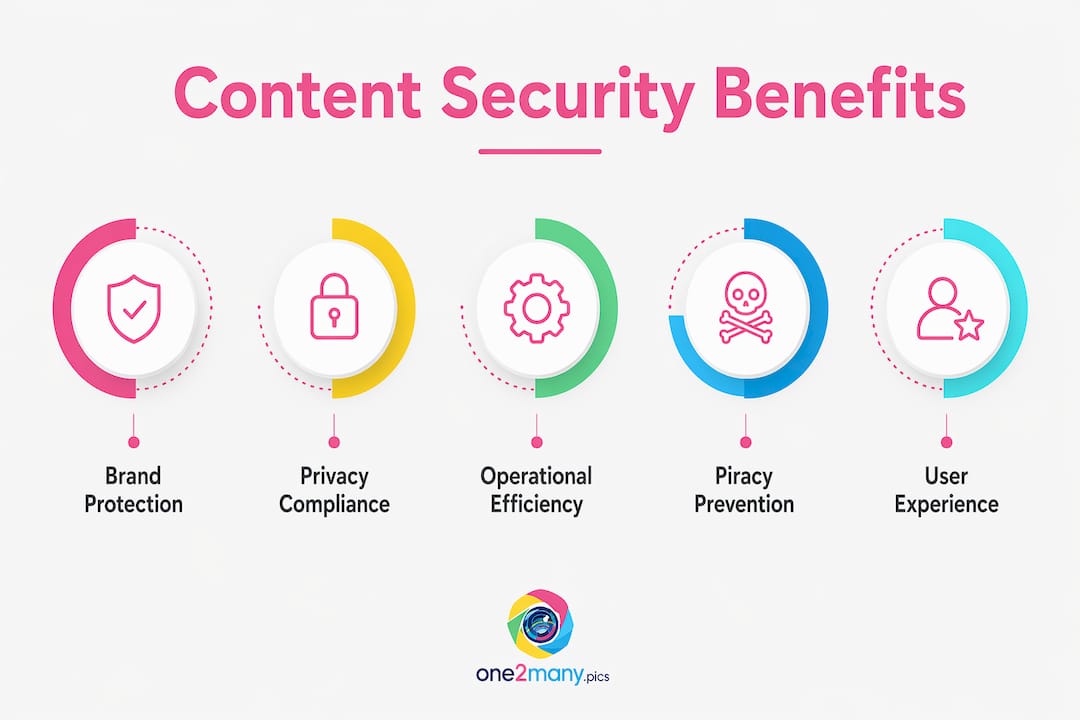
The operational case for unified platforms is clear when you compare the two approaches:
| Feature area | Fragmented setup | Unified platform |
|---|---|---|
| Access policy management | Separate rules per tool | Single policy applied across all assets |
| Audit trail | Scattered across multiple logs | Centralized, searchable, and exportable |
| Compliance reporting | Manual aggregation required | Automated and verifiable on demand |
| User onboarding | Multiple logins and training sessions | One interface, one permission set |
| Shadow IT risk | High, due to usability friction | Low, when the tool is easy enough to use |
Poor tool usability causes shadow IT, where team members bypass official systems for convenience and create new security gaps in the process. A unified platform removes the friction that drives that behavior. Secure collaboration tools improve productivity by consolidating communication and asset management into a single environment, reducing the app sprawl that slows teams down and leaves data exposed.
One2many applies this principle directly to visual content. Instead of managing metadata removal, image variation, and secure download as three separate steps across three separate tools, the platform handles all of it in one workflow. That consolidation is not just convenient. It is what makes the security consistent.
Key Takeaways
Secure content tools are the foundation of brand protection, privacy compliance, and operational efficiency for any creator or marketer working at scale in 2026.
| Point | Details |
|---|---|
| Piracy prevention is specific | Use expiring links, download limits, DRM, and watermarking together, not individually. |
| Compliance requires evidence | Audit logs and encryption are the proof regulators and clients request first. |
| AI workflows need specialized controls | Standard security tools miss unstructured data risks; classification and monitoring fill the gap. |
| Unified platforms reduce risk | One secured perimeter beats multiple disconnected tools every time. |
| Usability drives adoption | Tools that are hard to use get bypassed, which creates the exact vulnerabilities they were meant to prevent. |
The security mindset that most creators skip
The most common mistake I see creators and marketers make is treating security as a one-time setup. They install a tool, configure the basics, and move on. Security requires continuous operation, not a single configuration event. Threats evolve, platforms update their detection methods, and the content workflows that were safe six months ago may expose new risks today.
The second mistake is choosing security tools based on feature lists rather than actual workflow fit. A tool with 40 security features that your team finds confusing will be bypassed within a week. The team will revert to email attachments, personal cloud storage, and direct message file sharing. Those workarounds are where breaches actually happen.
What works is starting with the specific risks your workflow faces. If you post visual content across multiple accounts, metadata exposure and duplicate detection are your primary threats. If you manage client campaigns, access control and audit trails matter most. Match the tool to the threat, then build the habit around it. One2many's approach of focusing on image privacy for creators reflects exactly this kind of threat-specific design. Security that fits the workflow gets used. Security that fights the workflow gets ignored.
— one2many.pics
Secure content management built for creators and marketers
Content creators and social media managers need security that works inside their actual posting workflow, not around it.

One2many is built for exactly that. The platform removes metadata from images, generates unique visual variations to avoid duplicate detection, and delivers files through secure download options that protect your content at every step. Whether you manage one account or fifty, the workflow stays consistent and your digital footprint stays private. Subscription plans scale from single-image processing to bulk automation with workflow integrations, so the level of protection matches the size of your operation. For creators serious about influencer privacy strategies, One2many is the practical starting point.
FAQ
What are the main benefits of secure content tools?
Secure content tools prevent piracy, protect privacy compliance, and reduce brand damage from data leaks. They also consolidate access controls and audit trails into a single manageable system.
Why is metadata removal important for content creators?
Metadata embedded in images and files can reveal your location, device, and posting schedule to platforms and third parties. Removing it before publishing protects your digital footprint and reduces the risk of content suppression.
How do secure content tools support GDPR and CCPA compliance?
They provide encryption, role-based access controls, and audit logs that generate the verifiable evidence regulators require. Enterprise-grade platforms also carry certifications like SOC 2 Type II and ISO 27001 to confirm consistent security practices.
What makes AI workflows a new security risk for content teams?
AI systems often process unstructured data, including images and documents, without the access controls that govern structured databases. Specialized secure content tools classify and monitor this data in real time to prevent accidental exposure.
Why does tool usability matter for content security?
Tools that are difficult to use get bypassed. When team members route around official systems for convenience, they create shadow IT workarounds that introduce the exact vulnerabilities the tools were meant to prevent.