

Agencies are defined as data processors under privacy law, meaning they carry legal responsibility for how client and audience data is collected, stored, and used across every content workflow. The role of agencies in content privacy goes far beyond signing a policy document. Under frameworks like GDPR and CCPA, agencies must implement contractual safeguards, technical controls, and governance procedures that protect personal data at every stage of content production. New US state laws effective january 2026 in Indiana, Kentucky, and Rhode Island add opt-in consent requirements for sensitive data, raising the compliance bar even further. Agencies that treat privacy as a core operating principle, not a legal checkbox, build stronger client relationships and win more enterprise business.
What legal and contractual responsibilities do agencies have for content privacy?
Agencies act as data processors, not data controllers. The client owns the data and defines the purpose; the agency executes the processing under the client's instructions. That distinction matters because it determines who bears liability when something goes wrong.

The cornerstone of this relationship is the Data Processing Addendum (DPA). A DPA is a binding contract that defines how personal data is handled, protected, and deleted at the end of an engagement. Most agencies designate the client as Data Controller and themselves as Data Processor, and the DPA formalizes that arrangement with specific protocols. Without a signed DPA, an agency is operating outside the law in most jurisdictions covered by GDPR or CCPA.
DPAs must address several specific areas:
- Scope of processing: What data is collected, why, and for how long
- Sub-processor management: Every vendor the agency uses, including AI tools, must have its own DPA in place
- Security standards: Encryption, access controls, and breach notification timelines
- Termination protocols: How data is returned or destroyed when the contract ends
- Geographic scope: Where data is stored and transferred, especially across borders
Client-agency contracts must also address consent for image and likeness use, geographic territories, ownership status, and content duration. These clauses reduce the risk of litigation and unauthorized use, particularly in influencer and social media campaigns where personal images are central to the work.
New US state privacy laws effective january 2026 require agencies to implement opt-in consent for sensitive data categories and recognized opt-out mechanisms for profiling and targeted advertising. That means consent flows must be built into content campaigns before launch, not retrofitted after a complaint.
Pro Tip: Audit every vendor in your tech stack annually. If a tool processes personal data and lacks a signed DPA, it is a compliance liability regardless of how small or specialized the vendor is.
How do agencies implement privacy and security protocols across content workflows?
Technical controls are the backbone of content privacy compliance. Policies and contracts set the rules; technical architecture enforces them.
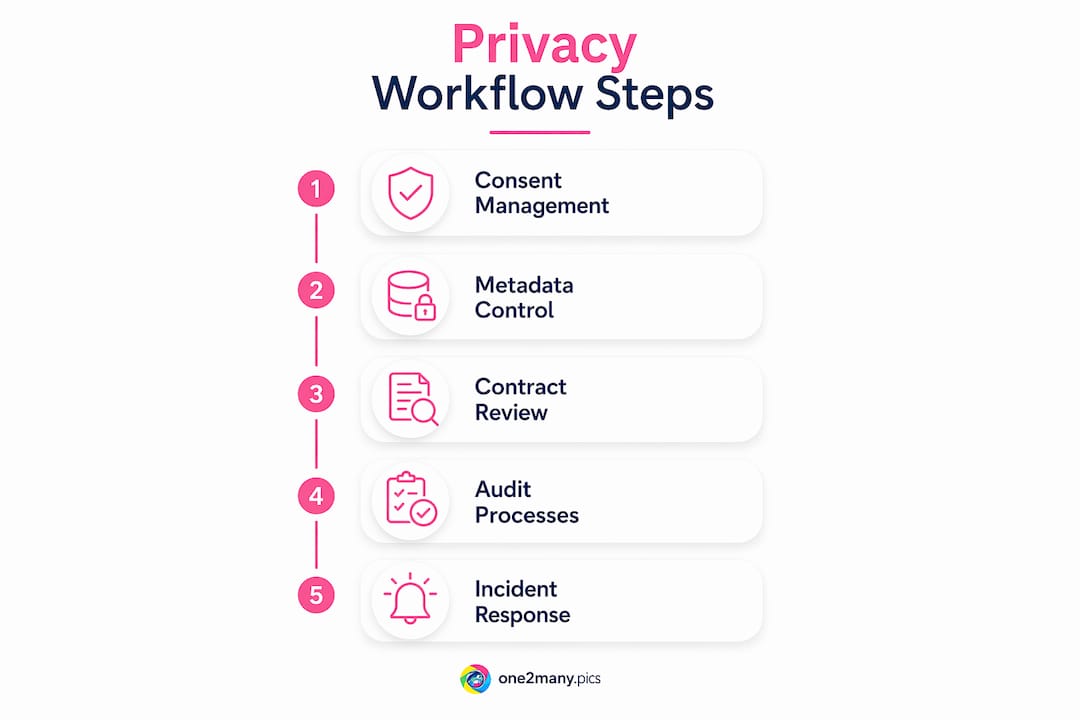
The strongest protection comes from multi-tenant data isolation at the database level. This approach physically and cryptographically separates each client's data so that no cross-access is possible between accounts sharing the same platform. UI-level separation, where data is filtered by user interface logic alone, is far weaker and does not meet the standard expected under GDPR or enterprise client contracts.
Agencies managing multiple clients and content streams should implement the following controls in sequence:
- Role-based access controls: Limit who can view, edit, or export personal data based on job function, not convenience.
- Data minimization: Every data field collected must have a documented business purpose. Collecting excessive data increases breach exposure and creates operational complexity at scale.
- Audit logging: Every action taken on personal data should be recorded with a timestamp and user ID. Logs must be tamper-proof and retained for the period specified in the DPA.
- Human review gates: Content pipelines, especially those using AI tools, require human checkpoints before publication to catch privacy leakage or unauthorized likeness generation.
- Incident response readiness: Agencies must have a documented breach response plan that meets the 72-hour notification requirement under GDPR.
The table below shows how these controls map to common agency workflow stages:
| Workflow stage | Primary control | Compliance purpose |
|---|---|---|
| Data collection | Consent management | Opt-in and opt-out compliance |
| Content creation | Role-based access | Limit exposure of personal data |
| AI tool usage | Sub-processor DPAs | Prevent unauthorized data sharing |
| Content review | Human review gates | Catch privacy leakage before publish |
| Data retention | Audit logs and deletion schedules | Meet DPA termination protocols |
Metadata management is an often overlooked control. Images and documents carry embedded metadata including location data, device identifiers, and timestamps. Agencies distributing visual content across platforms must strip or manage this metadata to avoid exposing client or audience information. Tools like One2many address this directly by removing metadata from images and generating unique visual variations, which protects the digital footprint of content across multiple accounts and platforms.
What are the privacy challenges and risks with AI in agency content production?
AI tools create privacy risks that most agency contracts were not written to handle. The gap between what employees use and what the agency has formally approved is where most violations occur.
Shadow AI is the clearest example. Shadow AI usage occurs when employees use external AI tools without signed DPAs, which can breach client confidentiality and data protection laws even when no data leak actually happens. The violation is the unauthorized processing itself. An employee pasting client data into an unapproved AI chatbot is a DPA breach, full stop.
Agencies must address AI risks across four areas:
- Input classification: Classify all data inputs by sensitivity level before they enter any AI workflow. Personal data, client confidential information, and licensed creative assets each require different handling rules.
- Contractual AI clauses: Client contracts must specify which AI tools are permitted, what data they may process, and whether AI-generated content must be disclosed to the end audience.
- Documented procedures: Recursive AI content creation increases privacy risk because each generation step can expose or transform personal details in ways that are hard to trace. Agencies must document data-handling procedures at every stage of an AI workflow.
- Approval logging: AI workflows should capture metadata and human review records for all content stages. This creates a traceable chain of custody that protects the agency in the event of a dispute or regulatory inquiry.
Pro Tip: Build a short AI usage policy that lists approved tools, prohibited data types, and required disclosure language. Distribute it at onboarding and review it every quarter as the tool landscape changes.
Agencies managing visual content privacy face a specific challenge: AI image generation tools can inadvertently reproduce recognizable likenesses or copyrighted elements. Human review before any AI-generated image goes live is not optional. It is the control that prevents both privacy violations and intellectual property claims.
How can agencies turn content privacy compliance into a competitive advantage?
Privacy compliance is not just a cost center. Agencies that build genuine privacy governance into their operations win clients that less rigorous competitors cannot serve.
Enterprise-grade data privacy compliance outperforms 90% of competitors during enterprise sales cycles. Large clients, particularly those in healthcare, finance, and regulated industries, require detailed evidence of data handling controls before signing. Agencies that can produce a complete DPA, a sub-processor list, and an incident response plan on request close those deals. Agencies that cannot, lose them.
The competitive advantages of proactive privacy governance include:
- Client confidence: Transparent AI usage disclaimers and clear data handling policies reduce client anxiety and build long-term trust.
- Reduced legal exposure: Documented consent flows and contract clarity lower the risk of disputes over data ownership and content rights.
- Operational efficiency: Agencies with documented privacy workflows spend less time responding to ad hoc client questions and more time on billable work.
- Brand credibility: A reputation for rigorous data handling attracts clients who value security, particularly as privacy compliance becomes a standard procurement criterion.
"Privacy compliance can transform from a vulnerability into a trust-based growth advantage when agencies are transparent and rigorous in their practices. The agencies that treat privacy governance as a differentiator, not a burden, are the ones that will define the next generation of client relationships."
Proactive incident response is part of this advantage. Agencies that notify clients quickly, clearly, and with a documented remediation plan when something goes wrong preserve relationships that reactive agencies lose. The privacy checklist for marketers approach, where every campaign is reviewed against a standard set of privacy criteria before launch, is the most practical way to build this culture at scale.
Key Takeaways
Agencies that embed privacy controls into contracts, workflows, and AI governance from the start outperform those that treat compliance as a reactive task.
| Point | Details |
|---|---|
| DPAs are non-negotiable | Every agency-client engagement requires a signed Data Processing Addendum covering data scope, security, and deletion. |
| Sub-processors must be covered | AI tools and vendors that process personal data need their own DPAs or they create direct compliance liability. |
| Shadow AI is a real breach risk | Employees using unapproved AI tools violate DPAs even without an actual data leak. |
| Data minimization reduces exposure | Collect only data with a documented business purpose to limit breach risk and operational complexity. |
| Compliance drives enterprise sales | Agencies with enterprise-grade privacy governance win clients that competitors without documented controls cannot serve. |
Privacy compliance is not the enemy of creative work
At One2many, we work with agencies and creators every day who assume that privacy compliance will slow down their content production. The opposite is true when privacy is built in from the start rather than bolted on at the end.
The agencies that struggle most are the ones that treat a DPA as a legal formality and an AI policy as something for the legal team to handle. Privacy governance is an operational discipline. It belongs in your onboarding checklist, your vendor selection process, and your content review workflow, not just in a folder on the shared drive.
The harder conversation is about client expectations. Clients often want speed and volume. Privacy controls take time. The agencies that navigate this well are the ones that set expectations early, document their procedures clearly, and use compliance as proof of professionalism rather than an excuse for delay. A client who understands why you strip metadata from images before distribution, or why you require a DPA before connecting a new AI tool, is a client who trusts you with their most sensitive campaigns.
The industry needs clearer standards for AI content governance in particular. Right now, every agency is writing its own rules. That creates inconsistency and risk. A shared framework, similar to what GDPR provided for data processing, would benefit the entire sector and make it easier for smaller agencies to compete on privacy quality rather than just price.
— one2many.pics
One2many for privacy-compliant content workflows
Content agencies managing visual assets across multiple accounts face a specific privacy risk that most compliance frameworks do not address directly: embedded metadata in images.
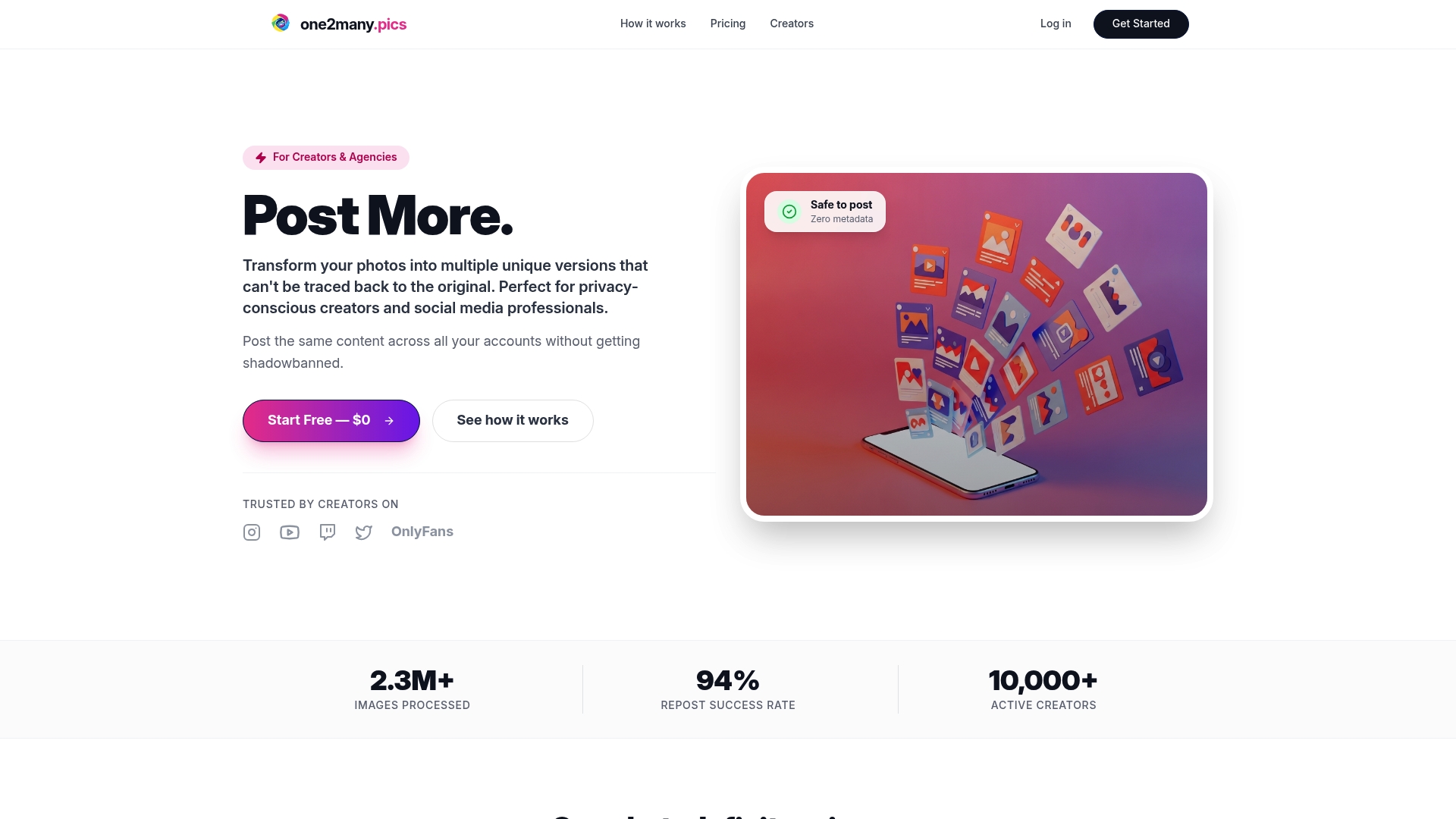
One2many removes metadata including location data, device identifiers, and timestamps from images before distribution, and generates unique visual variations that prevent duplicate detection across platforms. For agencies running campaigns across multiple social accounts, that means cleaner content, a protected digital footprint, and no platform penalties from duplicate content flags. The privacy tools for creators at One2many are built for the scale and workflow demands of professional content teams, with bulk processing, customizable variation settings, and secure download options. Agencies managing influencer content can also apply One2many's approach to influencer privacy strategies to protect both the creator's identity and the client's brand.
FAQ
What is the role of agencies in content privacy?
Agencies act as data processors responsible for implementing privacy controls, maintaining signed DPAs, and protecting audience data across all content workflows on behalf of their clients.
What is a Data Processing Addendum and why do agencies need one?
A Data Processing Addendum is a binding contract that defines how an agency handles, protects, and deletes personal data. It is legally required under GDPR and CCPA for any agency that processes client or audience data.
How does shadow AI create privacy risks for agencies?
Shadow AI occurs when employees use external AI tools without approved DPAs, which constitutes a data protection violation even if no data is actually leaked or stolen.
What do new US state privacy laws require from agencies in 2026?
Laws effective in Indiana, Kentucky, and Rhode Island in january 2026 require agencies to implement opt-in consent for sensitive data categories and provide recognized opt-out options for profiling and targeted advertising.
How can agencies use privacy compliance as a competitive advantage?
Agencies with documented privacy governance outperform 90% of competitors in enterprise sales by demonstrating strong data handling controls, clear AI usage policies, and incident response readiness.