

Metadata is the invisible infrastructure behind every post you publish. It's quietly telling platforms who you are, what your content is about, where you shot it, and whether it deserves to be surfaced to new audiences or buried. Most creators obsess over captions and visuals while completely ignoring the data layer that actually shapes discovery, engagement, and privacy. Once you understand how metadata works across social platforms, you gain control over something most competitors don't even know they're missing.
Table of Contents
- What is metadata and why does it matter on social media?
- How metadata shapes discovery, sharing, and engagement
- Privacy implications and pitfalls of social media metadata
- Best practices for managing metadata: Consistency, automation, and governance
- Most advice about metadata misses the forest for the trees
- How One2Many.pics helps you master metadata for social media
- Frequently asked questions
Key Takeaways
| Point | Details |
|---|---|
| Metadata boosts reach | Well-managed metadata makes content more discoverable and increases audience engagement across platforms. |
| Privacy risks persist | Some metadata can expose sensitive info unless proactively removed before uploading. |
| Automate and govern | Using automation and clear rules ensures consistent, scalable, and privacy-safe metadata management. |
| Preview vs. discovery signals | Optimized previews help with shares and click-throughs, but deep discovery depends on in-app metadata and engagement. |
What is metadata and why does it matter on social media?
Metadata literally means "data about data." On social media, it refers to all the structured information attached to or describing your content, separate from the content itself. A photo of a coffee shop isn't just pixels. It carries timestamps recording when the shot was taken, EXIF data identifying your camera model and GPS coordinates, file size, color profile, and more. A video post also carries resolution specs, encoding format, duration, and thumbnail data. Even a plain text post generates metadata: the time it was published, the account that created it, and the platform's internal content classification tags.
Metadata in social media acts as the interpretive layer that helps platforms categorize, display, and recommend content, shaping discovery, sharing, and downstream analytics. Think of it as the index card inside a library book. You never read the index card, but without it, the librarian can't find the book.

Here's a breakdown of the most common metadata types you'll encounter:
| Metadata type | Where it lives | What it controls |
|---|---|---|
| Timestamp | Every post and file | Feed ordering, freshness ranking |
| Hashtags | Post captions | Categorization, search, trending topics |
| EXIF data | Image/video files | Device ID, location, camera settings |
| Open Graph (og:image, og:title) | Link previews | How links look when shared |
| User tags and location tags | Post settings | Discoverability via tagged pages |
| Keywords and descriptions | Video titles, captions | Search indexing on TikTok, YouTube |
Platforms use metadata signals like titles and keywords to improve content retrieval and relevance in search and recommendation systems. This is not a passive process. Every post you publish feeds a real-time classification engine.
Here's why every creator and marketer should care:
- Discoverability: Metadata determines whether your content appears in search results, suggested feeds, and trending categories.
- Privacy: Metadata can reveal sensitive personal information, including your physical location and device identity, without you ever mentioning it in your caption.
- Platform trust: Consistent, accurate metadata signals authority and relevance, which positively influences algorithmic ranking over time.
Aligning your posting best practices with a metadata-aware strategy is one of the fastest ways to see compounding results from content you're already creating.
How metadata shapes discovery, sharing, and engagement
Understanding metadata in theory is one thing. Seeing exactly how it changes outcomes is where the real insight lives.
When you publish a post, the platform doesn't just store it. It ingests the content through a multi-step pipeline:
- File and field parsing: The platform extracts every structured attribute, including file type, embedded EXIF, caption text, hashtags, tagged accounts, and any URL attached.
- Indexing and classification: Content is indexed against topic graphs and keyword taxonomies so it can be retrieved in search and matched to user interests.
- Semantic enrichment: Modern platforms use hybrid retrieval systems blending metadata signals with semantic retrieval to assess what your content is really about, even beyond exact keyword matches.
- Engagement scoring: As users interact, the platform updates your content's relevance score in real time, reinforcing or suppressing further distribution.
- Recommendation surfacing: Based on all of the above, the algorithm decides whether to show your post to followers only, push it to broader audiences, or keep it out of non-follower feeds entirely.
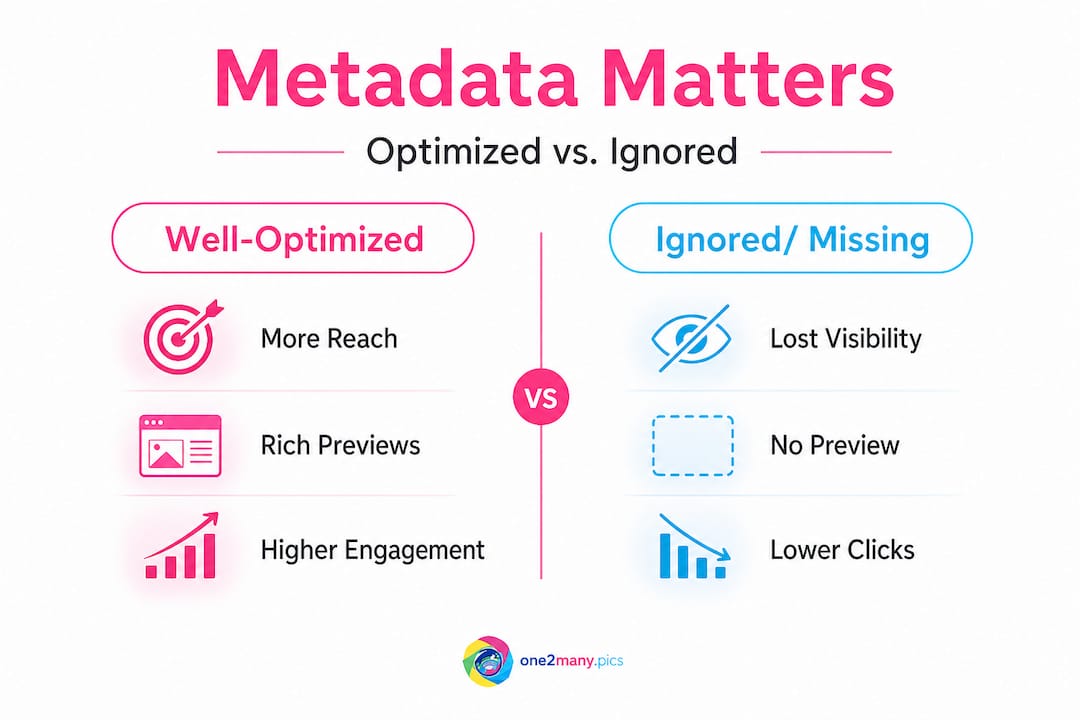
Here's a direct comparison showing what happens when metadata is optimized versus ignored:
| Metadata element | Well-optimized | Ignored or missing |
|---|---|---|
| og:image for link shares | Rich preview drives higher click-through | Broken or generic image, low engagement |
| Hashtags | Categorized, appears in searches | No categorization, limited reach |
| Video keywords/description | Indexed for search, recommended | Invisible to search, poor recommendations |
| Post timing (timestamp) | Published at peak audience time | Buried in off-peak feed position |
| Alt text | Accessible, signals content to algorithm | Missed classification opportunity |
For link shares specifically, Open Graph and platform-specific card metadata determine how your preview renders, which directly affects whether people click. A missing og:image means your link shows up as a plain text URL with no visual hook. That's a conversion killer.
On TikTok, keyword metadata gives creators control over video search visibility. TikTok's search function has grown dramatically, and users now search the platform the same way they use Google. If your video description lacks relevant keywords, you simply won't appear for those queries.
The payoff from well-managed cross-platform posting multiplies when each post is metadata-optimized for the specific platform where it lives.
Pro Tip: Don't fall into the trap of treating metadata optimization as a one-time checklist. Platforms update their ranking signals regularly, and what drove reach six months ago may be less effective today. Revisit your metadata strategy quarterly.
Privacy implications and pitfalls of social media metadata
Here's where many creators get blindsided. Metadata isn't just an optimization tool. It's also a privacy risk vector, and the consequences of ignoring it range from mild inconvenience to real-world safety issues.
The main privacy risks in metadata include:
- Location leakage via EXIF: A photo taken on your phone embeds GPS coordinates by default. Share the raw file and anyone can extract your exact address, route, or workplace.
- Device fingerprinting: EXIF and file metadata can expose your camera model, software version, and device serial numbers, creating a unique identifier that links content across multiple accounts.
- Automated classification: Platforms analyze content and apply internal category tags that may flag your content in ways you never intended.
- Accidental personal info: Metadata in documents or screenshots can reveal author names, company IDs, or internal file paths.
"Even if users can't see metadata, platforms may retain what you upload."
That quote captures a critical nuance. Many creators assume that because a platform compresses or strips visible EXIF from images before displaying them to followers, the data is gone. It isn't. Even if a platform strips EXIF from what other users download or view, ingestion and backend retention can still occur, meaning the strongest privacy posture is to strip metadata before uploading, not after.
Operationalizing this means building redaction into your workflow from the start. Metadata automation tools allow content teams to define governance schemas and apply rules that automatically flag or remove PII-heavy fields before any file leaves your control.
For practical implementation, the image privacy guide walks through specific tools and steps for removing sensitive fields from image files. The broader social media privacy guide covers platform-specific settings and behaviors you need to know. If you're managing multiple accounts or posting similar content across platforms, learning how to anonymize images is a non-negotiable step in your workflow.
Pro Tip: Never trust a platform to strip everything you want removed. Platforms optimize for their own data needs, not your privacy preferences. Local removal before upload is the only approach you fully control.
Best practices for managing metadata: Consistency, automation, and governance
Knowing the risks and opportunities is only useful if you build a repeatable system around them. Here's how to structure a metadata workflow that scales without creating chaos.
Step-by-step metadata workflow:
- Define your schema and taxonomy. Decide which metadata fields matter for your strategy, including keywords, categories, creator attribution, and privacy-sensitive fields. Document this so every team member applies consistent standards.
- Automate standard metadata generation. Use tools that auto-apply consistent file naming, keyword tags, and descriptions based on content type. Consistent, governed metadata fields are a practical prerequisite for scaling AI-assisted marketing workflows.
- Apply governance rules for sensitive fields. Set up rule engines that enforce classification standards for PII-heavy content, such as requiring location fields to be stripped or flagging images taken on personal devices before they enter the publishing queue.
- Review and approve privacy-sensitive content manually. Automation handles the routine. Human review catches the edge cases, like a team member's face in a background or an accidental location tag.
- Audit and iterate regularly. Metadata schemas need updating as platforms change their ranking signals and as your content strategy evolves.
Efficient metadata management habits for creators and marketers include:
- Standardized file naming conventions that embed content category, date, and platform in every filename
- Batch processing tools that strip or apply metadata to groups of files simultaneously
- API integrations between your content management system and publishing platforms to pass metadata automatically
- Scheduled audits of live content to catch metadata inconsistencies before they compound
Pro Tip: Automate the repetitive, privacy-neutral parts of your metadata workflow first. Get those running consistently before optimizing for performance signals. A clean baseline beats an inconsistently optimized one every time.
Managing your digital footprint and reach starts with understanding metadata at this structural level. For a deeper look at how different formats affect your exposure, the privacy-focused content types guide breaks it down format by format.
Most advice about metadata misses the forest for the trees
Here's an honest take that most "metadata optimization" guides won't tell you: fixing your og:image and adding a few hashtags is not a metadata strategy. It's basic hygiene. Real metadata mastery in 2026 means understanding that platforms are running multi-layered, context-sensitive ranking systems where no single field determines outcome.
Optimizing Open Graph previews mainly affects link click-through and perceived context. In-feed ranking depends far more on platform-native engagement signals and semantic retrieval patterns. That means a post with a beautiful link preview but weak in-app engagement will still lose the distribution game. Metadata optimization and content quality reinforce each other. Neither replaces the other.
The privacy angle gets even more neglected. We see creators put serious effort into building a personal brand, then inadvertently embed their home address in every photo they post. The metadata conversation cannot be reduced to SEO tactics. It's also a risk management question, especially for creators who post from personal locations, manage multiple accounts, or work with sensitive clients.
What actually works for creators serious about their results is an integrated, adaptive metadata practice. That means defining your schema, automating what can be automated, stripping what should be stripped before upload, and revisiting your approach as platforms evolve. Checklists get stale. Systems don't.
Looking at visual content variations through a metadata lens reveals another layer: creating unique versions of images isn't just about avoiding duplicate detection. It's about giving each post its own clean metadata slate, which strengthens its ability to perform independently.
How One2Many.pics helps you master metadata for social media
Knowing what metadata does is only useful if you have tools that help you act on that knowledge at scale.
One2Many.pics is built specifically for creators, social media managers, and marketing teams who need to manage metadata privacy and content variation as a workflow, not a one-off task. The platform removes privacy-sensitive metadata including location data, device identifiers, and timestamps from images before you publish. It also generates unique visual variations of your content, giving each version its own clean metadata footprint. This matters for avoiding duplicate detection, shadowbanning triggers, and cross-account content flags. Whether you're managing a handful of accounts or running bulk publishing operations, the platform's subscription tiers scale to your needs with automation and workflow integration options.
Frequently asked questions
What's the difference between metadata and hashtags on social media?
Hashtags are a user-facing, searchable tool that also function as a form of metadata, but metadata includes all structured background data like timestamps, creator info, device identifiers, and keywords that platforms use to categorize and rank content behind the scenes.
Can social platforms still access metadata if I strip it from images?
If you remove metadata locally before uploading, the platform never receives that data. However, even if a platform strips EXIF from what users can view, backend ingestion or retention may have already occurred, which is why local removal before upload is the only fully reliable approach.
How does metadata affect content discovery on platforms like TikTok or Facebook?
Metadata like keywords, titles, and descriptions helps platforms index and recommend your content, but hybrid retrieval systems blend these metadata signals with semantic analysis and real engagement patterns, so both technical optimization and audience engagement matter.
What tools or workflows help automate metadata management?
Metadata automation relies on defining consistent schemas, applying rule-based governance for sensitive fields, and using batch processing or API integrations to apply and strip fields at scale, reducing manual effort while maintaining privacy standards.